Get exclusive breakthroughs on sensors in IoT, energy, healthcare, and more, delivered straight to your inbox.
"IEEE Sensors Alert" is a pilot project of the IEEE Sensors Council. Started as one of its new initiatives, this weekly digest publishes teasers and condensed versions of our journal papers in layperson's language.
Articles Posted in the Month (July 2025)
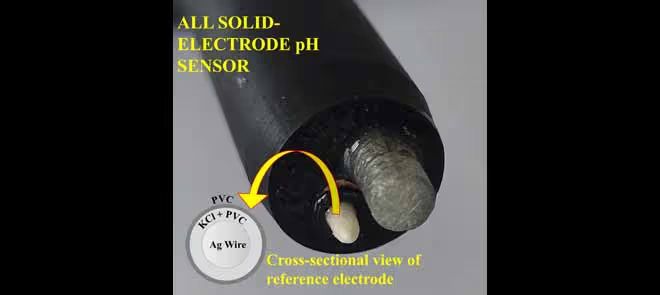
A Robust Sensor for Inline pH Measurements
Author: Joseph Jose, A. V. Akshaya, ANANTHASURESH G. K., Bosco Michael John, Nair Nikila
Published in: IEEE Sensors Journal (Volume: 25, Issue: 1, January 2025)
Summary Contributed by: Anupama
Traditional glass pH sensors often degrade in harsh environments and become ineffective under extreme pH conditions. This study introduces an innovative all-solid-electrode pH sensor featuring an antimony sensing electrode and an Ag/AgCl solid reference electrode. The sensor demonstrated stability, repeatability and linear performance in controlled and real-world applications. It offers a robust, durable, low-maintenance solution for continuous inline pH monitoring in various fields, including food processing, water treatment, agriculture, and pharmaceuticals.
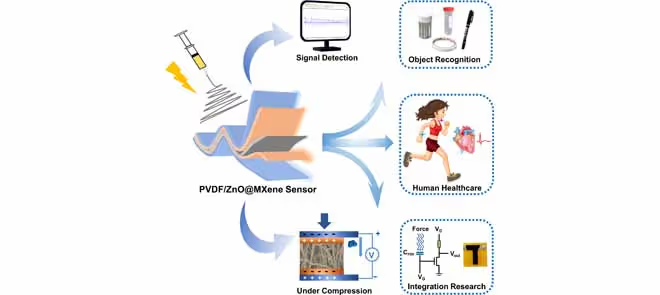
Flexible Electrospun Nanofibers for Tactile Sensing and Integrated System Research
Author: Chen Rongsheng, Ma Zhiling, Huang Wei, Yang Mei
Published in: IEEE Sensors Journal (Volume: 25, Issue: 1, January 2025)
Summary Contributed by: Rongsheng Chen (Author)
The demand for flexible sensors has grown with the advancement in wearable technology and smart systems. This paper discusses the development of a flexible piezoelectric sensor using electrospun nanofibers with a controlled structure and alignment, which improves the sensor's performance. It highlights the advantages and exceptional piezoelectric properties, flexibility, and sensitivity of materials like polyvinylidene fluoride (PVDF) and its copolymers. Its applications include wearable electronics, human-computer interaction, electronic skins, and soft robotics.
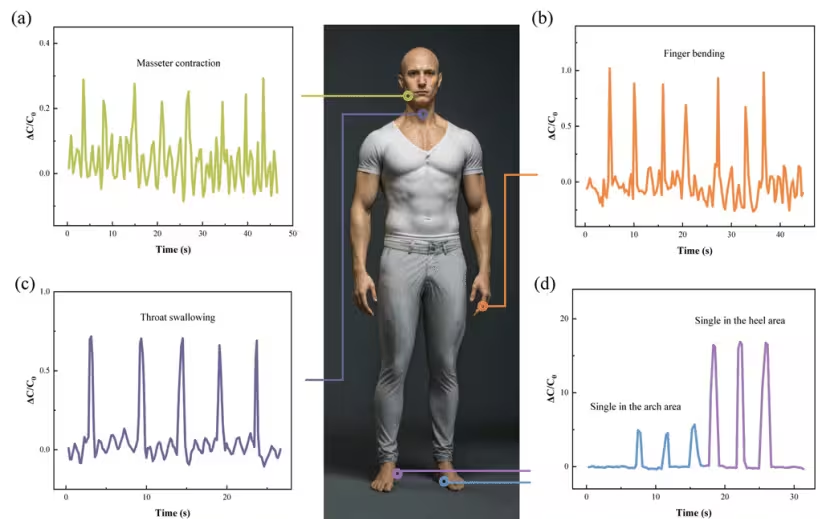
Highly Sensitive Flexible Sensor Over a Wide Linear-Range Based on Carbon Nanotube Toward Physiological Monitoring
Author: Pan Gebo, Gao Xin, Lv Peiyu, Qin Xu, Xu Wenqing, Yang Limei
Published in: IEEE Sensors Journal (Volume: 25, Issue: 3, February 2025)
Summary Contributed by: Saurabh Dubey
Capacitive pressure sensing is crucial in real-time physiological monitoring and human-robot interaction. This study presents a novel sensor developed using a composite dielectric layer of polyvinylidene fluoride, thermoplastic polyurethane, and multi-walled carbon nanotubes (MWCNTs). Its exceptional sensitivity and wide range effectively detect substantial and subtle human motion, including swallowing and muscle and joint movement. Flexibility, mechanical stability, and responsiveness make it suitable for next-generation wearable health monitoring and healthcare applications.
Microwave Glucose Sensing Using Double Circular Split Ring Resonators for Improved Sensitivity: The Role of Artificial Blood Plasma and Deionized Water
Author: Borges Ben-hur, Alarcon Julio Cesar, Pepino Vinicius Marrara, Santos Natalia M., Souza Mateus Isaac de Oliveira, Varanda Laudemir C.
Published in: IEEE Sensors Journal (Volume: 25, Issue: 3, February 2025)
Summary Contributed by: Borges Ben-hur (Author)
Accurate and affordable glucose monitoring is vital for managing diabetes, affecting millions worldwide. This research presents a compact, passive 2.48 GHz microwave sensor for enhanced glucose monitoring. The sensor's accuracy is significantly boosted by replacing deionized water with artificial blood plasma, achieving a 0-400 mg/dL range with 25 mg/dL resolution. Low cost and license-free operation make this novel sensor promising for comfortable, accurate, and accessible next-generation wearable health devices.
Research on Intelligent Diagnosis Method of Swallowing Signal Based on Complex Electrical Impedance Myography
Author: Yu Shaoshuai, Chu Xu, Fu Letian, Fu Zhang, Liu Qi, Yang Yuxiang
Published in: IEEE Sensors Journal (Volume: 25, Issue: 4, February 2025)
Summary Contributed by: Payal Savani
Dysphagia or swallowing disorders occur when the muscles or nerves involved in swallowing malfunction. Early and accurate detection will reduce risks to health and life. This study presents an innovative diagnostic framework that integrates Complex Electrical Impedance Myography (C-EIM) with advanced machine learning algorithms that analyze both amplitude and phase data. The smart system achieves an accuracy of 95.2%, demonstrating strong potential in early diagnosis and clinical decision-making for managing dysphagia.
Microneedle Uric Acid Biosensor With Graphite Ink and Electrodeposited MWCNT
Author: Kameoka Jun, Kawahira Hiroshi, Nohgi Toru, Tu Yifan
Published in: IEEE Sensors Journal (Volume: 25, Issue: 3, February 2025)
Summary Contributed by: Jun Kameoka (Author)
Uric acid is a well-established biomarker for gout. Recent studies have suggested its prospective as an indicator of visceral fat accumulation, particularly in monitoring metabolic syndrome. This paper introduces a microneedle-based uric acid biosensor using graphite ink and electrodeposited multi-walled carbon nanotubes (MWCNTs). The device supports non-invasive, real-time monitoring of uric acid concentrations in interstitial skin fluid (ISF). It has excellent potential for point-of-care applications and integration into wearable health technologies.
Parallel Detection of Mixed Pesticides Based on Dual Quantum Dot/Porous Silicon Optical Biosensors
Author: Jia Zhenhong, Cao Jianghong, Huang Xiaohui, Lv Xiaoyi, Wang Jiajia, Yang Jie, Yue Haitao
Published in: IEEE Sensors Journal (Volume: 24, Issue: 23, December 2024)
Summary Contributed by: Saurabh Dubey
Pesticide detection is vital for protecting human health and the environment. The proposed optical biosensor uses dual quantum dots and porous silicon technology to provide a cost-effective and real-time solution for detecting mixed pesticides. With high sensitivity, stability, and low cross-reactivity, this biosensor can efficiently monitor pesticides, thus improving food and environmental safety. Its application in resource-limited areas helps reduce costs and facilitates automated pesticide monitoring and detection.
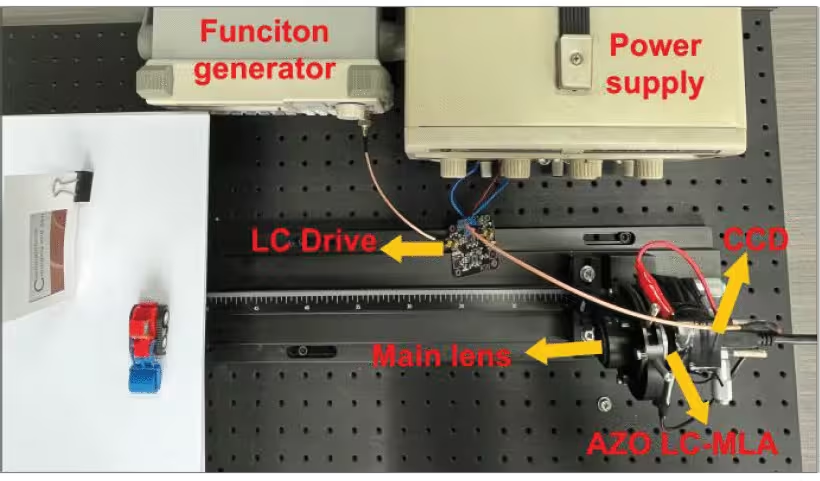
Liquid Crystal Microlens Arrays Based on Aluminum-Doped Zinc Oxide Oriented Microstructure Facilitate Light Field Image Resolution Enhancement
Author: Li Hui, Li Zikang, Qiao Chuan, Wu Yuntao
Published in: IEEE Sensors Journal (Volume: 25, Issue: 4, February 2025)
Summary Contributed by: Hui Li (Author)
Light-field cameras are excellent at capturing comprehensive scene information; however, they often face issues due to unstable liquid crystal (LC) alignment in their liquid crystal microlens arrays (LC-MLAs). This study introduces an LC-MLA imaging system based on an aluminum-doped zinc oxide (AZO) alignment layer, achieving ordered LC alignment. The system enhances image resolution by integrating full variational denoising and convex optimization, contributing significantly to the advancements in light-field imaging technology.
Design and Test of a High-Sensitivity MEMS Capacitive Resonator for Photoacoustic Gas Detection
Author: Shi Junhui, Gao Da, Ren Danyang, Wang Yuqi, Yin Yonggang
Published in: IEEE Sensors Journal (Volume: 24, Issue: 24, December 2024)
Summary Contributed by: Anupama
Photoacoustic spectroscopy (PAS) enables precise trace gas detection by converting absorbed laser energy into acoustic signals. This study introduces a high-sensitivity micro-electromechanical system (MEMS) capacitive resonator for photoacoustic gas detection designed by altering the overlapping areas to minimize gas damping. Experimental results demonstrate increased sensitivity and stability of the resonator and improved trace gas detection methods. The advancement paves the way for more sensitive and accurate environmental monitoring and other applications.
HOT Watch: IoT-Based Wearable Health Monitoring System
Author: Jhansi Bharathi Madavarapu, S. Nachiyappan, S. Rajarajeswari, N. Anusha, Nirmala Venkatachalam, Rahul Charan Bose Madavarapu, A. Ahilan
Published in: IEEE Sensors Journal (Volume: 24, Issue: 15, October 2024)
Summary Contributed by: Saurabh Dubey
Heart rate oxygen rate temperature watch (HOT Watch) transforms IoT-based health monitoring by providing real-time tracking of vital signs with an accuracy exceeding 99.4%. It outperforms other leading devices available. Powered by IoT and the Pan-Tompkins algorithm(PTA), it efficiently processes health data and transmits it via Bluetooth for instant notification. GPS tracking and real-time alerts facilitate prompt medical responses, making it a dependable solution for personal and remote healthcare.
Multi-sensor fusion is becoming an increasingly crucial part of the environmental perception system in autonomous driving. Experience the cutting-edge fusion of millimeter-wave radar and machine vision in the proposed MS-YOLO, powered by You Only Look Once (YOLOv5) algorithm. The proposed fusion model offers exceptional accuracy in detecting objects and provides immediate real-time insights regardless of light and weather conditions.
Decoding or understanding non-verbal communication forms in babies is paramount to parents. These forms are expressed in various poses and body-language signals, which can be interpreted using a Human Pose Estimation method. Babies are tracked in real-time using 2D videos. Pose estimators that model these poses into keypoints are then employed to recognize and monitor these activities. This study delves into these estimation models that interpret baby poses with 99% accuracy.
A non-profit organization, IEEE is the world's largest technical professional organization dedicated to advancing technology for the benefit of humanity.
Copyright 2023 IEEE – All rights reserved. Use of this website signifies your agreement to the IEEE Terms and Conditions
This site is also available on your smartphone.