Get exclusive breakthroughs on sensors in IoT, energy, healthcare, and more, delivered straight to your inbox.
"IEEE Sensors Alert" is a pilot project of the IEEE Sensors Council. Started as one of its new initiatives, this weekly digest publishes teasers and condensed versions of our journal papers in layperson's language.
Articles Posted in the Month (September 2025)
AuNP-Decorated Textile as Chemo Resistive Sensor for Acetone Detection
Volatile Organic Compounds (VOCs) pose significant health risks, making the effective monitoring of these compounds essential. This article presents a novel, cost-effective chemoresistive sensor that uses citrate-functionalized gold nanoparticles (AuNPs) deposited on cotton fabric for precise acetone (CH3COCH3) detection. Its impedance-based mechanism demonstrates high selectivity and strong reusability. This AuNP-Textile sensor offers a promising solution for portable, real-time VOC exposure assessment in applications ranging from health monitoring to environmental pollution.
A Multimatrix E-Nose With Optimal Multiranged AFE Circuit for Human Volatilome Fingerprinting
Author: Radogna Antonio Vincenzo, Capone Simonetta, D'Amico Stefano, Forleo Angiola, Grassi Giuseppe, Siciliano Pietro Aleardo
Published in: IEEE Sensors Journal (Volume: 25, Issue: 5, March 2025)
Summary Contributed by: Radogna Antonio Vincenzo (Author)
The human volatilome, a combination of volatile organic compounds (VOCs) present in breath and bodily fluids, reflects overall health and can signal the early onset of disease. This study presents SPYROX, an electronic nose that converts VOC signatures into digital fingerprints. It features a multirange analog front-end (AFE) circuit with a multimatrix learning algorithm for adaptive sensitivity across diverse samples. SPYROX offers an accurate, non-invasive, portable solution for routine health screenings and diagnostics.
Published in: IEEE Sensors Journal (Volume: 25, Issue: 5, March 2025)
Summary Contributed by: Saurabh Dubey
Niobium-doped BZT-BCT thin films are emerging as a sustainable, high-performance alternative to the toxic lead zirconate titanate (PZT) for piezoelectric devices. Fabricated via a sol-gel process and optimized poling, these lead-free films exhibit enhanced dielectric, ferroelectric, and piezoelectric properties. With stable switching, improved resonance, and strong mechanical integrity, they demonstrate promise for MEMS devices, biomedical implants, and energy-harvesting applications, thus paving the way for eco-friendly piezoelectric technologies.
Published in: IEEE Sensors Journal (Volume: 25, Issue: 5, March 2025)
Summary Contributed by: Hussain Irfan (Author)
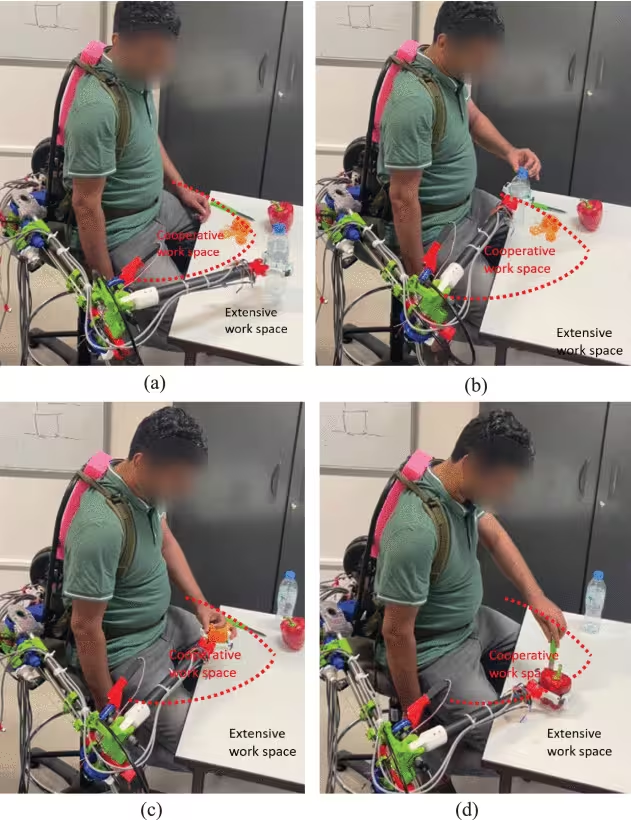
Supernumerary robotic arms (SRAs) can assist post-stroke patients with daily activities. However, its conventional designs are bulky and power-hungry. This paper introduces a novel SRA featuring twisted, string-driven flexure joints that eliminate large actuators, resulting in a compact, lightweight, and energy-efficient wearable device. This advance in assistive robotics empowers stroke survivors to regain independence in bimanual activities and paves the way for the next generation of affordable, human-assistive technologies.
Smart, Wearable and Power-Controlled Mixed-Signal Platform for Screening and Follow-Up of Cystic Fibrosis Based on Real-Time Chloride Concentration Evaluation in Sweat
Author: De Venuto Daniela, Bollella Paolo, De Venuto Domenica, Mascellaro Grazia, Spadavecchia Giuseppe, Torsi Luisa
Published in: IEEE Sensors Journal (Volume: 25, Issue: 5, March 2025)
Summary Contributed by: Payal Savani
Wearable sensors have garnered significant attention in recent years, particularly in the realm of personalized diagnostics and continuous health monitoring. This paper discusses the development of a wearable sweat-based sensor system for monitoring cystic fibrosis (CF) in patients. It offers a resolution of ±2 mV and sensitivity of 56.9 mV/dec, with an average power consumption of 350 micro watts. The sensor is a compact, energy-efficient, and developed for home use.
A Wearable Multisensor Fusion System for Neuroprosthetic Hand
Author: Liu Honghai, Meng Jianjun, Ding Han, Guo Weichao, Shi Shang, Yang Xingchen, Yin Zongtian
Published in: IEEE Sensors Journal (Volume: 25, Issue: 8, April 2025)
Summary Contributed by: Liu Honghai (Author)
Getting a near-natural control from neuroprosthetic hands is challenging. This study introduces a compact, wearable multisensor system that integrates ultrasound, surface electromyography (sEMG), and Inertial Measurement Unit (IMU) sensors to improve prosthetic hand control. Ultrasound and EMG model gestures, sEMG detects resting states, and the IMU filters unintended movements like shaking. The system's small size allows seamless integration into prosthetic sockets, and control strategies enhance stability, offering an improved experience for amputees.
An Open-Path Optical Sensor for Hydrogen Sulfide and Methane Detection by QCL
Author: Li Jun, Fan Binbin, Hao Le, Jaworski Piotr, Luan Guohua, Ma Tian, Wang Zhen, Zeng Qingjie, Zhai Xiaowei, Zhang Jiarui
Published in: IEEE Sensors Journal (Volume: 25, Issue: 5, March 2025)
Summary Contributed by: Saurabh Dubey
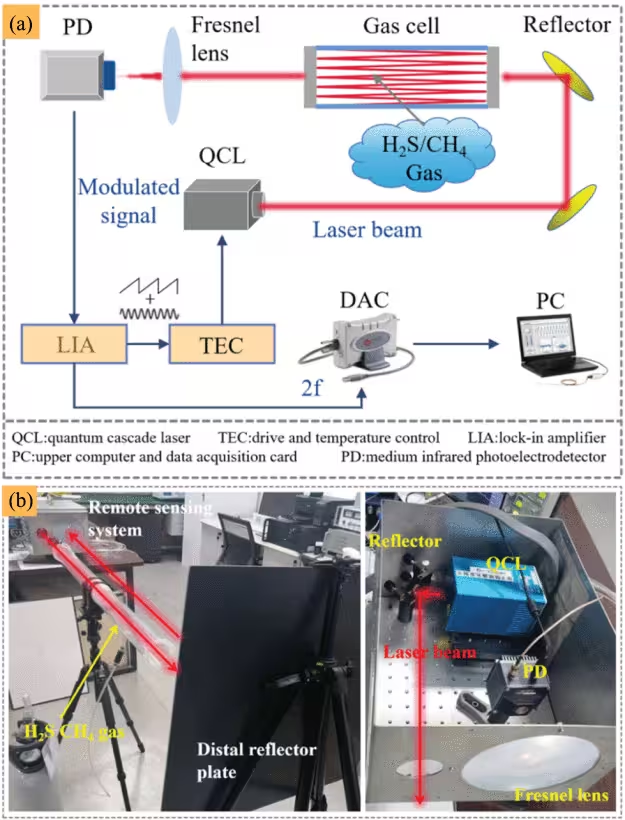
A Quantum Cascade Laser–based open-path optical sensor enables real-time, precise, and high-sensitivity detection of harmful hydrogen sulfide (H₂S) and methane (CH₄) gases up to 50 m and a response time of 3.4 s. Resistant to water vapor interference, it delivers a strong signal-to-noise ratio, surpassing traditional sensors. Ideal for remote oilfields, refineries, and hazardous sites, it ensures reliable long-range monitoring with future IoT integration and multi-gas detection for enhanced industrial safety.
Nonlinear Behavioral Model of Capacitive MEMS Microphone for Predicting Ultrasound Intermodulation Distortion
Author: Rahaman Ashiqur, Albahri Shehab, Boor Steven, Bradt Christopher, Lee Sung B.
Published in: IEEE Sensors Journal (Volume: 25, Issue: 1, January 2025)
Summary Contributed by: Ashiqur Rahaman (Author)
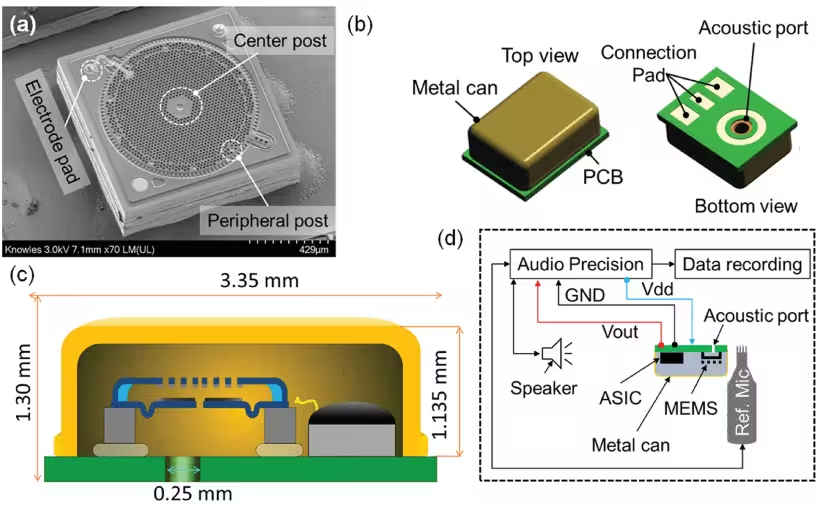
Ultrasound intermodulation distortion (IMD) in microphones, particularly in hearing aids, can lead to audible distortions around ultrasonic devices. The primary source of this nonlinearity is the micro-electromechanical systems (MEMS) transducer. This paper explores how specific design features of capacitive MEMS microphones affect IMD using a nonlinear behavioral model to reduce distortion while maintaining acoustic performance. The optimized design shows 15 dB IMD reduction at 20 kHz, providing excellent electro-acoustic characteristics.
Design and Simulation Analysis of Electrolyte-Gated Aluminum Oxide Organic Thin-Film Transistor Biosensor for High Sensitivity
Author: Wadhwa Girish, Proto Antonino, Taibi Angelo, Thakur Anchal
Published in: IEEE Sensors Journal (Volume: 25, Issue: 6, March 2025)
Summary Contributed by: Payal Savani
The pH sensor has various applications in environmental, industrial, and healthcare monitoring. This paper introduces an electrolyte-gated aluminum oxide organic thin-film transistor (EG-Al₂O₃ OTFT) biosensor with a pentacene structure designed for highly sensitive detection. Using aluminum oxide improved stability, sensitivity, and low-voltage operation. The biosensor detects biomolecules by converting biochemical interactions into electrical signals. This low-cost, flexible, efficient device can prove to be a reliable biosensing for medical diagnostics and environmental monitoring.
Published in: IEEE Sensors Journal (Volume: 25, Issue: 4, February 2025)
Summary Contributed by: Gutierrez-rojas Daniel (Author)
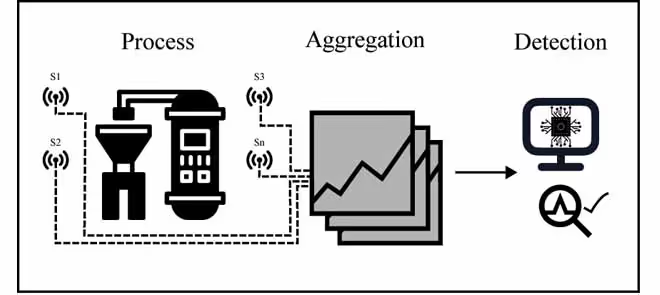
As industrial systems grow more complex powered by wireless sensor networks (WSNs), effective anomaly detection becomes essential. This paper introduces a smart, explainable framework to detect and classify anomalies in WSN-enabled Cyber-Physical Systems. Enhanced by novel explainable AI (XAI) techniques, the model incorporates data acquisition, fusion, and analytics. The results show high accuracy and reliability with reduced risks, faster fault correction, enhanced efficiency, system security, and resilience against cyber threats.
Heart rate oxygen rate temperature watch (HOT Watch) transforms IoT-based health monitoring by providing real-time tracking of vital signs with an accuracy exceeding 99.4%. It outperforms other leading devices available. Powered by IoT and the Pan-Tompkins algorithm(PTA), it efficiently processes health data and transmits it via Bluetooth for instant notification. GPS tracking and real-time alerts facilitate prompt medical responses, making it a dependable solution for personal and remote healthcare.
Vision-based tactile sensors (VBTS) are attracting attention for their application in robotics. As an innovative optical sensor, VBTS leverages tactile sensing to enhance the interpretation and utilization tactile information. The paper presents an overview of the hardware aspects of VBTS, including their technology, capabilities, challenges, and potential solutions. It provides insightful guidelines for optimizing the design and fabrication processes of VBTS to improve their performance.
A non-profit organization, IEEE is the world's largest technical professional organization dedicated to advancing technology for the benefit of humanity.
Copyright 2023 IEEE – All rights reserved. Use of this website signifies your agreement to the IEEE Terms and Conditions
This site is also available on your smartphone.