Get exclusive breakthroughs on sensors in IoT, energy, healthcare, and more, delivered straight to your inbox.
"IEEE Sensors Alert" is a pilot project of the IEEE Sensors Council. Started as one of its new initiatives, this weekly digest publishes teasers and condensed versions of our journal papers in layperson's language.
Articles Posted in the Month (October 2024)
Fingerprint Augment Based on Super-Resolution for WiFi Fingerprint Based Indoor Localization
Published in: IEEE Sensors Journal (Volume: 22, Issue: 12, June 2022)
Summary Contributed by: Saurabh Dubey
Indoor localization based on WiFi Fingerprint techniques, augmented with the proposed FASR (Fingerprint Augment Based on Super-Resolution) framework, demonstrates increased localization accuracy and cost-effectiveness. The study explores the processing of the FASR framework and its super-resolution attributes in multiple modules. Assisted by deep neural network learning models, the framework shows consistent performance across various spatial samples with high position accuracy and promising application in the field of image processing.
Published in: IEEE Sensors Journal (Volume: 23, Issue: 4, February 2023)
Summary Contributed by: Kamalesh Tripathy
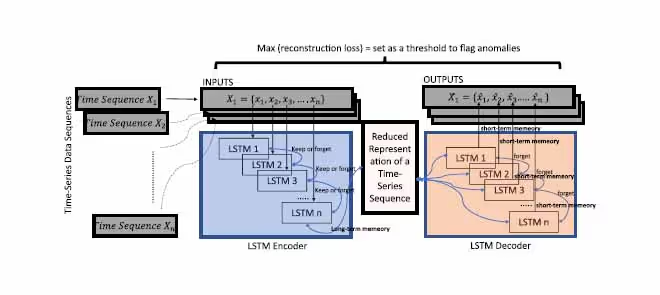
Maintaining indoor air quality (IAQ) is crucial for health and wellness. Accurate data analysis and contextual anomaly detection are essential for IAQ monitoring. The paper introduces a hybrid deep-learning model, combining long short-term memory (LSTM) with autoencoder (AE). LSTM learns typical carbon dioxide (CO2) time sequence patterns, while AE computes optimal reconstruction errors and detects anomalies. Achieving 99.50% accuracy in real-world testing, the model shows promise for enhancing IAQ monitoring.
3-D-Printing and Reliability Evaluation of an Easy-to-Fabricate Position Sensing System for Printed Functional Wearable Assistive Devices
Author: Michalec Paweł, Faller Lisa-Marie
Published in: IEEE Sensors Journal (Volume: 24, Issue: 4, February 2024)
Summary Contributed by: Michalec Paweł (Author)
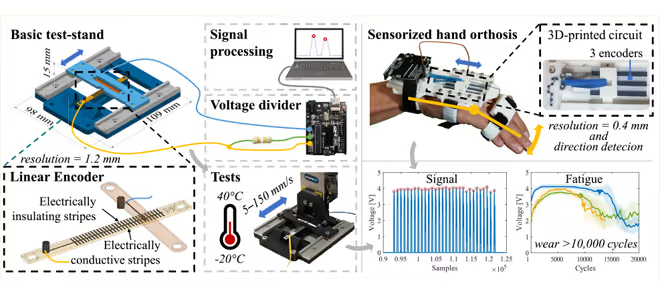
The demand for advanced medical devices has created challenges in integrating sensors into cost-effective wearable medical assistive devices. The paper presents a novel, fully 3D-printed linear encoder developed using commercially available electrically conductive and nonconductive materials. This easy-to-fabricate technology was tested in a sensorized hand orthosis (sHO). It aims to enhance the functionality of wearable assistive devices by accurately detecting and monitoring movements, thus offering promising solutions for rehabilitation devices.
CAMs-SLAM: Cloud-Based Multisubmap VSLAM for Multisource Asynchronous Sensing of Biped Climbing Robots
Author: Zhang Hong, Chen Weinan, Gu Shichao, Zhu Lei
Published in: IEEE Sensors Journal (Volume: 24, Issue: 14, July 2024)
Summary Contributed by: Hong Zhang (Author)
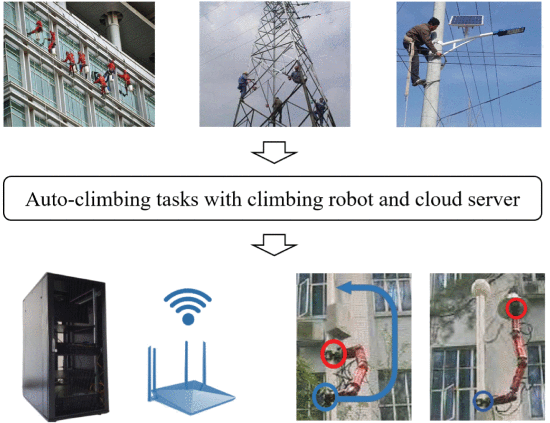
Understanding and navigating the surroundings is a key feature of biomimetic Biped climbing robots (BiCRs). This is achieved through visual simultaneous localization and mapping (VSLAM). The paper presents a cloud-based asynchronous multisubmap VSLAM (CAMs-SLAM) system, which assists these robots with necessary computing, mapping, environment perception, and autonomous navigation. Even with weak internet connections and low data, this system demonstrates its feasibility and superiority in autonomous climbing applications, offering practical benefits for real-world use.
TSF: Two-Stage Sequential Fusion for 3D Object Detection
Author: Heng Qi, Peicheng Shi, Zhiqiang Liu, Aixi Yang
Published in: IEEE Sensors Journal (Volume: 22, Issue: 12, June 2022)
Summary Contributed by: Anupama
This paper introduces a two-stage sequential fusion (TSF) method for 3D object detection in autonomous driving. TSF fuses the raw LiDAR point cloud with corresponding image data to produce an improved point cloud. The study also analyzes the impact of the fusion module on detection capabilities and explores the balance between accuracy and speed. The results show that TSF substantially boosts LiDAR detection accuracy, especially in small-object detection.
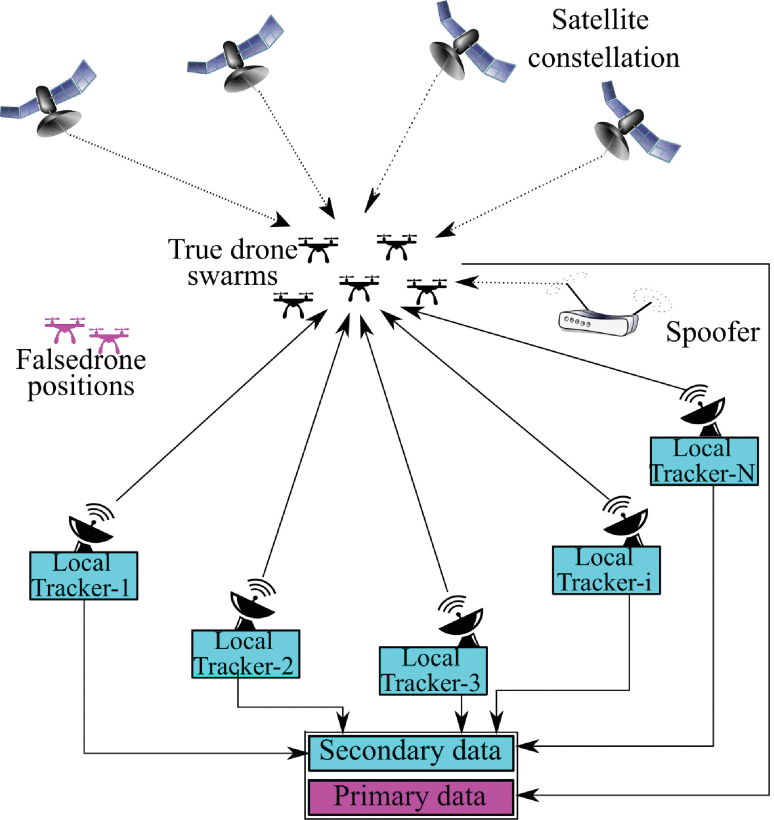
GPS-based navigation, widely used worldwide, is cost-effective for providing position, velocity, and time data. However, it is susceptible to spoofing, especially in UAVs (unmanned aerial vehicles). The paper proposes a GPS spoofing detection and mitigation method using distributed radar tracking and data fusion techniques. The approach combines primary and secondary data through extended Kalman filters and track-to-track association. It ensures accuracy even during spoofing attacks, making it ideal for drone swarms.
Published in: IEEE Sensors Journal ( Volume: 22, Issue: 10, May 2022)
Summary Contributed by: Kamalesh Tripathy
Micro-Electro-Mechanical-Systems (MEMS) based piezoresistive pressure sensors are widely used across various industries. However, these sensors are prone to failure due to junction leakage at high-temperature applications. The paper presents three piezoresistive pressure sensors designed using different technologies: standard diffused piezoresistors, oxide-isolated polysilicon, and single crystal silicon piezoresistors. Tested up to 200°C and 140 bar, all sensors showed reduced sensitivity with temperature, with oxide-isolated polysilicon sensors exhibiting the best performance.
Fetal Movement Detection by Wearable Accelerometer Duo Based on Machine Learning
Author: Jingyi Xu, Chao Zhao, Bo Ding, Xiaoxia Gu, Wenru Zeng, Liang Qiu, Hong Yu, Yang Shen, Hong Liu
Published in: IEEE Sensors Journal (Volume: 22, Issue: 12, June 2022)
Summary Contributed by: Chao Zhao (Author)
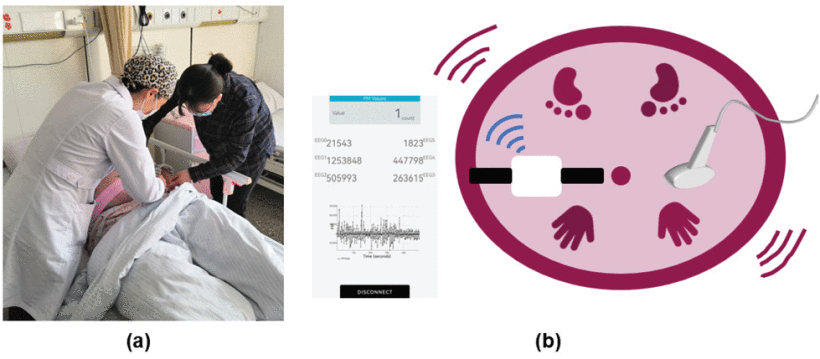
Fetal movement monitoring is vital for fetal health. The accuracy of the maternal perception in monitoring fetal movement varies. In this work, a wearable device with two accelerometers and machine learning algorithms was developed for accurate and continuous fetal movement monitoring. It aims for accuracy comparable to ultrasound. The device showed promising results in fetal movement monitoring, potentially providing valuable insights into the fetal biological profile during the perinatal period.
Single Aerosol Particle Detection by Acoustic Impaction
Author: Nadine Karlen, Tobias Rüggeberg, Bradley Visser, Jana Hoffmann, Daniel A. Weiss, Ernest Weingartner
Published in: IEEE Sensors Journal (Volume: 22, Issue: 12, June 2022)
Summary Contributed by: Saurabh Dubey
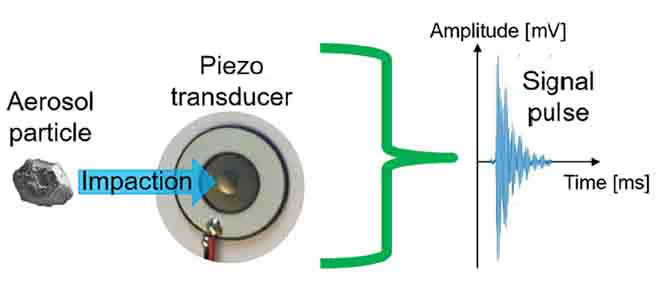
Accurate detection of aerosol particles is vital for health and addressing climate risks. The paper discusses DustEar, a state-of-the-art measurement method, which employs an acoustic Piezo transducer to accelerate particles in a nozzle, enabling precise detection of individual aerosol particles up to 15 μm. The design reduces airflow interference and noise levels, ensuring accurate single-particle measurement. It has diverse applications in drug quality control, pollution source analysis, and environmental management.
Estimating Relative Angles Using Two Inertial Measurement Units Without Magnetometers
Author: Seung Yun Song, Yinan Pei, Elizabeth T. Hsiao-Wecksler
Published in: IEEE Sensors Journal (Volume: 22, Issue: 20, October 2022)
Summary Contributed by: Seung Yun Song (Author)
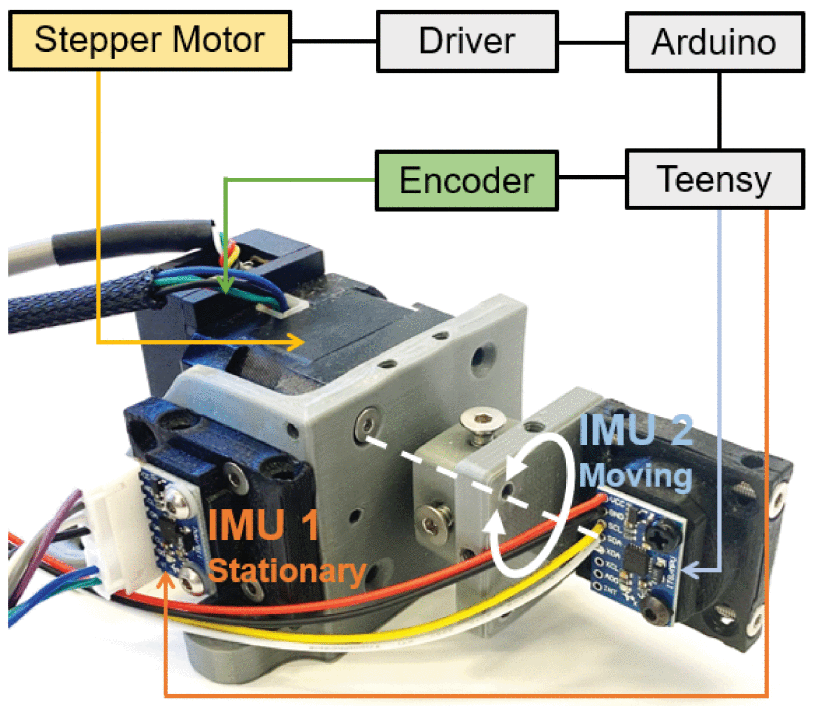
Wearable technology heavily relies on miniature sensors called inertial measurement units (IMU). IMUs are vital for computing body segment angular kinematics in biomechanics and clinical settings. This study presents a low-cost two 6-axis IMU system without magnetometers to estimate relative angles. It validates existing algorithms for 3D orientation computation. The system's user-friendly design and accurate orientation calculation hold promise for advancements in virtual reality, health monitoring, and wearable technologies.
MEMS gyroscope has advanced with the advancements in processing and manufacturing technology. However, their structure and system-based noise level continue to pose challenges in proper implementation and restrict their performance with high accuracy and precision. This paper proposes a system-level noise model that analyzes the relationship between frequency split and noise performance. It identifies noise sources and contributes to bias instability, establishing a frequency-tuning criterion for different noise requirements.
Complex multi-sensor networks face challenges in storage management, data processing and resource optimization. Data fusion methods analyze and integrate diverse sensor information to produce coherent and accurate information. Researchers propose an adaptive weighted fusion algorithm on grouped sensor data that can efficiently reduce data redundancy, optimize resources, and lower network congestion. It showed higher accuracy and energy efficiency than other fusion algorithms.
A non-profit organization, IEEE is the world's largest technical professional organization dedicated to advancing technology for the benefit of humanity.
Copyright 2023 IEEE – All rights reserved. Use of this website signifies your agreement to the IEEE Terms and Conditions
This site is also available on your smartphone.