Get exclusive breakthroughs on sensors in IoT, energy, healthcare, and more, delivered straight to your inbox.
"IEEE Sensors Alert" is a pilot project of the IEEE Sensors Council. Started as one of its new initiatives, this weekly digest publishes teasers and condensed versions of our journal papers in layperson's language.
Articles Posted in the Month (August 2025)
A Programmable Transimpedance Amplifier for High Capacitive Sensors
Published in: IEEE Sensors Journal (Volume: 25, Issue: 5, March 2025)
Summary Contributed by: Kamalesh Tripathy
Transimpedance amplifiers (TIAs) are essential for sensing applications that require accurate current-to-voltage conversion, such as biosensing, materials analysis, and device testing. Conventional TIA designs face trade-offs between gain, bandwidth, noise, and chip area. This paper introduces a programmable TIA fabricated in 65-nm Si-CMOS for high-capacitance inputs, using active feedback to achieve high effective resistance. The result is a compact, efficient, and flexible solution ideal for modern high-capacitance sensor interfaces.
Substrate Effects on the Transient Chemiresistive Gas Sensing Performance of Monolayer Graphene
Author: Fahrenthold Eric, Doshi Manasi, Zhang Jie
Published in: IEEE Sensors Journal (Volume: 25, Issue: 3, February 2025)
Summary Contributed by: Eric P. Fahrenthold (Author)
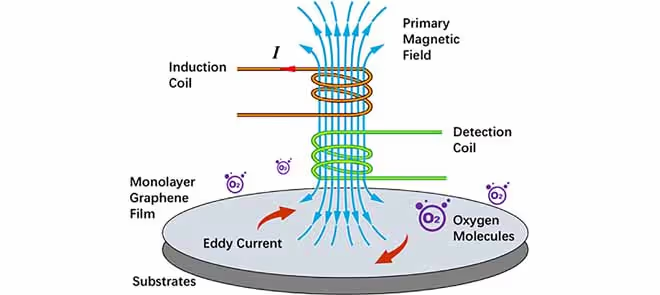
The substrate supporting monolayer graphene profoundly impacts its electronic properties and electrochemical response. Using a novel, non-contact eddy current method, the researchers show that different substrates dope the graphene in different ways, altering its conductivity, and can reverse how it reacts to gas exposure. This approach offers a fast, non-destructive method for qualitative assessment of low-dimensional materials and provides practical insights for sensor design.
Published in: IEEE Sensors Journal (Volume: 25, Issue: 3, February 2025)
Summary Contributed by: Saurabh Dubey
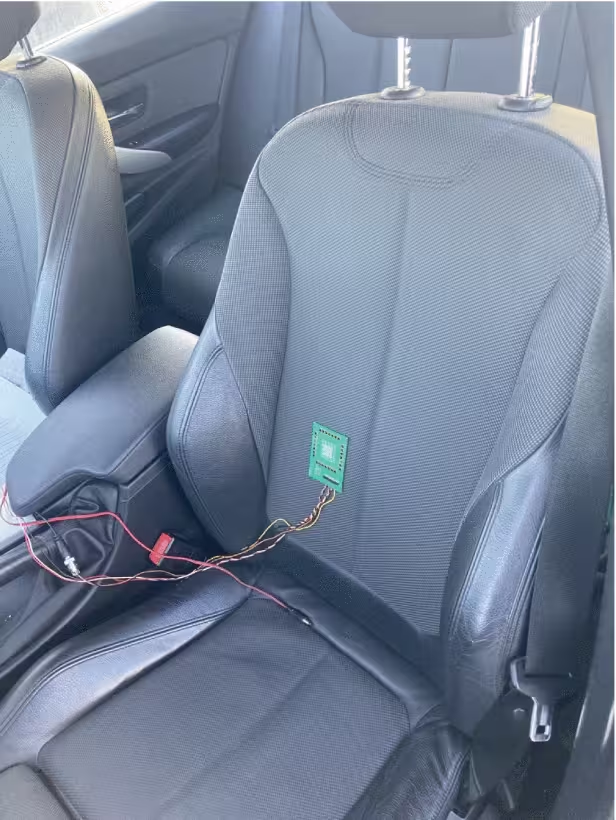
Health monitoring systems integrated into vehicles improve road safety. This paper presents a novel reflective photoplethysmogram (PPG) sensor designed for in-vehicle heart rate monitoring. Embedded in the backrest of the vehicle's seat, the device provides non-intrusive, regular, and accurate heart rate monitoring with minimal motion or clothing interference. It is ideal for in-vehicle health monitoring applications that monitor heart rate, stress, and fatigue, thus enhancing driver comfort and safety.
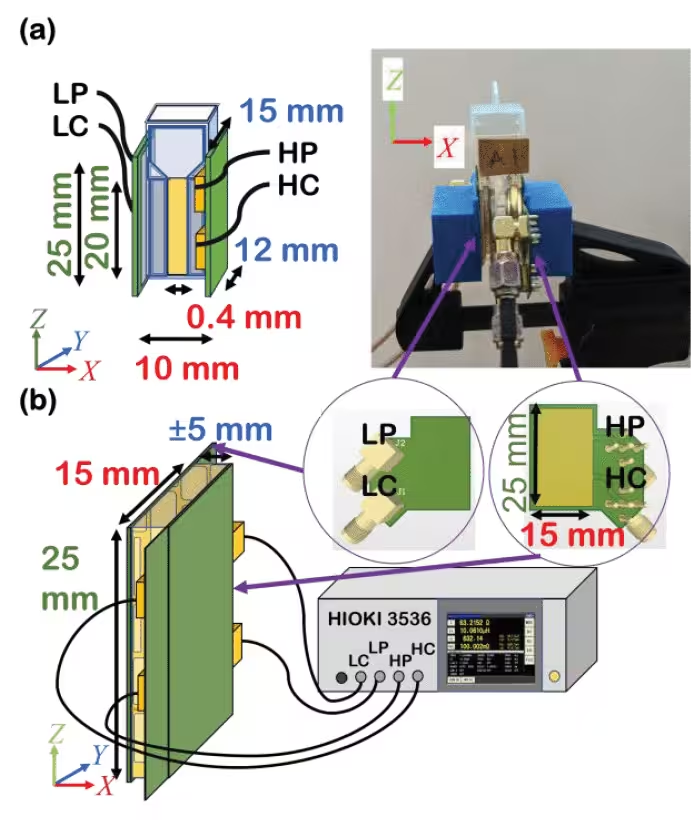
Temperature-sensing methods with high sensitivity and quick response times are crucial for applications that require real-time temperature monitoring in challenging conditions. This paper introduces a novel optical fiber temperature sensor with a silicon Fabry-Pérot cavity attached to a single-mode fiber tip that achieves high sensitivity (84.6 pm/°C), exceptional resolution (0.0006°C), and a fast response time of 0.51 ms. The innovative design and performance metrics make it ideal for dynamic environments.
Tradeoff Between the Number of Transmitted Molecules and the BER Performance in Molecular Communication Between Bionanosensors
Author: Eckford Andrew, Jing Dongliang, Li Linjuan, Lin Lin
Published in: IEEE Sensors Journal (Volume: 25, Issue: 1, January 2025)
Summary Contributed by: Anupama
Molecular communication (MC) uses bionanosensors to transmit data using molecules. Due to limited transmitter resources, optimizing communication efficiency is critical. This study analyzes the relationship between the number of transmitted molecules and the bit error rate (BER). It introduces a balance function and uses a Gradient Descent Algorithm to find an optimal tradeoff. Results highlight a tunable framework for balancing communication reliability and molecular resource usage, benefiting applications in defense, healthcare, entertainment, and biosensing.
Monitoring the concentration of proteins in interstitial fluid is vital for assessing various diseases, including albuminuria and edema. This paper proposed an electrical spectroscopy-based system enhanced with admittance relaxation time distribution (aRTD) for protein concentration quantification. Results indicate that aRTD shows a positive correlation with total protein concentration at high relaxation times and can distinguish between albumin and γ-globulin concentration fluctuation at lower relaxation times.
Real-Time Vehicle Classification and License Plate Recognition via Deformable Convolution-Based Yolo v8 Network
Author: R Srinivasan, A Arivarasi, D Rajeswari, Govindasamy Alagiri
Published in: IEEE Sensors Journal (Volume: 24, Issue: 23, December 2024)
Summary Contributed by: Saurabh Dubey
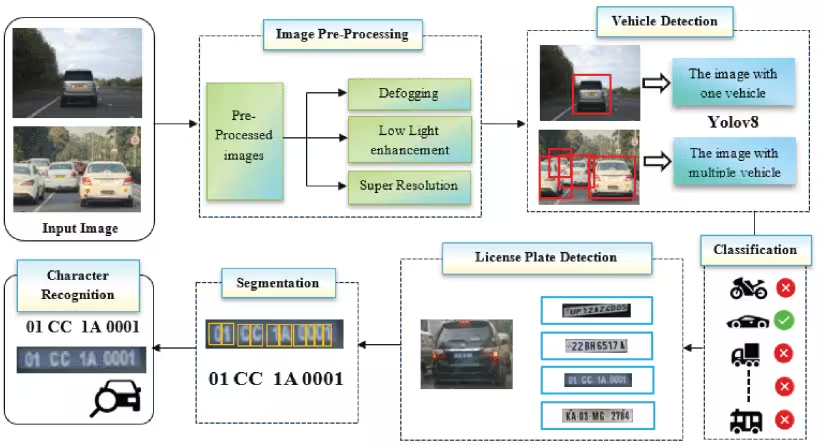
An exponential increase in vehicles has made traffic management challenging. The proposed novel DEN-YOLO uses a YOLOv8 model with a deformable convolution network for better adaptation to varying object shapes. It uses low-light enhancement, defogging, and super-resolution to improve image clarity even in challenging conditions. It provides fast and reliable vehicle and license plate detection for traffic management, toll collection, and surveillance, making it ideal for real-world applications.
Design and Fabrication of Highly Performance EGFET and Application in Thrombin Detection
Author: Wang Yiqing, Ding Song, Jiang Jidong, Liu Tao, Wang Ting, Zhang Minghui, Zhang Wei, Zhu Xinglong
Published in: IEEE Sensors Journal (Volume: 25, Issue: 3, February 2025)
Summary Contributed by: Yiqing Wang (Author)
Extended-gate field-effect transistors (EGFETs) are highly effective in ion detection, particularly pH sensing. Their unique design simplifies fabrication and maintenance. This study introduces a 3D simulation-optimized EGFET designed for pH sensing and detecting highly sensitive thrombin, a crucial biomarker in blood coagulation. The device demonstrated exceptional pH sensitivity, long-term stability, and quick and specific thrombin recognition. The results highlight the potential applications in biomedical diagnostics, environmental monitoring and point-of-care testing.
Flexible Conductive Polymer Reinforced Polyurethane Foam for Real-Time Human Body Electrical Signal Sensing and ECG Peaks
Author: Subramanian Jeyanthi, M Suchetha, Rajeev Krishna, Vijayan Akash
Published in: IEEE Sensors Journal (Volume: 25, Issue: 3, February 2025)
Summary Contributed by: Saurabh Dubey
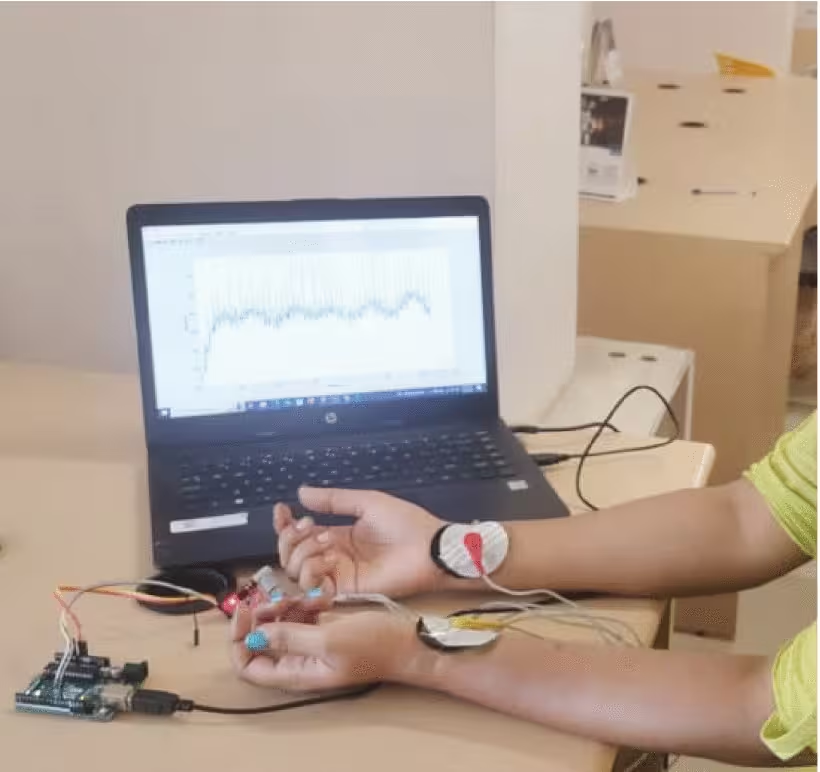
Polymer composites made from conductive and flexible material are transforming wearable health devices. This study introduces a soft, flexible foam made from polyurethane and reinforced with conductive polymers, designed to detect the human body’s electrical signals like electrocardiogram (ECG). This sensor captures real-time data without requiring the traditional gel electrodes. The eco-friendly device provides stable monitoring and enhances accuracy and comfort, making it ideal for wearable medical technologies and biosensing applications.
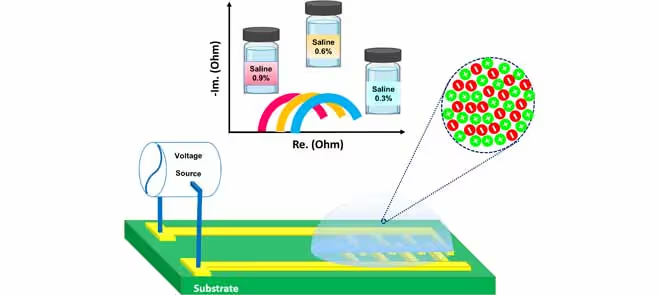
Monitoring the properties of aqueous solutions is essential across various industries like agriculture and oceanics. This paper introduces a novel, low-cost, interdigitated electrode (IDE) sensor based on electrochemical impedance spectroscopy to assess the properties of aqueous solutions. This sensor effectively detects subtle differences in concentration and provides reliable pH measurements with high sensitivity, showing its potential for applications in different areas, like the food industry and environmental and biological studies.
Diabetes leads to serious health challenges and is a leading cause of numerous chronic diseases. This study explores electronics-based biosensors, particularly Organic Field Effect Transistors (OFET) and Organic Electrochemical Transistors (OECT), as adept glucose and DNA biosensors in diabetes management. The biosensors, fabricated from biodegradable natural materials, offer a flexible, cost-effective, and easily accessible solution, showcasing exceptional sensitivity and selectivity in their performance.
Technology to detect signs of life under rubble could save lives. The study proposes a novel radar system with a two-step computation model for detecting live victim's vital signs behind or under obstructions. The first step is to establish a region of interest and identify obstacles. The second step detects respiratory vital signs patterns through time-varying phase data. Experimental demonstration of the proposed system shows significant accuracy in detecting live victims.
A non-profit organization, IEEE is the world's largest technical professional organization dedicated to advancing technology for the benefit of humanity.
Copyright 2023 IEEE – All rights reserved. Use of this website signifies your agreement to the IEEE Terms and Conditions
This site is also available on your smartphone.