Get exclusive breakthroughs on sensors in IoT, energy, healthcare, and more, delivered straight to your inbox.
"IEEE Sensors Alert" is a pilot project of the IEEE Sensors Council. Started as one of its new initiatives, this weekly digest publishes teasers and condensed versions of our journal papers in layperson's language.
Articles Posted in the Month (February 2026)
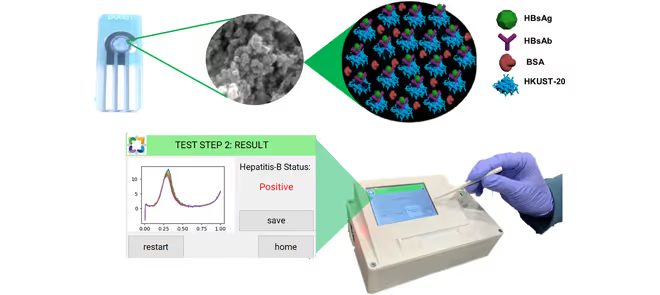
HBV-Testing: HKUST-1-Modified Electrochemical Immunosensor for Point-of-Care Testing of Hepatitis B
Author: Yuliarto Brian, Dewi Kariana Kusuma, Raihan Muhammad Fadlan, Septiani Ni Luh Wulan, Wustoni Shofarul
Published in: IEEE Sensors Journal (Volume: 25, Issue: 15, August 2025)
Summary Contributed by: Brian Yuliarto (Author)
Early detection of Hepatitis B is crucial to prevent severe liver conditions. The hepatitis B surface antigen (HBsAg) appears early in infection, making it a key biomarker. This study introduces the HBV-Test, a portable electrochemical immunosensor designed for rapid, affordable HBsAg detection at the point-of-care. Using a copper-based nanomaterial (HKUST-1), it almost accurately identifies viral antigens in 5 minutes. Its robust clinical performance supports its use directly in healthcare systems.
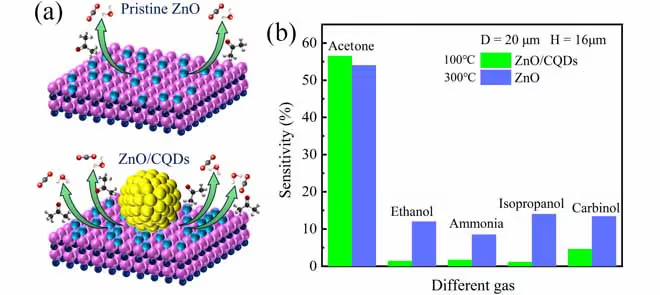
High-Sensitivity CQDs-Modified ZnO Nanowire Gas Sensor Fabricated on 3-D Substrate for Acetone Detection
Author: Ma Liuhong, Chen Pandi, Duan Zhiyong, Fu Yingchun, He Fan, Li Mengke, Li Puguang, Si Chaowei, Zhang Xin
Published in: IEEE Sensors Journal (Volume: 25, Issue: 12, June 2025)
Summary Contributed by: Saurabh Dubey
A Carbon quantum dot (CQD)-modified zinc oxide (ZnO) nanowire gas sensor designed on a 3-D micropillar substrate enables high-sensitivity, low-temperature acetone detection. The 3-D structure increases surface area, while CQD form p–n heterojunctions that enhance adsorption and selectivity. This sensor shows scalable, energy-efficient, and reliable performance, achieving higher sensitivity and lower operating temperature than unmodified ZnO, making it ideal for industrial, environmental, and commercial applications in acetone monitoring.
Published in: IEEE Sensors Journal (Volume: 25, Issue: 15, August 2025)
Summary Contributed by: Frank J. Wouda (Author)
With increasing life expectancy, gait disorders that worsen with age have become a global concern. Presently, body-worn devices with multiple on-body sensors are required for accurate gait monitoring. This study proposes a novel portable gait analysis setup that combines an ultra-wideband (UWB) sensor and an inertial measurement unit (IMU) on each foot to track accurately their positions (within 2.5cm) and orientation (within 4 degrees) in real time without drift.
Published in: IEEE Sensors Journal (Volume: 25, Issue: 15, August 2025)
Summary Contributed by: Payal Savani
In diabetes management, noninvasive and painless glucose monitoring is challenging. This work presents a flexible, side-gated field-effect transistor (FET) test strip that uses graphene oxide (GO)-catalyzed CuO-ZnO hollow spheres for saliva-based glucose sensing. Demonstrating excellent reproducibility and repeatability, this portable platform achieved an ultra-low limit of detection (0.001 μM) and high sensitivity (1600 μA·mM⁻¹) across a wide range of saliva concentrations, offering a point-of-care solution for glucose monitoring.
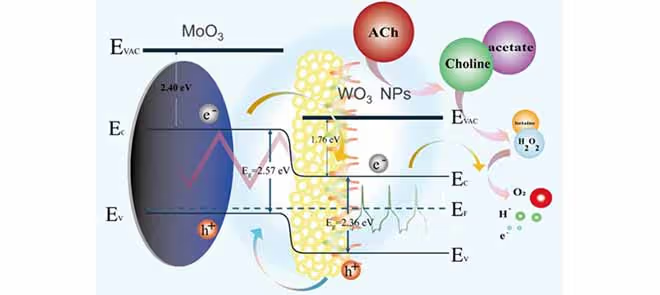
Electrochemical Study of a WO₃ NPs/MoO₃ Heterojunction-Based Dual-Enzyme Amperometric Acetylcholine Sensor
Author: Chou Jung-chuan
Published in: IEEE Sensors Journal (Volume: 25, Issue: 15, August 2025)
Summary Contributed by: Jung-Chuan Chou (Author)
Acetylcholine (ACh) is a crucial neurotransmitter, and fluctuations in its concentration are associated with neurodegenerative diseases. This study presents an amperometric dual-enzyme acetylcholine sensor integrating tungsten oxide (WO₃) nanoparticles with a molybdenum oxide (MoO₃) thin film to form a heterojunction structure. Dual-enzyme immobilization enables a wide linear range, ultra-low detection limit, high selectivity, and stable operation. The sensor shows potential for mass-producible, low-cost platforms for real-time neurochemical monitoring and portable biomedical applications.
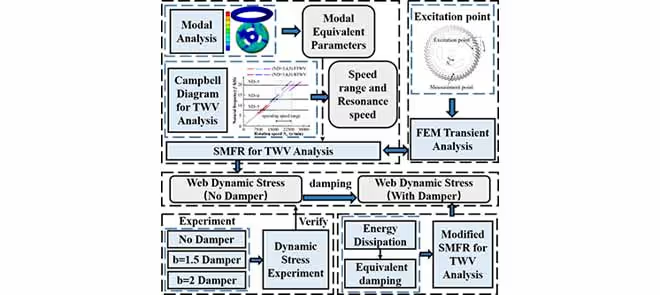
Web Dynamic Stress Identification and Damping Analysis of High-Speed Spiral Bevel Gear
Author: Zhu Rupeng, Chen Weifang, Wang Shuai, Yan Weiping, Yu Hu
Published in: IEEE Sensors Journal (Volume: 25, Issue: 12, June 2025)
Summary Contributed by: Saurabh Dubey
Thin-webbed spiral bevel gears are susceptible to dangerous nodal diameter (ND) vibrations in high-speed transmissions, increasing web dynamic stress (WDS). The Single-Mode Forced Response (SMFR) method introduced in this work integrates prestressed modal analysis with traveling-wave resonance prediction to identify critical resonances and influence passive ring-damper design. These dampers reduce resonance by 65% and WDS from 123.5 MPa to 43 MPa, offering a reliable and cost-effective framework for improving aerospace gear performance.
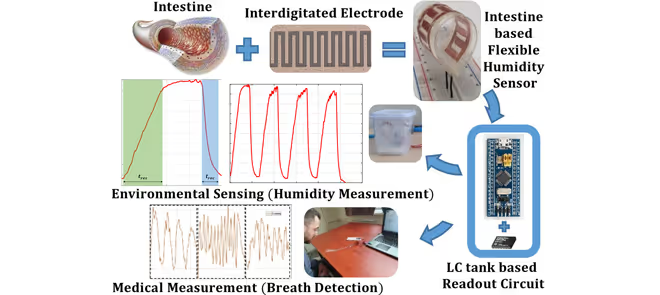
An Intestine-Based Biocompatible Humidity Sensor for Environmental and Medical Measurements
Author: Yavsan Emrehan, Erismis Mehmet Akif, KARA MUHAMMET ROJHAT
Published in: IEEE Sensors Journal (Volume: 25, Issue: 15, August 2025)
Summary Contributed by: Emrehan Yavsan (Author)
The rise in electronic waste has driven demand for sustainable, biodegradable alternatives. This study presents a sustainable and biocompatible humidity sensor derived from processed cattle intestine for environmental and medical measurements. The inherent durability of intestinal tissue ensures exceptional longevity, with the sensor remaining functional for more than a year under any conditions. Its capability to detect respiratory cycles demonstrates strong potential for integration into non-invasive medical and environmental sensing platforms.
Published in: IEEE Sensors Journal (Volume: 25, Issue: 15, August 2025)
Summary Contributed by: Kamalesh Tripathy
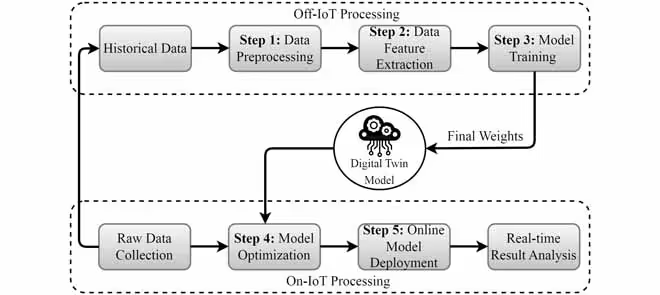
Flood prediction is crucial for disaster management. This paper introduces a novel smart framework designed with digital twin modelling, Internet of Thing (IoT) sensing, neuro-fuzzy learning, and blockchain security to forecast flood risks with exceptional accuracy. By combining real-time environmental data with modelling complex hydrological interactions, this approach delivers a highly reliable Flood Index Value with testing accuracy above 95%, making it an efficient tool for disaster preparedness and planning.
Published in: IEEE Sensors Journal (Volume: 25, Issue: 13, July 2025)
Summary Contributed by: Subham Das (Author)
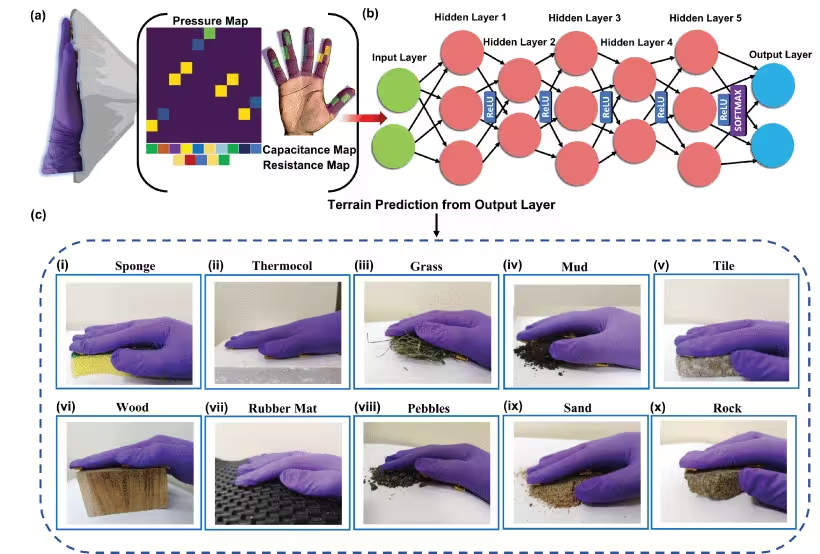
Replicating the complexity of human touch is challenging. This research introduces a novel tactile sensing skin designed to detect and interpret surface textures accurately. Combining a flexible tactile sensor and a thermal sensor creates a system capable of distinguishing surface features with precision. By integrating machine learning, the system can identify terrain with high accuracy, bringing machines closer to mimicking human touch and advancing the field of intelligent robotics and prosthetics.
Published in: IEEE Sensors Journal (Volume: 25, Issue: 16, August 2025)
Summary Contributed by: Kamonrat Phopin (Author)
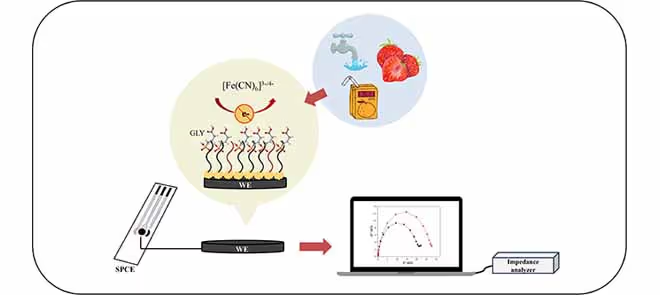
Hazardous pesticides have posed life-threatening effects to human livelihood and wellness for a decade. This paper presents an aptamer-based impedimetric sensor for glyphosate (GLY) detection in environmental and food commodities. The proposed aptasensor offers a simple, cost-effective, and fast alternative to conventional methods. It also demonstrates effective real-world performance, including a wide dynamic range and satisfactory cross-reactivity against common interferences, making it promising for real-life applications.
After years of existence and research efforts, dielectric materials in non-contact bioelectrodes guarantee the hope and survival of patients with heart abnormalities. Without painful skin abrasion, cardiac monitoring devices could reliably ensure constant care and well-being of patients. The researchers provide invaluable insights into the influence of dielectric materials that could change the future of ECG monitoring systems.
Sensors have become a part of everyday life, seamlessly connecting the physical and electronic worlds. The paper focuses on the current-output sensing technique, providing information and analytical study of various sensors and design guidance of current readout circuits. Additionally, state-of-the-art current-sensing frontends are analyzed concerning gain, bandwidth, stability, and noise. The paper presents insights into general design architectures and their performance tradeoffs.
A non-profit organization, IEEE is the world's largest technical professional organization dedicated to advancing technology for the benefit of humanity.
Copyright 2023 IEEE – All rights reserved. Use of this website signifies your agreement to the IEEE Terms and Conditions
This site is also available on your smartphone.