Get exclusive breakthroughs on sensors in IoT, energy, healthcare, and more, delivered straight to your inbox.
"IEEE Sensors Alert" is a new service of the IEEE Sensors Council. Started as one of its new initiatives, this weekly digest publishes teasers and condensed versions of our journal papers in layperson's language.
Articles Posted in the Month (October 2025)
A Fully Differential Analog Read-Out Circuit for Differential Capacitive Sensors
Published in: IEEE Sensors Journal (Volume: 25, Issue: 5, March 2025)
Summary Contributed by: Gianluca Barile (Author)
The ease of fabrication and versatile use make capacitive sensors a popular choice. This work introduces a fully differential analogue read-out circuit for differential capacitive sensors, featuring an auto-balancing bridge with voltage-controlled capacitors (VCCs) and integral negative feedback. The interface achieved 102 mV/pF sensitivity, and a linearity error of 0.47%, with 8–11 ms dynamic response times. The design enhances sensitivity and linearity, reduces parasitic effects, and demonstrates strong potential for precision sensing.
The Implementation of Single VCII-Based RC Sinusoidal Oscillators: 28 Novel Configurations
Author: Barile Gianluca, Scarsella Massimo
Published in: IEEE Sensors Journal (Volume: 25, Issue: 5, March 2025)
Summary Contributed by: Gianluca Barile (Author)
The design of sinusoidal oscillators is a challenging research area. This work presents 28 novel, energy-efficient RC (Resistor-Capacitor) sinusoidal oscillators based on a single second-generation voltage conveyor (VCII). These designs significantly reduce component count compared to traditional operational amplifier circuits and operate in current-mode, enabling low power consumption without requiring an additional voltage output buffer. Experimental validation confirmed 16 configurations operating as expected, highlighting their potential for advanced sensor interfacing applications.
Design and Optimization of a Highly Sensitive Surface Plasmon Resonance Biosensor for Accurate Detection of Mycobacterium tuberculosis
Author: Mahmud Russel Reza, Barua Bobby, Islam M. Shariful, Mondal Tanu Prava, Rafi Shah Ali
Published in: IEEE Sensors Journal (Volume: 25, Issue: 6, March 2025)
Summary Contributed by: Russel Reza Mahmud (Author)
Surface Plasmon Resonance (SPR) has transformed medical diagnostics. This paper presents a highly sensitive SPR biosensor developed for the accurate detection of tuberculosis (TB) causing bacteria, Mycobacterium tuberculosis. By leveraging a novel hybrid structure incorporating black phosphorus and optimized material layers, the sensor achieved remarkable angular sensitivity, enabling rapid, label-free diagnosis with high precision. It can detect even trace amounts of bacteria, providing a powerful tool for faster and accurate TB screening.
Enhancement of Target Localization Based on Angle-of-Arrival Measurement via Quantum Sensor Networks
Author: Chai Hongzhou, Hui Jun
Published in: IEEE Sensors Journal (Volume: 25, Issue: 6, March 2025)
Summary Contributed by: Hongzhou Chai (Author)
With the advancement of quantum information technology, integrating quantum resources, such as entangled photons into traditional measurement fields can improve parameter estimation accuracy. This study introduces a novel quantum-enhanced angle-of-arrival (AoA) estimation method for evaluating the performance of a quantum sensing localization system. The work contributes to realizing quantum navigation and localization with drastically improved integrated accuracy, thereby refining its applications in radar, navigation, wireless communication, and target localization.
Published in: IEEE Sensors Journal (Volume: 25, Issue: 5, March 2025)
Summary Contributed by: Simone Benatti (Author)
Accurate hand motion modeling is important for intuitive human–machine interaction (HMI). This paper introduces an event-based high-density surface electromyography encoding method for multifinger force estimation, optimized for real-time, low-power microcontroller applications. Evaluated on the High-densitY Surface Electromyogram Recording (HYSER) dataset in realistic multiday settings, it showed competitive accuracy. With energy consumption under 6.5 μJ per sample and latency below 280 μs, it enables efficient, real-time regression for future wearable HMI applications.
Volatile Organic Compounds (VOCs) pose significant health risks, making the effective monitoring of these compounds essential. This article presents a novel, cost-effective chemoresistive sensor that uses citrate-functionalized gold nanoparticles (AuNPs) deposited on cotton fabric for precise acetone (CH3COCH3) detection. Its impedance-based mechanism demonstrates high selectivity and strong reusability. This AuNP-Textile sensor offers a promising solution for portable, real-time VOC exposure assessment in applications ranging from health monitoring to environmental pollution.
A Multimatrix E-Nose With Optimal Multiranged AFE Circuit for Human Volatilome Fingerprinting
Author: Radogna Antonio Vincenzo, Capone Simonetta, D'Amico Stefano, Forleo Angiola, Grassi Giuseppe, Siciliano Pietro Aleardo
Published in: IEEE Sensors Journal (Volume: 25, Issue: 5, March 2025)
Summary Contributed by: Radogna Antonio Vincenzo (Author)
The human volatilome, a combination of volatile organic compounds (VOCs) present in breath and bodily fluids, reflects overall health and can signal the early onset of disease. This study presents SPYROX, an electronic nose that converts VOC signatures into digital fingerprints. It features a multirange analog front-end (AFE) circuit with a multimatrix learning algorithm for adaptive sensitivity across diverse samples. SPYROX offers an accurate, non-invasive, portable solution for routine health screenings and diagnostics.
Published in: IEEE Sensors Journal (Volume: 25, Issue: 5, March 2025)
Summary Contributed by: Saurabh Dubey
Niobium-doped BZT-BCT thin films are emerging as a sustainable, high-performance alternative to the toxic lead zirconate titanate (PZT) for piezoelectric devices. Fabricated via a sol-gel process and optimized poling, these lead-free films exhibit enhanced dielectric, ferroelectric, and piezoelectric properties. With stable switching, improved resonance, and strong mechanical integrity, they demonstrate promise for MEMS devices, biomedical implants, and energy-harvesting applications, thus paving the way for eco-friendly piezoelectric technologies.
Published in: IEEE Sensors Journal (Volume: 25, Issue: 5, March 2025)
Summary Contributed by: Hussain Irfan (Author)
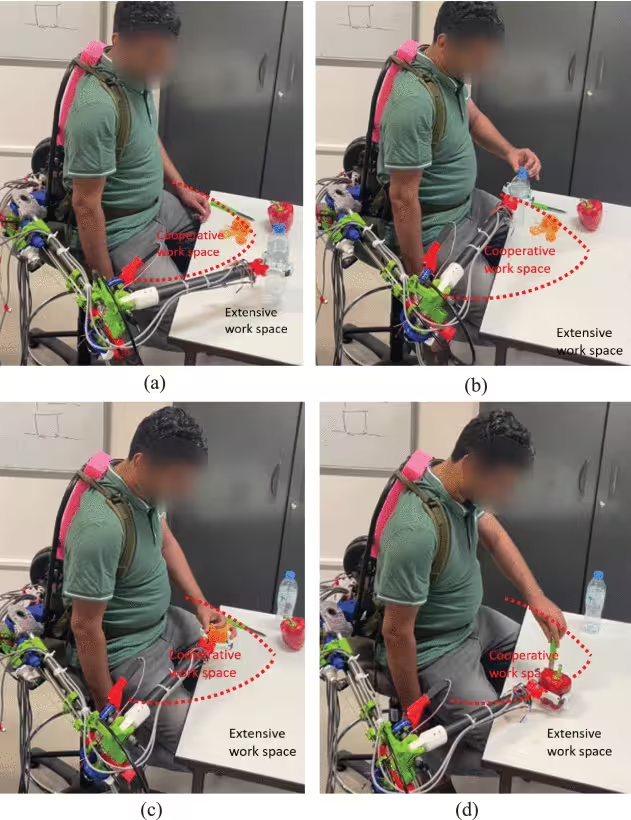
Supernumerary robotic arms (SRAs) can assist post-stroke patients with daily activities. However, its conventional designs are bulky and power-hungry. This paper introduces a novel SRA featuring twisted, string-driven flexure joints that eliminate large actuators, resulting in a compact, lightweight, and energy-efficient wearable device. This advance in assistive robotics empowers stroke survivors to regain independence in bimanual activities and paves the way for the next generation of affordable, human-assistive technologies.
Smart, Wearable and Power-Controlled Mixed-Signal Platform for Screening and Follow-Up of Cystic Fibrosis Based on Real-Time Chloride Concentration Evaluation in Sweat
Author: De Venuto Daniela, Bollella Paolo, De Venuto Domenica, Mascellaro Grazia, Spadavecchia Giuseppe, Torsi Luisa
Published in: IEEE Sensors Journal (Volume: 25, Issue: 5, March 2025)
Summary Contributed by: Payal Savani
Wearable sensors have garnered significant attention in recent years, particularly in the realm of personalized diagnostics and continuous health monitoring. This paper discusses the development of a wearable sweat-based sensor system for monitoring cystic fibrosis (CF) in patients. It offers a resolution of ±2 mV and sensitivity of 56.9 mV/dec, with an average power consumption of 350 micro watts. The sensor is a compact, energy-efficient, and developed for home use.
A Wearable Multisensor Fusion System for Neuroprosthetic Hand
Author: Liu Honghai, Meng Jianjun, Ding Han, Guo Weichao, Shi Shang, Yang Xingchen, Yin Zongtian
Published in: IEEE Sensors Journal (Volume: 25, Issue: 8, April 2025)
Summary Contributed by: Liu Honghai (Author)
Getting a near-natural control from neuroprosthetic hands is challenging. This study introduces a compact, wearable multisensor system that integrates ultrasound, surface electromyography (sEMG), and Inertial Measurement Unit (IMU) sensors to improve prosthetic hand control. Ultrasound and EMG model gestures, sEMG detects resting states, and the IMU filters unintended movements like shaking. The system's small size allows seamless integration into prosthetic sockets, and control strategies enhance stability, offering an improved experience for amputees.
An Open-Path Optical Sensor for Hydrogen Sulfide and Methane Detection by QCL
Author: Li Jun, Fan Binbin, Hao Le, Jaworski Piotr, Luan Guohua, Ma Tian, Wang Zhen, Zeng Qingjie, Zhai Xiaowei, Zhang Jiarui
Published in: IEEE Sensors Journal (Volume: 25, Issue: 5, March 2025)
Summary Contributed by: Saurabh Dubey
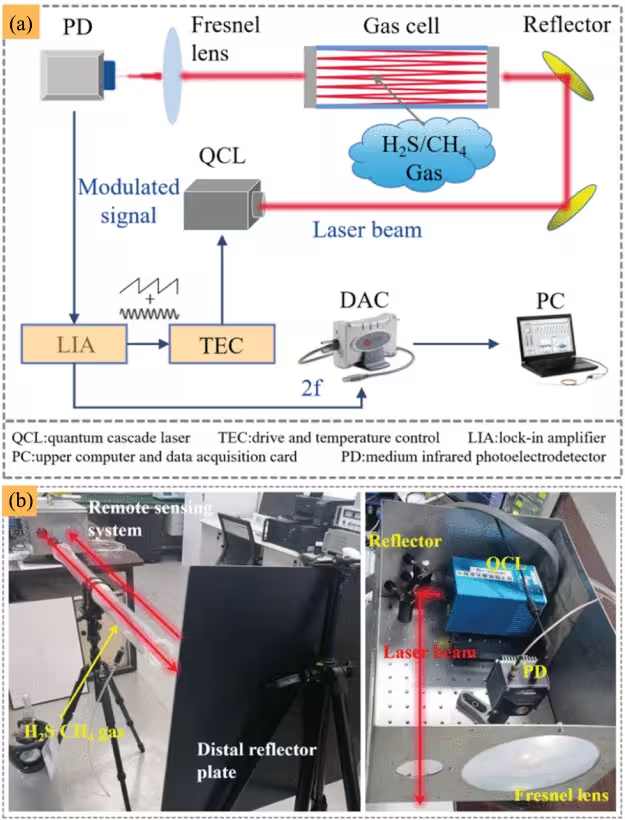
A Quantum Cascade Laser–based open-path optical sensor enables real-time, precise, and high-sensitivity detection of harmful hydrogen sulfide (H₂S) and methane (CH₄) gases up to 50 m and a response time of 3.4 s. Resistant to water vapor interference, it delivers a strong signal-to-noise ratio, surpassing traditional sensors. Ideal for remote oilfields, refineries, and hazardous sites, it ensures reliable long-range monitoring with future IoT integration and multi-gas detection for enhanced industrial safety.
Nonlinear Behavioral Model of Capacitive MEMS Microphone for Predicting Ultrasound Intermodulation Distortion
Author: Rahaman Ashiqur, Albahri Shehab, Boor Steven, Bradt Christopher, Lee Sung B.
Published in: IEEE Sensors Journal (Volume: 25, Issue: 1, January 2025)
Summary Contributed by: Ashiqur Rahaman (Author)
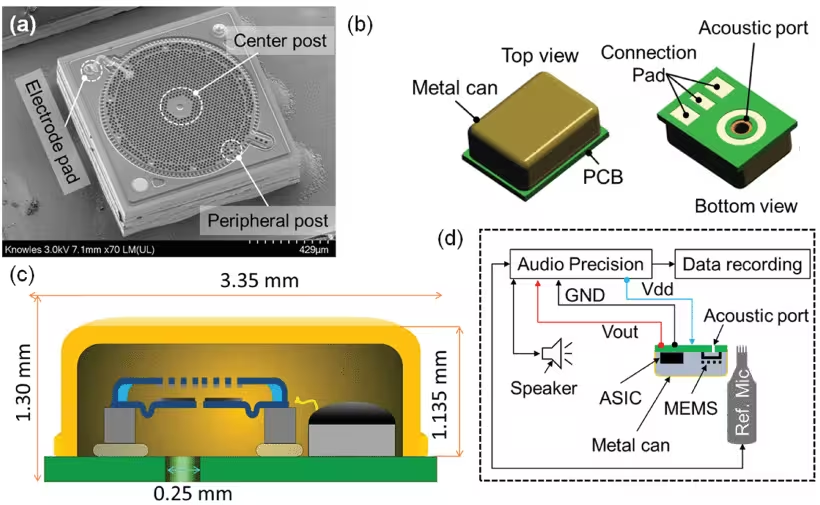
Ultrasound intermodulation distortion (IMD) in microphones, particularly in hearing aids, can lead to audible distortions around ultrasonic devices. The primary source of this nonlinearity is the micro-electromechanical systems (MEMS) transducer. This paper explores how specific design features of capacitive MEMS microphones affect IMD using a nonlinear behavioral model to reduce distortion while maintaining acoustic performance. The optimized design shows 15 dB IMD reduction at 20 kHz, providing excellent electro-acoustic characteristics.
Design and Simulation Analysis of Electrolyte-Gated Aluminum Oxide Organic Thin-Film Transistor Biosensor for High Sensitivity
Author: Wadhwa Girish, Proto Antonino, Taibi Angelo, Thakur Anchal
Published in: IEEE Sensors Journal (Volume: 25, Issue: 6, March 2025)
Summary Contributed by: Payal Savani
The pH sensor has various applications in environmental, industrial, and healthcare monitoring. This paper introduces an electrolyte-gated aluminum oxide organic thin-film transistor (EG-Al₂O₃ OTFT) biosensor with a pentacene structure designed for highly sensitive detection. Using aluminum oxide improved stability, sensitivity, and low-voltage operation. The biosensor detects biomolecules by converting biochemical interactions into electrical signals. This low-cost, flexible, efficient device can prove to be a reliable biosensing for medical diagnostics and environmental monitoring.
Published in: IEEE Sensors Journal (Volume: 25, Issue: 4, February 2025)
Summary Contributed by: Gutierrez-rojas Daniel (Author)
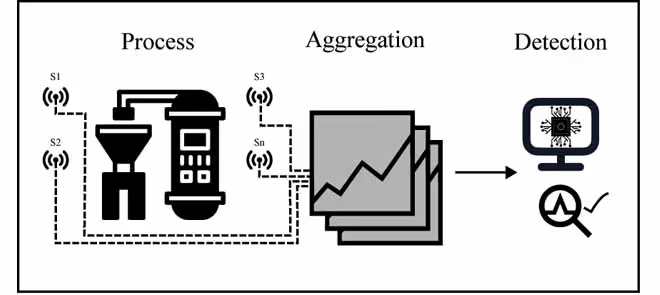
As industrial systems grow more complex powered by wireless sensor networks (WSNs), effective anomaly detection becomes essential. This paper introduces a smart, explainable framework to detect and classify anomalies in WSN-enabled Cyber-Physical Systems. Enhanced by novel explainable AI (XAI) techniques, the model incorporates data acquisition, fusion, and analytics. The results show high accuracy and reliability with reduced risks, faster fault correction, enhanced efficiency, system security, and resilience against cyber threats.
After years of existence and research efforts, dielectric materials in non-contact bioelectrodes guarantee the hope and survival of patients with heart abnormalities. Without painful skin abrasion, cardiac monitoring devices could reliably ensure constant care and well-being of patients. The researchers provide invaluable insights into the influence of dielectric materials that could change the future of ECG monitoring systems.
Sensors have become a part of everyday life, seamlessly connecting the physical and electronic worlds. The paper focuses on the current-output sensing technique, providing information and analytical study of various sensors and design guidance of current readout circuits. Additionally, state-of-the-art current-sensing frontends are analyzed concerning gain, bandwidth, stability, and noise. The paper presents insights into general design architectures and their performance tradeoffs.
A non-profit organization, IEEE is the world's largest technical professional organization dedicated to advancing technology for the benefit of humanity.
Copyright 2023 IEEE – All rights reserved. Use of this website signifies your agreement to the IEEE Terms and Conditions
This site is also available on your smartphone.