Get exclusive breakthroughs on sensors in IoT, energy, healthcare, and more, delivered straight to your inbox.
"IEEE Sensors Alert" is a new service of the IEEE Sensors Council. Started as one of its new initiatives, this weekly digest publishes teasers and condensed versions of our journal papers in layperson's language.
Articles Posted in the Month (April 2025)
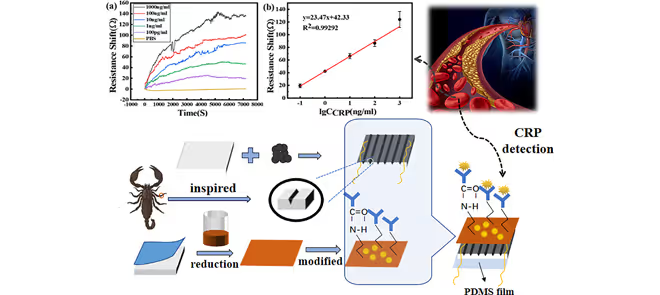
Scorpion-Inspired, Hydrophobic, Highly Sensitive, and Paper-Based Magnetoelastic Biosensor for C-Reactive Protein Detection
Author: Sang Shengbo, Ge Yang, Guo Xing, Yuan Zhongyun, Zhao Dong, Luo Man
Published in: IEEE Sensors Journal (Volume: 24, Issue: 8, April 2024)
Summary Contributed by: Saurabh Dubey
C-reactive protein (CRP) in human blood is a vital biomarker for detecting inflammation or acute infection. This study presents a hydrophobic, paper-based magnetoelastic biosensor inspired by scorpion anatomy and made using eco-friendly materials and V-shaped grooves to enhance sensitivity for detecting CRP. The sensor overcomes the limitations of traditional detection methods and offers rapid, cost-effective, and highly sensitive diagnostics for acute inflammation and tissue damage.
Improving the Spatial Resolution of Small Satellites by Implementing a Super-Resolution Algorithm Based on the Optical Imaging Sensor’s Rotation Approach
Published in: IEEE Sensors Journal (Volume: 24, Issue: 24, December 2024)
Summary Contributed by: Iman Kazemi (Author)
Image processing can improve the image quality of data transmitted by small satellites. This paper presents a novel method of enhancing small satellite image resolution using a super-resolution algorithm combined with a rotating sensor. The algorithm reconstructs a high-resolution image by boosting spatial resolution. This method increases image clarity by gathering more data in flight and vertical directions and efficiently processing images in approximately 0.713 seconds, making it suitable for microsatellite applications.
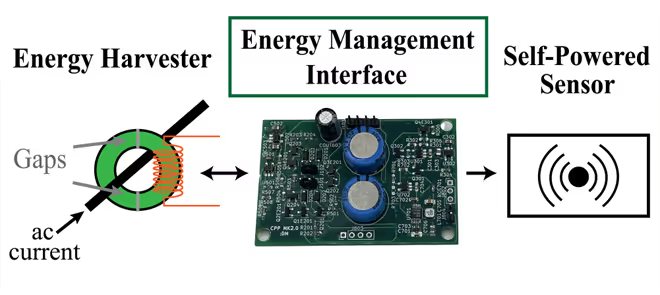
Rule the Joule: An Energy Management Design Guide for Self-Powered Sensors
Author: Monagle Daniel, Ponce Eric Andrew, Leeb Steven
Published in: IEEE Sensors Journal (Volume: 24, Issue: 01, January 2024)
Summary Contributed by: Saurabh Dubey
Rule the Joule Energy Management System for self-powered sensors features dynamic control, cold-start capability, and robust maximum power point tracking (MPPT) to optimize energy harvesting and storage. Its real-time energy flow regulation reduces reliance on predictive models, enhancing efficiency in noisy environments. Experimental validation confirms its reliability for powering wireless sensor nodes, providing overvoltage protection and improved component longevity, paving the way for advancement in IoT, smart technologies, and wireless sensor networks.
Microfluidic Electrochemical Sensor for Online Detection of Chemical Oxygen Demand Based on AuNPs/Au Electrodes
Author: Yang Xiaozhan, Wu Haotian, Xie Song
Published in: IEEE Sensors Journal (Volume: 24, Issue: 23, December 2024)
Summary Contributed by: Xiaozhan Yang (Author)
Chemical oxygen demand (COD) is a key parameter for water quality assessment. The paper presents a compact, microfluidic electrochemical sensor for real-time monitoring of COD in water. The sensor uses gold nanoparticles (AuNPs) on modified gold electrodes to enhance sensitivity and accuracy. It does real-time COD monitoring with high efficiency and quick response, i.e., 3 minutes. Successful tests on water samples highlight its potential for water quality monitoring and environmental management.
Triaxial 3-D-Channeled Soft Optical Sensor for Tactile Robots
Author: Matteo Lo Preti, Federico Bernabei, Anderson B. Nardin, Lucia Beccai
Published in: IEEE Sensors Journal (Volume: 24, Issue: 17, September 2024)
Summary Contributed by: Payal Savani
Robotic systems integrated with sensors show enhanced performance in challenging environments and tasks. The proposed novel triaxial 3D-channeled soft fingertip-shaped optical sensor designed for tactile robots uses transparent channels to detect forces in three dimensions. The compact and flexible sensors made from soft materials with optical waveguides enhance the robot's sensitivity to touch. It offers flexibility and accuracy for real-time tactile feedback, showing potential for real-time force detection in robotic hands.
Published in: IEEE Sensors Journal (Volume: 24, Issue: 24, December 2024)
Summary Contributed by: Toshihiko Noda (Author)
Accurate plant monitoring is vital for smart agriculture. Traditional pH sensors struggle with light interference and require dark conditions for accurate pH measurement. This study introduces a novel pH image sensor mitigating light interference. Employing dual-pixel technology, it distinguishes between pH and light signals, enabling precise measurements under illumination. Results show errors within 10%, a significant improvement over existing methods. This advancement facilitates real-time multi-ion sensing for optimized crop management.
Noninvasive Blood Glucose Measurement Using RF Spectroscopy and a LightGBM AI Model
Author: Dominic Klyve, Steve Lowe, Kaptain Currie, James H. Anderson, Carl Ward, Barry Shelton
Published in: IEEE Sensors Journal (Volume: 24, Issue: 17, September 2024)
Summary Contributed by: Saurabh Dubey
Blood glucose monitoring is crucial in diabetes patients. This paper combines radiofrequency (RF) spectroscopy with a LightGBM AI model to explore a non-invasive method for measuring blood glucose levels. RF signals detect the change in blood glucose concentration in the skin, which is processed through the AI model to estimate blood glucose levels accurately. The approach aims to provide a non-invasive, safe, and convenient way for regular glucose monitoring in diabetic care.
Published in: IEEE Sensors Journal (Volume: 24, Issue: 23, December 2024)
Summary Contributed by: Brent Leier (Author)
The limitations of conventional temperature sensors in extremely cold environments pose significant challenges across various industries. This paper introduces a microwave sensor utilizing a stripline transmission for low-temperature sensing. The sensor exploits the temperature-sensitive properties of dielectric materials, enabling precise detection of frequency shifts correlated with temperature variations. The innovatively designed sensor is feasible for low and sub-zero temperature measurement owing to its linear sensitivity and stable, repeatable measurements.
Author: N. Bhavana, Mallikarjun M. Kodabagi, B. Muthu Kumar, P. Ajay; N. Muthukumaran, A. Ahilan
Published in: IEEE Sensors Journal (Volume: 24, Issue: 15, August 2024)
Summary Contributed by: Anupama
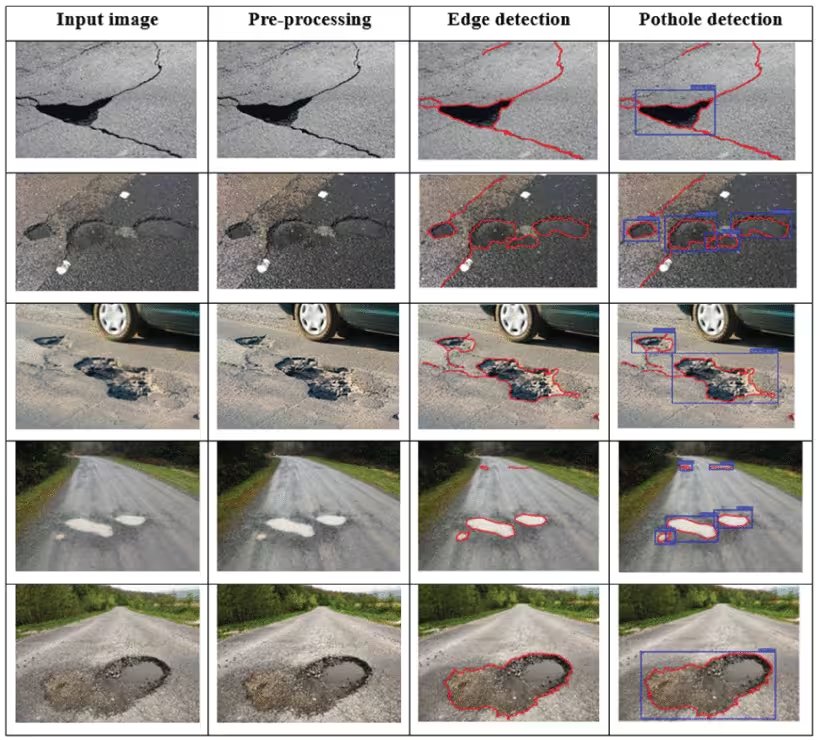
Road potholes pose significant risks to road safety and infrastructure. POT-YOLO is a novel real-time detection system combining edge segmentation with the You Look Only Once (YOLOv8) architecture. This innovative approach improves pothole localization by accurately identifying their contours. POT-YOLO demonstrates exceptional performance, ensuring accurate and efficient detection even in challenging conditions. Its real-time capabilities allow for deployment on edge devices, facilitating proactive maintenance and improving road safety.
Analysis and Design of Biplanar Coils Within Magnetic Shielding Room Considering Actual Ferromagnetic Boundaries
Author: Xu Xueping, Liu Yi, Sun Xin, Zhou Weiyong
Published in: IEEE Sensors Journal (Volume: 24, Issue: 24, December 2024)
Summary Contributed by: Xu Xueping (Author)
Studying the coupling relationship between the magnetic shield and coil is crucial for designing a magnetic field coil with high uniformity. This paper presents a novel method for designing high-uniformity biplanar coils inside a closed magnetic shielding room with ferromagnetic boundaries. The approach accounts for the permeability and thickness of the magnetic shielding materials to effectively improve the uniformity of the coil, which is important for achieving a near-zero magnetic field environment.
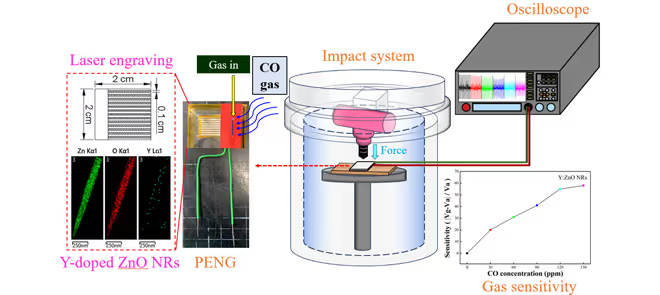
High-Sensitivity of Self-Powered Gas Sensors Based on Piezoelectric Nanogenerators With Y-Doped 1-D ZnO Nanostructures
Author: Ji Liang-wen, Chu Tung-Te, Chu Yen-Lin, Xie Jun-Hong
Published in: IEEE Sensors Journal (Volume: 24, Issue: 12, June 2024)
Summary Contributed by: Saurabh Dubey
Self-powering sensors will make the sensing devices portable. This study explores a self-powered gas sensor using Yttrium-doped zinc oxide (Y-doped ZnO) nanorod arrays and piezoelectric nanogenerators (PENGs). The sensor demonstrated self-powering capability, offering portability and energy efficiency. It exhibits superior sensitivity to carbon monoxide (CO) compared to conventional sensors. The advantages include portability, improved gas adsorption and functionality, facilitating integration into the IoT systems, and wearable sensors for real-time environmental monitoring.
Published in: IEEE Sensors Journal (Volume: 24, Issue: 24, December 2024)
Summary Contributed by: Tobias Gnos (Author)
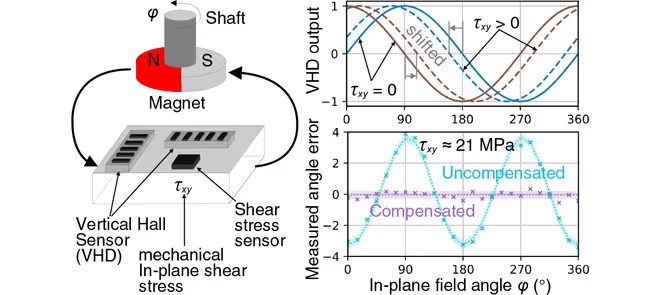
Vertical Hall Devices (VHD) offer a way for accurate low-cost angular position sensing. In-plane stresses on the silicon die caused by packaging or external forces challenge the increasing accuracy requirements in the automotive and automation industry over a wide temperature range. The study presents a novel active stress compensation method to increase the accuracy of angle measurements in CMOS-integrated VHD’s. The approach is particularly beneficial for applications requiring high-accuracy magnetic field sensing.
Published in: IEEE Sensors Journal (Volume: 24, Issue: 18, September 2024)
Summary Contributed by: Saurabh Dubey
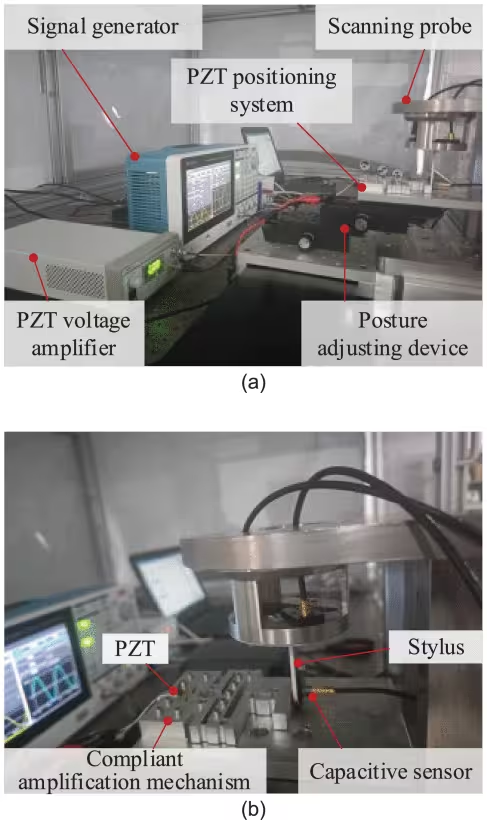
Contact scanning probes may have issues of reduced accuracy due to high speed and high frequency. This paper presents the innovative contact scanning probe, utilizing dual-parameter feedback to optimize pole configuration. It enhances accuracy by correcting high-speed and high-frequency errors with real-time accuracy and dynamic compensation. The approach aims to improve measurement accuracy and stability in high-speed scanning systems. It has promising potential in precision manufacturing, nanotechnology, and medical fields.
From Simulation to Surgery: Comprehensive Validation of an Optical Sensor for Monitoring Focal Laser Ablation of Solid Organ Tumors
Author: Geoghegan Rory, Hughes Griffith, Marks Leonard, Natarajan Shyam, Priester Alan, Sisk Anthony, Sun Songping, Tirado Richard
Published in: IEEE Sensors Journal (Volume: 24, Issue: 24, December 2024)
Summary Contributed by: Rory Geoghegan (Author)
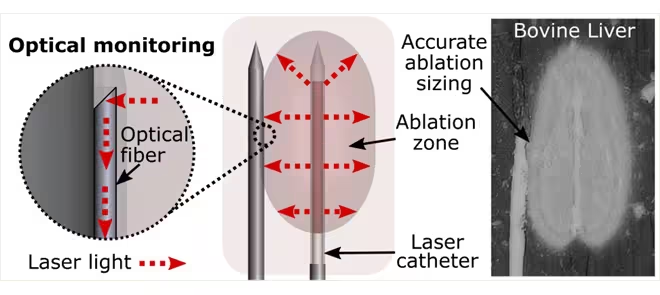
Focal laser ablation (FLA) is a minimally invasive procedure using thermal coagulation to treat tumors with fewer side effects than surgery. However, it lacks an accurate and affordable monitoring method. This paper presents an optical sensor for real-time monitoring of the ablation process. The sensor has been validated through simulations, ex vivo, and clinical studies and can detect the coagulation boundary precisely without tissue-specific calibration.
Exploring and Identifying Bias-Instability Noise Sources in Mode-Split MEMS Gyroscopes Based on Electrostatic Frequency Tuning
Author: Jie Lin, Yang Zhao, Guoming Xia, Qin Shi, Anping Qiu
Published in: IEEE Sensors Journal (Volume: 24, Issue: 18, September 2024)
Summary Contributed by: Kamalesh Tripathy
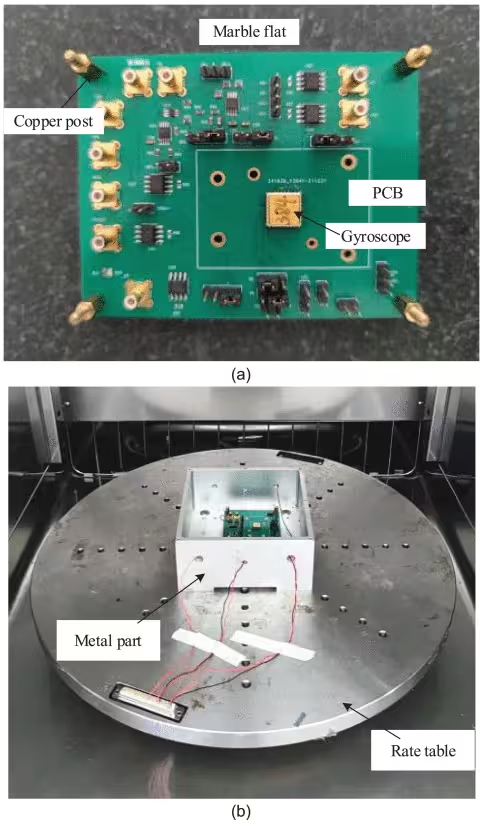
MEMS gyroscope has advanced with the advancements in processing and manufacturing technology. However, their structure and system-based noise level continue to pose challenges in proper implementation and restrict their performance with high accuracy and precision. This paper proposes a system-level noise model that analyzes the relationship between frequency split and noise performance. It identifies noise sources and contributes to bias instability, establishing a frequency-tuning criterion for different noise requirements.
The emerging application of consumer grade EEG measuring sensors and advancement in technology, which had made it portable and affordable, has made it accessible in the general market. EEG devices now have a broader use other than medicine. The researchers, educationists, game developers, engineers, and psychiatrists are enthusiastic about the consumer grade EEG device, which has made the study of the brain accessible and its application quite convenient.
The design of a flexible tactile sensor using liquid metal (LM) and elastic fibers provides sensing capability and enhances the performance of a hand prosthesis. This study details the measurement principles of the LM-based force sensor, the design and fabrication process, and the sensor signal processing circuit. The proposed flexible tactile sensor offers reliable performance with high sensitivity in three axes, low error, and improved functionality in hand prostheses.
A non-profit organization, IEEE is the world's largest technical professional organization dedicated to advancing technology for the benefit of humanity.
Copyright 2023 IEEE – All rights reserved. Use of this website signifies your agreement to the IEEE Terms and Conditions
This site is also available on your smartphone.