Get exclusive breakthroughs on sensors in IoT, energy, healthcare, and more, delivered straight to your inbox.
"IEEE Sensors Alert" is a pilot project of the IEEE Sensors Council. Started as one of its new initiatives, this weekly digest publishes teasers and condensed versions of our journal papers in layperson's language.
Articles Posted in the Month (December 2024)
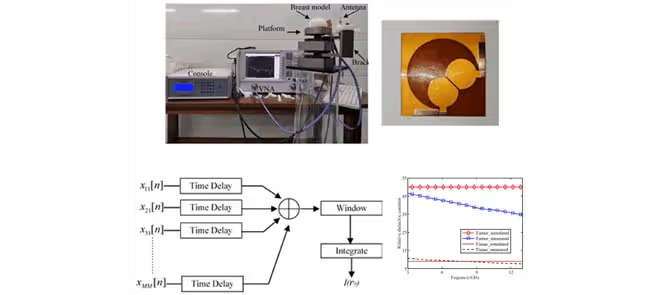
Flexible Dual-Polarized UWB Antenna Sensors for Breast Tumor Detection
Published in: IEEE Sensors Journal (Volume: 22, Issue: 13, July 2022)
Summary Contributed by: Saurabh Dubey
Early detection of breast cancer saves lives. The research presents a novel and adaptable breast cancer detection system integrating dual-polarized Ultra-Wideband (UWB) antennas on flexible Kapton polyimide, ensuring high precision. Eight UWB units surround the breast phantom and reconstruct 3D images using a delay-and-sum (DAS) algorithm to locate tumors with minimal clutter. Wearable and versatile, it can detect tumors with a 15 mm edge-to-edge distance, offering convenient health monitoring and self-diagnosis.
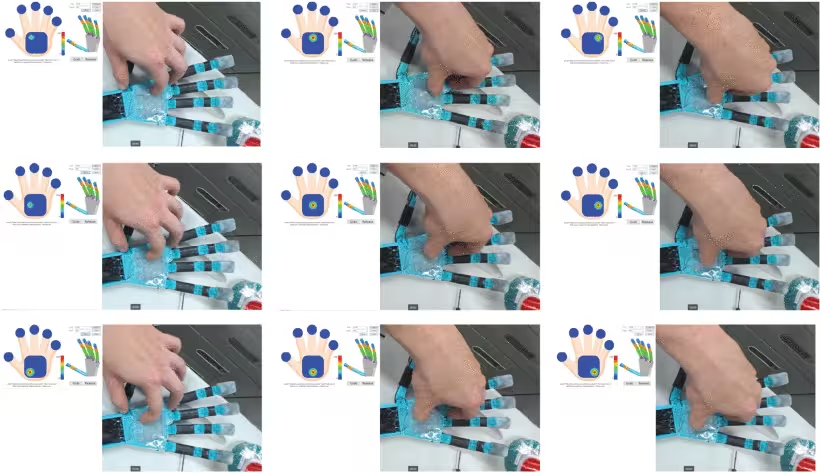
Design, Fabrication, and Validation of a Flexible Tactile Sensor for a Hand Prosthesis
Author: Kuo Chung-hsien, Nguyen Dai-Dong, Su Shun-Feng, Xie Wu-Qi
Published in: IEEE Sensors Journal (Volume: 24, Issue: 16, March 2024)
Summary Contributed by: Chung-Hsien Kuo (Author)
The design of a flexible tactile sensor using liquid metal (LM) and elastic fibers provides sensing capability and enhances the performance of a hand prosthesis. This study details the measurement principles of the LM-based force sensor, the design and fabrication process, and the sensor signal processing circuit. The proposed flexible tactile sensor offers reliable performance with high sensitivity in three axes, low error, and improved functionality in hand prostheses.
Published in: IEEE Sensors Journal (Volume: 22, Issue: 17, September 2022)
Summary Contributed by: Payal Savani
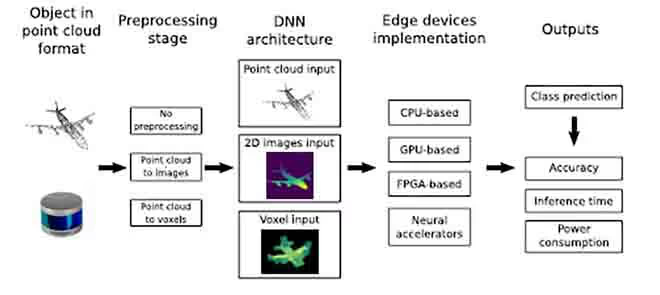
In our technology-driven world, devices require quick and efficient data processing. Edge computing enables rapid local decision-making, preserving bandwidth and privacy. Understanding platform intricacies is crucial for informed decision-making while navigating through vast data. The paper explores innovative approaches and experimental findings, providing insights into Deep Neural Networks (DNNs) architecture performance across diverse edge technologies. This aids in selecting optimal architectures based on performance metrics for specific applications.
Published in: IEEE Sensors Journal (Volume: 24, Issue: 13, July 2024)
Summary Contributed by: Arantxa Uranga (Author)
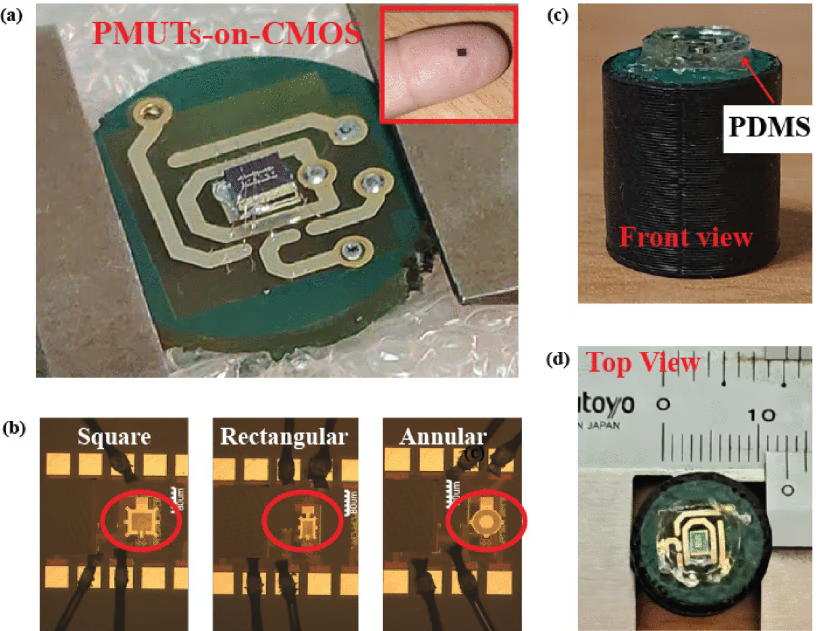
Hydrophones are devices that convert underwater acoustic pressure into electrical signals. The paper proposes a hydrophone designed using Aluminum Scandium Nitride (AlScN) piezoelectric micromachined ultrasonic transducers (PMUTs) integrated monolithically on CMOS (Complementary Metal-Oxide-Semiconductor). This single-chip AIScN PMUTs with COMS (PMUTs-on-CMOS) hydrophone offers compactness, high sensitivity, and energy efficiency for underwater acoustic sensing. It supports high-performance underwater detection and has promising applications in underwater communications, sonar, and environmental monitoring systems.
A Retail Object Classification Method Using Multiple Cameras for Vision-Based Unmanned Kiosks
Author: Ji-Ye Jeon, Shin-Woo Kang, Hyuk-Jae Lee, Jin-Sung Kim
Published in: IEEE Sensors Journal (Volume: 22, Issue: 22, November 2022)
Summary Contributed by: Saurabh Dubey
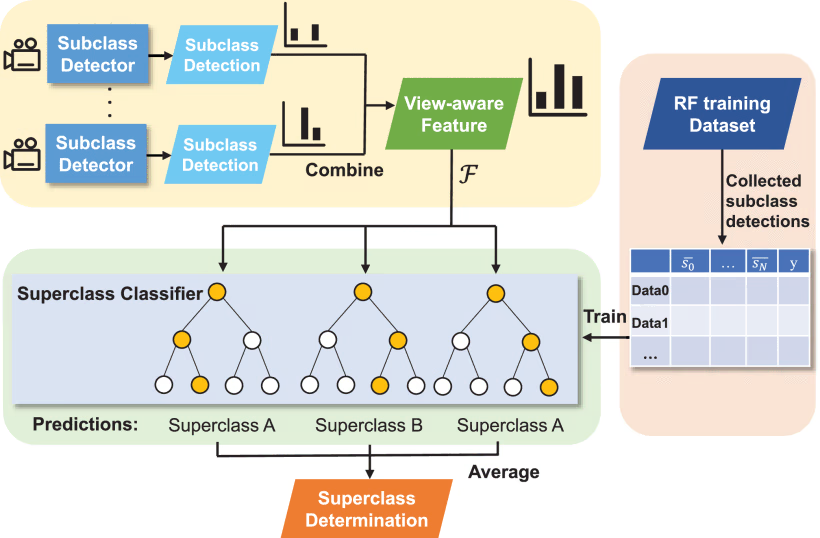
Sensor technology, wireless communications, and Internet of Things (IoT) use in unmanned self-checkout systems has elevated the retail experience. This paper presents a vision-based RGB kiosk using a sophisticated combination of multiple cameras and a cutting-edge Convolutional Neural Network (CNN) framework, yielding a 33.67% improvement over conventional methods. It solves inter-classification challenges and intra-class variations in products with 142k+ real-world dataset points, with promising applications in retail and lifestyle sectors.
TSSTDet: Transformation-Based 3-D Object Detection via a Spatial Shape Transformer
Author: Yoo Myungsik, Bui Cuong Duy, Hoang Hiep Anh
Published in: IEEE Sensors Journal (Volume: 24, Issue: 5, March 2024)
Summary Contributed by: Myungsik Yoo (Author)
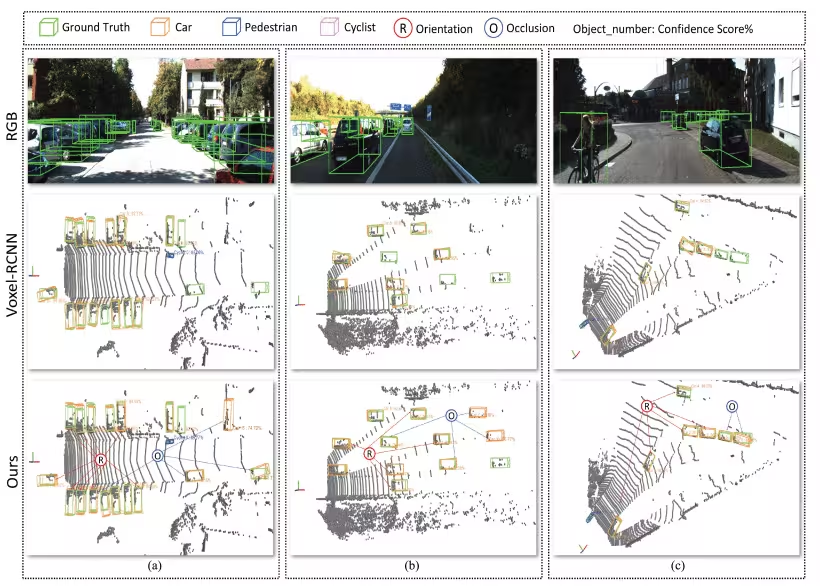
Accurate 3D object detection is essential for the safe navigation of autonomous vehicles. The novel transformation-based 3-D object detection via a spatial shape transformer (TSSTDet) overcomes the challenges of incomplete and varying orientations of the obstructions. Its key features include a rotational transformation convolutional backbone (RTConv) for orientation-invariant detection and a voxel-point shape transformer for reconstructing missing parts, thus improving obstacle detection and avoidance and enhancing safe navigation in autonomous driving.
Camera-Augmented Non-Contact Vital Sign Monitoring in Real Time
Author: Arash Shokouhmand, Samuel Eckstrom, Behnood Gholami, Negar Tavassolian
Published in: EEE Sensors Journal (Volume: 22, Issue: 12, June 2022)
Summary Contributed by: Payal Savani
Vital signs, such as heart rate (HR) and respiratory rates (RR), are crucial for patients' health assessment. Technological advancements have led to non-contact monitoring using cameras and radars. This paper introduces a camera-guided frequency-modulated continuous-wave (FMCW) radar system for real-time non-contact vital sign monitoring. The novel singular value-based point detection (SVPD) method is designed to optimize respiratory and heart rate monitoring. Experiments show high accuracy and effective vital signs monitoring.
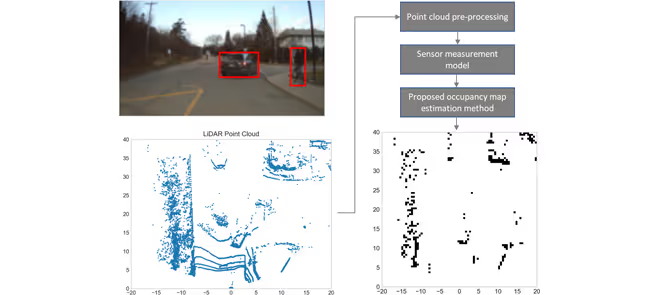
Environment mapping is a key component in assisted and autonomous driving. This paper introduces a method to generate 2D occupancy maps using light detection and ranging (LiDAR) and radar data, leveraging their clustered, sparse nature. It presents a linear sensor measurement model and pattern-coupled sparse Bayesian learning approach for occupancy map estimation. Tested with real-world data highlighting the methods, it shows superior performance in detecting obstacles.
A Fully Flexible Hydrogel Electrode for Daily EEG Monitoring
Author: Gencai Shen, Kunpeng Gao, Nan Zhao, Zhuangzhuang Wang, Chunpeng Jiang, Jingquan Liu
Published in: IEEE Sensors Journal (Volume: 22, Issue: 13, July 2022)
Summary Contributed by: Saurabh Dubey
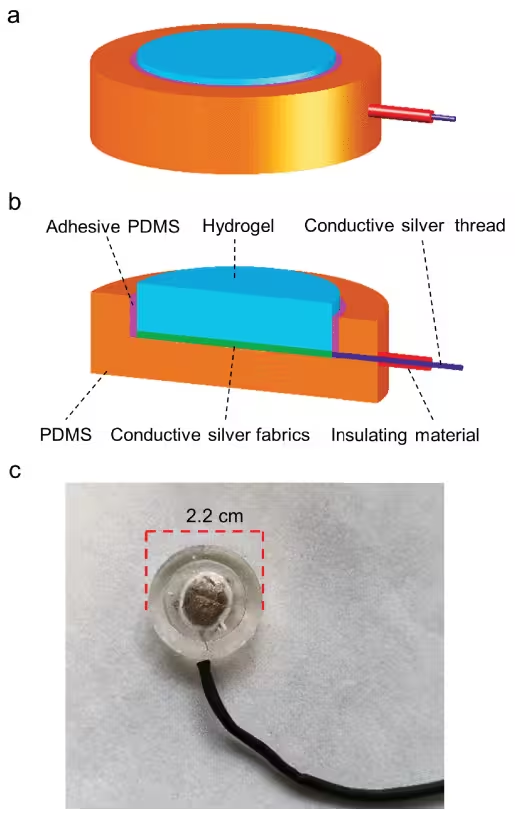
The study explores fully flexible hydrogel electrodes for daily monitoring of electroencephalogram (EEG) Signals. Synthesized through a NAGA (n-acryloyl glycinamide) hydrogel enriched with glycerol, these electrodes exhibit enhanced skin conductivity compared to dry and semi-dry electrodes. With stable signal monitoring, 70% deformation tolerance, and 90-day durability, these electrodes prove ideal for daily EEG monitoring, aiding brain activity monitoring applications in Brain Computer Interface studies based on data analysis algorithms.
Glyphosate Detection Through Piezoelectric and Fiber Optic Sensors Based on Molecular Imprinted Polymers
Author: Sequeira Filipa, Bilro Lucia, Gomes Maria Teresa S. R., Oliveira Ricardo, Reis Silvia, Rudnitskaya Alisa, Verissimo Marta
Published in: IEEE Sensors Journal (Volume: 24, Issue: 13, July 2024)
Summary Contributed by: Sequeira Filipa (Author)
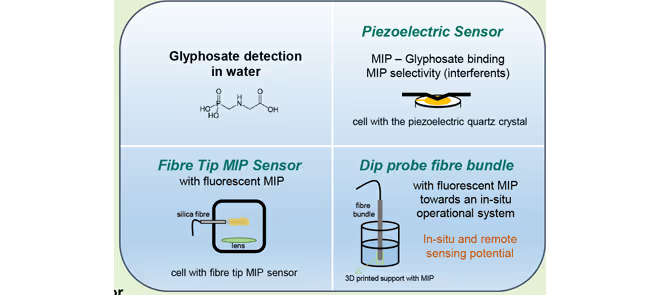
Glyphosate is a harmful herbicide often detected in soil and groundwater. The study demonstrates the proof of concept of a portable “sensing pen” for glyphosate detection using sensors with molecularly imprinted polymers (MIPs). MIPs are engineered to bind glyphosate to enhance detection accuracy. The sensors combine piezoelectric and fiber optic technologies to achieve high sensitivity and specificity. These sensors can rapidly detect glyphosate, offering a cost-effective and reliable solution for environmental monitoring.
Smart and precise irrigation planning plays a crucial role in preventing excess water usage and waste. Various machine learning-based irrigation models have been proposed. However, the proposed models should consider unpredictable climate changes. The researchers propose an intelligent neural network model considering the historical temporal dynamics of soil and climate. The prototype efficiently predicts volumetric water demand one day in advance.
In recent years, Micro-processor controlled prosthetic legs (MPCPL) are being preferred over conventional prosthetics because they use actuators to replace missing joint function and hence are more functional. Due to this the user’s walking gait and metabolic energy consumption can be imitated very well. The state-of-the-art MPCPL takes commands from the brain through muscles motion, converts that into the user’s gait intention and performs the locomotive motion based on the kinetics sensory system’s input. Very soon the comfort of the motion control will be complimented by taking inputs of eyes and ears to ensure gait further safer.
A non-profit organization, IEEE is the world's largest technical professional organization dedicated to advancing technology for the benefit of humanity.
Copyright 2023 IEEE – All rights reserved. Use of this website signifies your agreement to the IEEE Terms and Conditions
This site is also available on your smartphone.