Get exclusive breakthroughs on sensors in IoT, energy, healthcare, and more, delivered straight to your inbox.
"IEEE Sensors Alert" is a pilot project of the IEEE Sensors Council. Started as one of its new initiatives, this weekly digest publishes teasers and condensed versions of our journal papers in layperson's language.
Articles Posted in the Month (February 2025)
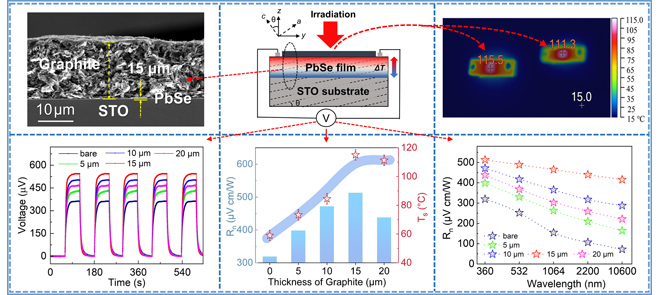
Enhancing the Detection Sensitivity of PbSe Thin Film TTE Photodetector by Adding Light-Trapping Coatings
Published in: IEEE Sensors Journal (Volume: 24, Issue: 18, September 2024)
Summary Contributed by: Saurabh Dubey
A breakthrough in PbSe thin-film transverse thermoelectric (TTE) photodetectors enhances sensitivity by adding 15-µm graphite coatings with light-trapping structures. This innovation improves photothermal conversion and sensitive light absorption, achieving a detection sensitivity of 415 µV cm/W, five times higher than traditional uncoated films. The increased efficiency positions this sensor as an advanced self-powered, ultrabroadband photodetector with future thermal sensor applications across various fields, ranging from ultraviolet to far-infrared wavelengths.
A Novel Plasmonic Nanoantenna-Based Sensor for Illicit Materials and Drugs Detection
Author: Marco Scalici, Patrizia Livreri
Published in: IEEE Sensors Journal (Volume: 24, Issue: 17, September 2024)
Summary Contributed by: Patrizia Livreri (Author)
The advancements in terahertz(THz) radiation have opened avenues for potential applications in the security and defense sectors. This paper introduces novel plasmonic nanoantennas-based sensors for detecting illicit materials and drugs through terahertz (THz) spectroscopy. Two innovative designs, the butterfly and shamrock nanoantennas, offer high sensitivity across specific THz frequencies. Their combined performance enables accurate, non-destructive molecular identification, providing an advanced tool for security, biomedical, and environmental applications.
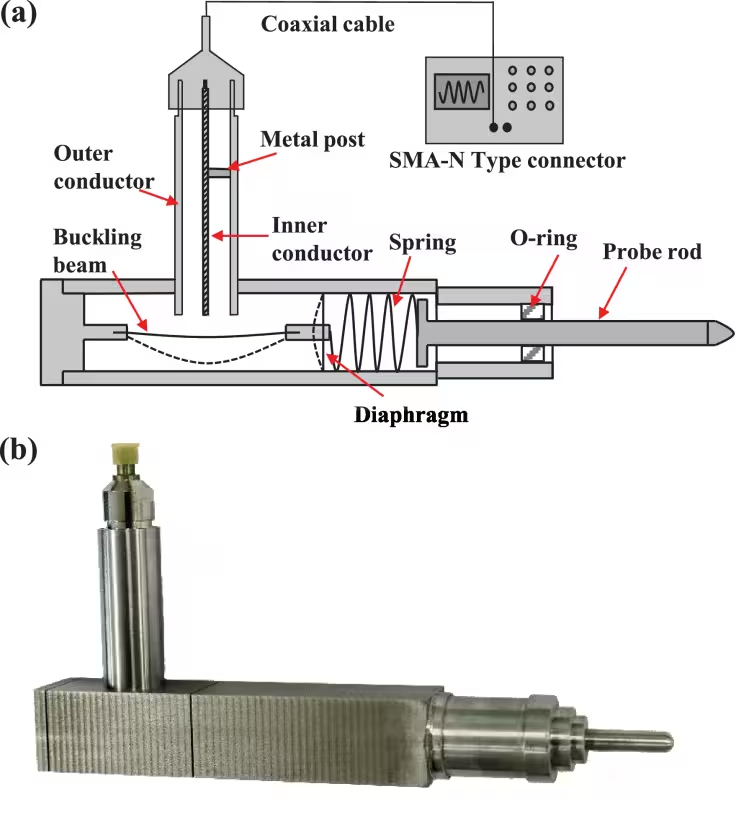
Displacement Sensitivity and Range Enhancement Through Buckled Beam-Assisted OE-HCCR
Author: Qi Zhang, Yizheng Chen, Zhuo Li, Yan Tang, Yun Liang, Yi Huang, Xiaobei Zhang
Published in: IEEE Sensors Journal (Volume: 24, Issue: 18, September 2024)
Summary Contributed by: Kamalesh Tripathy
Displacement measurement sensitivity has broad industrial, scientific and construction applications. The paper proposes an ultrasensitive and wide-range displacement sensor using an open-ended hollow coaxial cable resonator (OE-HCCR) assisted by a buckled beam. The integration of buckled beams enhances sensitivity and extends the measurement range. The sensor demonstrates significant improvements in signal-to-noise ratio and accuracy. The developed system will contribute to advancing micro-scale and nano-scale displacement technology.
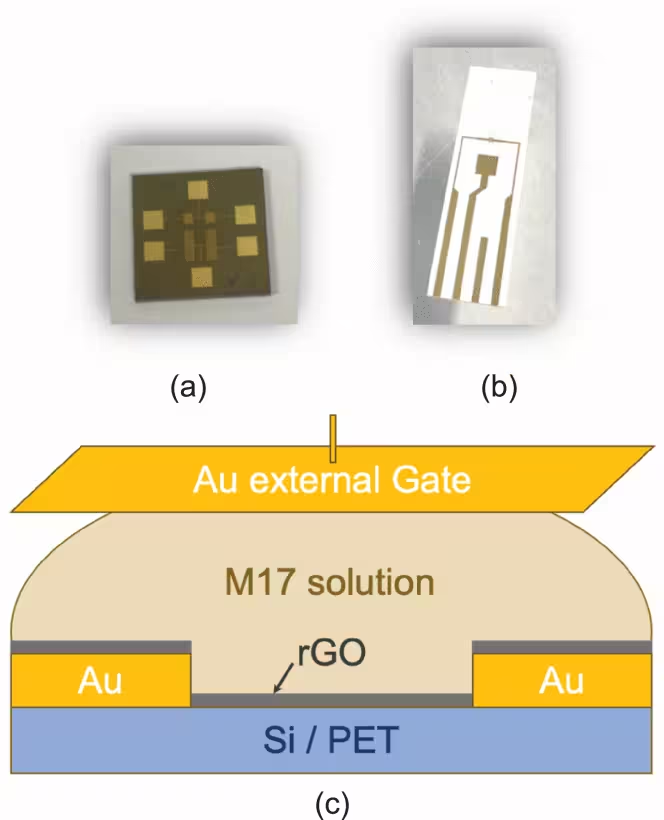
Monitoring of Lactococcus Lactis Growth Based on Reduced-Graphene Oxide TFT for Dairy Industry Applications
Author: L. Franchin, S. Casalini, A. Cester; A. Paccagnella, S. Bonaldo
Published in: IEEE Sensors Journal (Volume: 24, Issue: 17, September 2024)
Summary Contributed by: Franchin Lara (Author)
The biological activity of Lactococcus lactis (L. lactis) affects milk fermentation. This paper explores reduced-graphene oxide thin-film (rGO-TFT) to develop an effective biosensor, based on the field-effect transistor, for monitoring bacteria proliferation in dairy plants. This biosensor offers a real-time, highly sensitive, reliable, and non-invasive method to assess fermentation processes by detecting changes in electrical properties as bacterial populations grow, thus enabling precise bacterial growth monitoring in the dairy industry.
Deep Neural Network-Assisted Terahertz Metasurface Sensors for the Detection of Lung Cancer Biomarkers
Author: Hu Fangrong, Su An, Yang Mo, Chen Jie, Lin Shangjun, Ma Xiaoya
Published in: IEEE Sensors Journal (Volume: 24, Issue: 10, May 2024)
Summary Contributed by: Saurabh Dubey
Terahertz (THz) metasurface sensing technology, combined with deep neural networks (DNNs), offers an innovative method for detecting lung cancer biomarkers, including miRNA-21, miRNA-92a, and miRNA-339-3p. This integrated system achieved a classification accuracy of 97.22% for miRNA-21, showcasing its effectiveness as a low-energy, label-free solution for early cancer detection. It demonstrates significant advantages over traditional methods for real-time clinical applications, facilitating rapid diagnosis and monitoring of lung cancer.
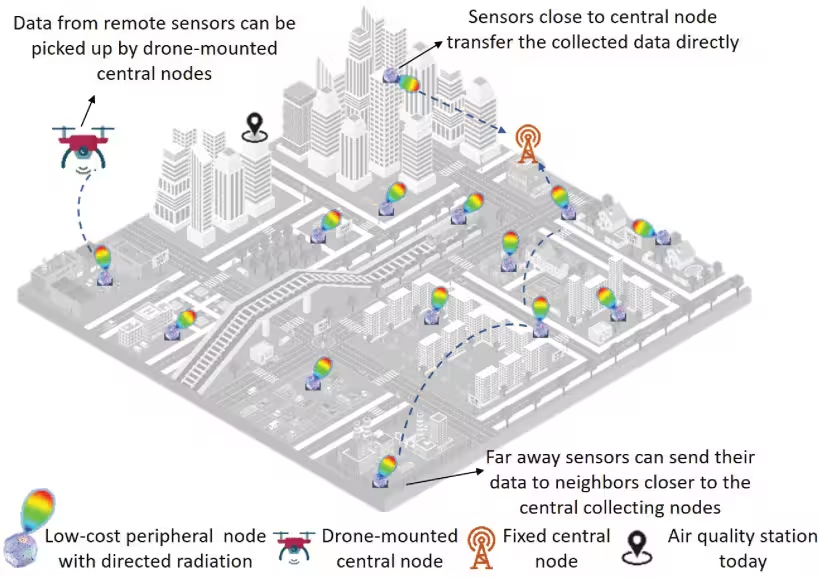
Self-Powered and Cost-Effective Wireless Sensor Node for Air Quality Monitoring With an Optically Transparent Smart Antenna System
Author: Maria Bermudez Arboleda, Atif Shamim
Published in: IEEE Sensors Journal (Volume: 24, Issue: 18, September 2024)
Summary Contributed by: Maria Bermudez Arboleda (Author)
Air quality monitoring is crucial for the environment and public health. However, traditional air quality monitoring systems are bulky, costly, and challenging to install. To overcome these shortcomings, this study introduces a compact, self-powered sensor node with optically transparent, reconfigurable antennas and modular solar panels. Its innovative design enables 80% size reduction. Equipped with comprehensive pollutant detectors, easy deployment of these cost-effective sensors enables high-resolution monitoring, previously unattainable with traditional systems.
Design and Output Voltage Model of Folding Magnetized Electronic Skin for Intelligent Manipulator
Author: Guoheng Lin, Ling Weng; Hui Zhang, Yang Liu, Yuxin Chen, Zhuolin Li
Published in: EEE Sensors Journal (Volume: 24, Issue: 18, September 2024)
Summary Contributed by: Payal Savani
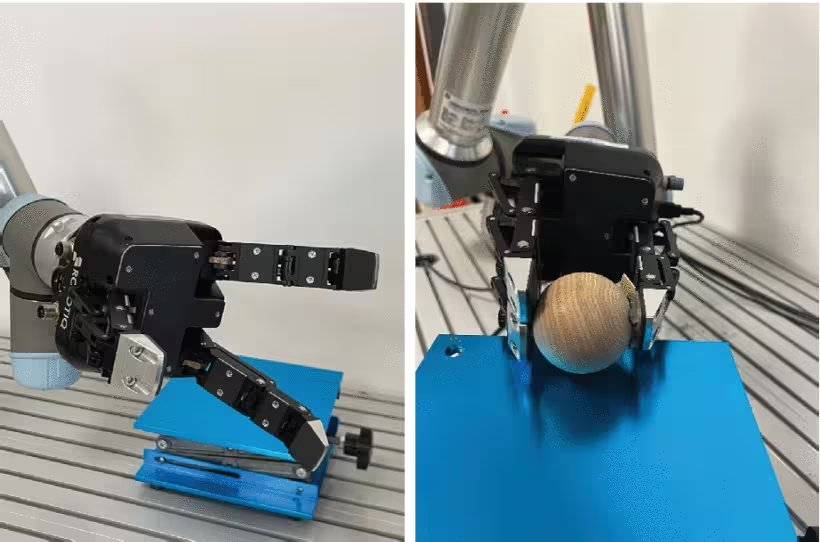
Flexible electronic skin (e-skin) broadens the application of tactile sensing and flexible sensor technology. The paper presents the design and modeling of a folding magnetized electronic skin with advanced multilayer designs and mathematical modeling for intelligent manipulators. It also combines flexible electronics and magnetic sensing for enhanced flexibility and precision. This e-skin boosts robotics performance in complex tasks requiring precise object handling and interaction by providing tactile and spatial awareness.
A Self-Calibration Method for Engineering Using 3-D Laser Scanning System Based on Cube Vertices
Author: Hongqiang Chen, Ruiheng Xia, Yi Zhang, Hua Deng, Kejun Li
Published in: IEEE Sensors Journal (Volume: 24, Issue: 3, February 2024)
Summary Contributed by: Yi Zhang (Author)
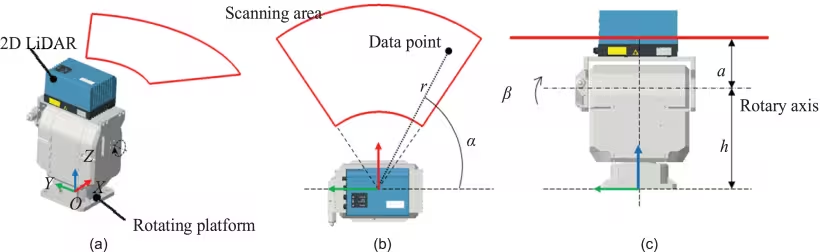
To meet the rapid calibration needs of engineering sites, a novel self-calibration technique is proposed for 3D scanners using 2D light detection and ranging (LiDAR) and a rotating platform. The calibration process uses a cube of known size as the calibration object, ensuring a straightforward process with no additional equipment. This approach addresses the limitations of shape-based calibration, enabling efficient on-site calibration and accurate measurements for most engineering applications.
A Multi-Sensor Tactile System Based on Fiber Bragg Grating Sensors for Soft Tissue Palpation
Author: M. Pulcinelli, L. Zoboli, F. De Tommasi, C. Massaroni, V. Altomare, A. Grasso, A. Gizzi, E. Schena, D. Lo Presti
Published in: IEEE Sensors Journal (Volume: 24, Issue: 16, August 2024)
Summary Contributed by: Saurabh Dubey
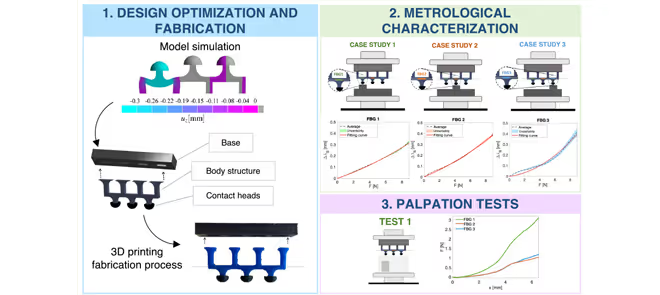
Diagnostic tissue palpitation is a common clinical practice to detect soft tissue tumors. This paper presents an innovative multi-sensor tactile system based on Fiber Bragg Grating sensors for non-invasive soft tissue palpation. It improves diagnostic accuracy with enhanced spatial resolution, reduced probe size, and minimized crosstalk errors. The simple and non-invasive tool is effective for soft tissue cancer and tumor detection, with the future potential for automated detection.
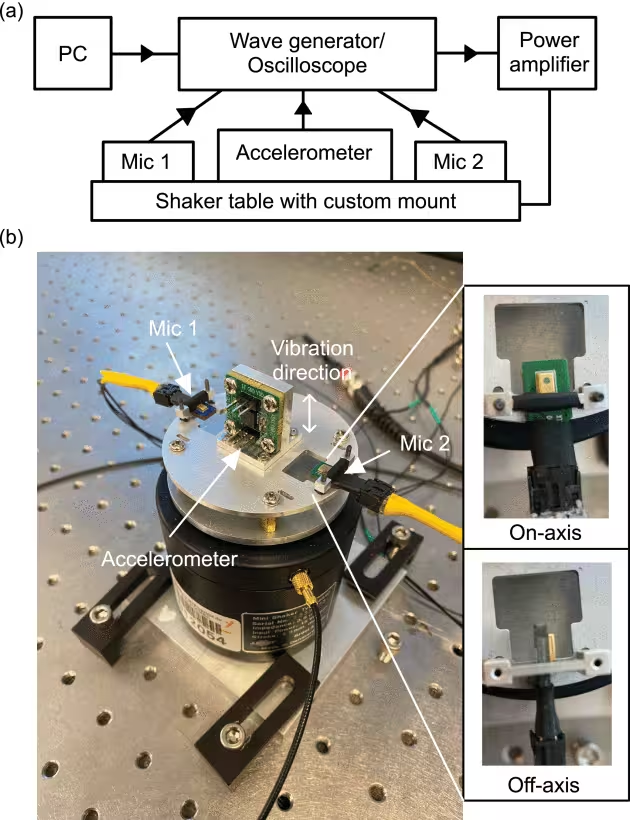
Two-port MEMS (Micro-Electro-Mechanical Systems) microphones offer better directional sensitivity than one-port designs but may be more affected by vibrations. The paper presents a simple universal expression for the vibration sensitivity of two-port MEMS microphones. It analytically and experimentally demonstrates that the vibration sensitivity of two-port MEMS mics is independent of their natural frequency (i.e., their stiffness) and is inversely proportional to frequency. Experimental results confirm these findings across various microphone designs.
Hand gesture recognition has become an integral part of Human-Computer Interactions. The paper introduces a methodology using a video-based dataset and convolutional neural network (CNN) model. It utilizes an RGB-Depth camera to create a dataset of six distinct hand gestures. A lightweight CNN model is then developed to detect and classify hand movements. The experimental results highlight its accuracy and efficiency, facilitating its practical use in scenarios demanding precise gesture recognition.
Time of Flight (ToF) camera sensor has emerged as a promising technology. Depth intensity pixel associated higher frame rate images, lightweight, compact design, and reduced power consumption and errors in the output have built great potential for ToF imaging in various domains. Despite its limitations like low resolutions and high noise, the ToF cameras are extensively used in computer graphics, machine vision, and robotics.
A non-profit organization, IEEE is the world's largest technical professional organization dedicated to advancing technology for the benefit of humanity.
Copyright 2023 IEEE – All rights reserved. Use of this website signifies your agreement to the IEEE Terms and Conditions
This site is also available on your smartphone.