Get exclusive breakthroughs on sensors in IoT, energy, healthcare, and more, delivered straight to your inbox.
"IEEE Sensors Alert" is a pilot project of the IEEE Sensors Council. Started as one of its new initiatives, this weekly digest publishes teasers and condensed versions of our journal papers in layperson's language.
Articles Posted in the Month (January 2025)
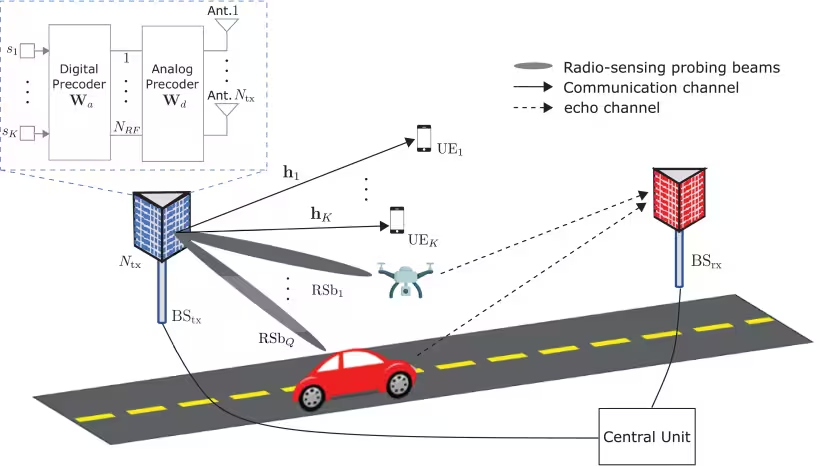
Hybrid Beamforming Design for Communication-Centric ISAC
Published in: IEEE Sensors Journal (Volume: 24, Issue: 13, July 2024)
Summary Contributed by: Anupama
An integrated sensing and communication (ISAC) system combines communication and radar sensing functions to optimize resource utilization. This paper has developed a hybrid analog-digital beamforming method for multi-user, multi-beam ISAC scenarios. The approach prioritizes communication performance through iterative optimization of digital and analog precoders while ensuring effective radar sensing. The proposed algorithm enhances cost, power and spectrum efficiency, and performance, making it ideal for next-generation communication systems.
The increasing threat of harmful algal blooms necessitates affordable and accessible water quality monitoring. This research presents a low-cost, portable, Internet of Thing (IoT)-enabled fluorometer-nephelometer for measuring key water quality parameters. This open-source, customizable system can be adapted to various applications, from single-point measurements to distributed networks. By adjusting sensitivity and adding components, it can monitor diverse aquatic environments, aiding in the research and management of marine ecosystems.
YOLOX-SAR: High-Precision Object Detection System Based on Visible and Infrared Sensors for SAR Remote Sensing
Author: Qiang Guo, Jianing Liu, Mykola Kaliuzhnyi
Published in: IEEE Sensors Journal (Volume: 22, Issue: 17, September 2022)
Summary Contributed by: Saurabh Dubey
Object detection using Synthetic Aperture Radar (SAR) sensors is significant in artificial intelligence, signal processing, radar imaging, and image processing. However, complex electromagnetic scattering backgrounds create challenges in accurate detection. The paper proposes the state-of-the-art YOLOX-SAR system, built upon the YOLOX architecture with advanced features and techniques for precise SAR image object detection. Incorporating technological advancements such as Meta-ACON and CBAM promises improved accuracy and robustness of SAR image object detection.
Published in: IEEE Sensors Journal (Volume: 24, Issue: 17, September 2024)
Summary Contributed by: Weileun Fang (Author)
The pandemic created the demand for a suitable alternative to lab tests to quickly detect antibodies with high precision. This paper presents a fast, sensitive, and accurate new system to detect COVID-19 neutralizing antibodies using optical spectroscopy and hybrid machine learning. The method evaluates immunity by detecting antibodies that block virus-receptor interactions, thus effectively monitoring vaccine efficacy and immune responses. Its high accuracy and scalability make it suitable for diagnostic and research applications.
Machine Learning-Based Network Vulnerability Analysis of Industrial Internet of Things
Author: Maede Zolanvari, Marcio A. Teixeira, Lav Gupta, Khaled M. Khan, Raj Jain
Published in: IEEE Internet of Things Journal (Volume: 6, Issue: 4, August 2019)
Summary Contributed by: Anupama
A cyberattack on the Industrial Internet of Things (IIoT) could have devastating consequences. The researchers have conducted a detailed assessment of existing IIoT protocols for cyber vulnerability. The case study demonstrates the effectiveness of the proposed machine learning (ML)-based intrusion detection system (IDS) against cyberattacks. An in-house developed testbed simulated real-world IIoT scenarios and potential cyberattacks to evaluate the performance of the proposed ML-based system.
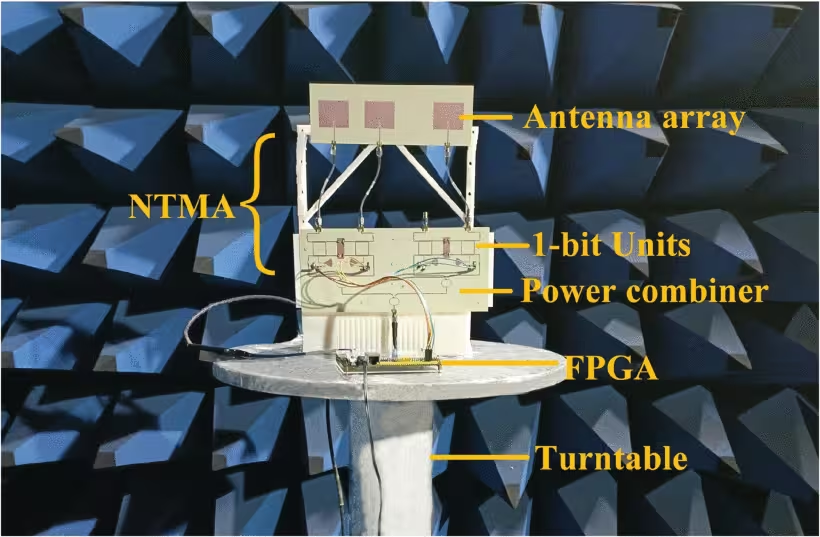
Single-Channel DoA Estimation Based on Nonuniform Time-Modulated Array With Asynchronous Sampling
Author: Li Long, Han Jiaqi, Liu Gong-Xu, Mu Yajie, Shi Yan, Wang Xin, Xia Dexiao
Published in: IEEE Sensors Journal (Volume: 24, Issue: 14, July 2024)
Summary Contributed by: Long Li (Author)
Direction-of-arrival (DoA) is essential for accurate target positioning and is important in wireless communication, radar detection, satellite navigation, etc. This paper introduces a single-channel direction-of-arrival (DoA) estimation method using a nonuniform time-modulated array (NTMA) with asynchronous sampling. The technique reduces hardware complexity and improves estimation accuracy using a single-channel receiver and an optimized modulation scheme. The results demonstrate the system's effectiveness, especially in applications with limited resources and where synchronous sampling is challenging.
Published in: IEEE Sensors Journal (Volume: 22, Issue: 14, July 2022)
Summary Contributed by: Payal Savani
Rice, a Global staple, is often plagued by various diseases that impact crop production. The challenge of identifying these diseases exacerbates the issue. While deep learning is a powerful tool in image processing and computer vision, its application in plant disease recognition has been restricted. This paper introduces MobInc-Net, a lightweight Inception network that recognizes and detects rice plant diseases. It offers a practical solution that achieves high accuracy even in challenging conditions.
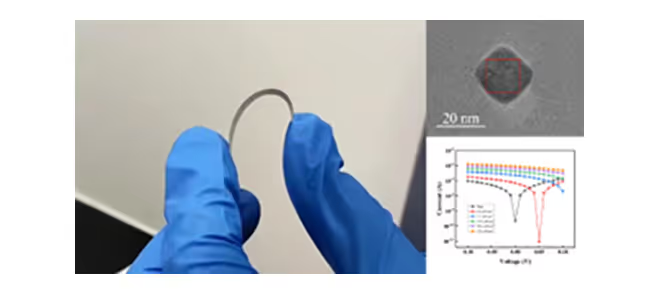
Self-Driven Photodetectors Based on Flexible Silicon Nanowires Array Surface-Passivated With Tin-Based Perovskites
Author: Yang Shengyi, Ge Zhenhua, Jiang Yurong, Wang Ying, Xin Haiyuan, Zhang Zhenheng, Zou Bingsuo
Published in: IEEE Sensors Journal (Volume: 24, Issue: 14, July 2024)
Summary Contributed by: Shengyi Yang (Author)
Silicon nanowire (Si-NW) photodetectors show great potential as efficient, self-driven, and compact devices in optoelectronic applications. However, their intrinsic surface defects reduce their responsivity and specific detectivity, limiting their performance. This paper introduces a novel self-driven photodetector based on flexible silicon nanowires array surface passivated with tin-based perovskites (FASnBr₃). The innovative design significantly enhances device performance and flexibility, making it a promising candidate for next-generation photodetectors.
Published in: IEEE Sensors Journal (Volume: 23, Issue: 3, February 2023)
Summary Contributed by: Saurabh Dubey
Anomalies between trains and platform doors threaten intercity railway safety. The paper proposes a method for anomaly detection using train predeparture key frame extraction and an Image-inpainting Anomaly Detection Network (IADN) based on image-inpainting autoencoder (AE) and local abnormal information enhancement and global-attentive reconstruction error (GARE). The tested results show effective and accurate anomaly detection, even outperforming state-of-the-art methods, ensuring safety with potential applications in security and locomotive industries.
Published in: IEEE Sensors Journal (Volume: 24, Issue: 15, August 2024)
Summary Contributed by: Nhien-An Le-Khac (Author)
Human activity recognition (HAR) using multiple sensors offers higher accuracy but raises privacy and convenience issues, while single sensors often lack detail and accuracy. The paper proposes Virtual Fusion with Contrastive Learning (VFCL), a novel framework for single-sensor-based activity recognition. Virtual fusion uses data from multiple sensors across different modalities for training but requires only one for predictions, while contrastive learning improves the accuracy and performance of each sensor independently.
Human Activity Recognition (HAR) is a field that recognizes human activities from raw time-series signals acquired through embedded sensors of smartphones and wearable devices among others. Deep learning networks modeled after neural network of human brain are widely used in HAR system to retrieve and classify distinct activities. AT present they can accurately recognize simple human activities which make them very useful in Smartphone HAR systems.
GPS-based navigation, widely used worldwide, is cost-effective for providing position, velocity, and time data. However, it is susceptible to spoofing, especially in UAVs (unmanned aerial vehicles). The paper proposes a GPS spoofing detection and mitigation method using distributed radar tracking and data fusion techniques. The approach combines primary and secondary data through extended Kalman filters and track-to-track association. It ensures accuracy even during spoofing attacks, making it ideal for drone swarms.
A non-profit organization, IEEE is the world's largest technical professional organization dedicated to advancing technology for the benefit of humanity.
Copyright 2023 IEEE – All rights reserved. Use of this website signifies your agreement to the IEEE Terms and Conditions
This site is also available on your smartphone.