Get exclusive breakthroughs on sensors in IoT, energy, healthcare, and more, delivered straight to your inbox.
"IEEE Sensors Alert" is a pilot project of the IEEE Sensors Council. Started as one of its new initiatives, this weekly digest publishes teasers and condensed versions of our journal papers in layperson's language.
Articles Posted in the Month (November 2025)
Unobtrusive Multimodal Monitoring of Physiological Signals for Driver State Analysis
Author: Amidei Andrea, Pavan Paolo, Rabbeni Roberto, Tagliavini Giuseppe
Published in: IEEE Sensors Journal (Volume: 25, Issue: 5, March 2025)
Summary Contributed by: Andrea Amidei (Author)
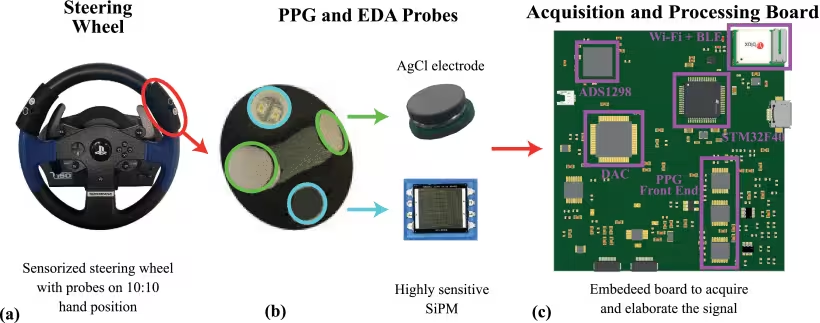
Driver distractions, stress, and fatigue are leading causes of accidents. This study introduces ANGELS v2, an enhanced smart steering wheel system that processes electrodermal activity (EDA) and photoplethysmography (PPG) signals by capturing signals such as heart rate, respiration, and skin response to assess the driver's physiological states in real time. Integrated into the vehicle's steering wheel for unobtrusive multimodal sensing, ANGELS v2 showed near-clinical accuracy in a high-fidelity simulator study.
Investigation on Substrate Material for a Sensitive Flexible Piezoresistive Pressure Sensor
Author: Gupta Navneet, Neeraj Neeraj
Published in: IEEE Sensors Journal (Volume: 25, Issue: 7, April 2025)
Summary Contributed by: Saurabh Dubey
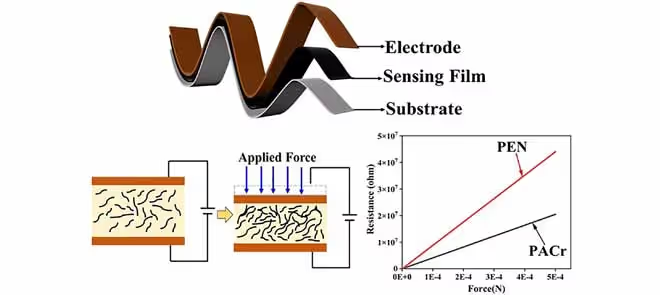
Flexible piezoresistive pressure sensors (FPPS) are revolutionizing wearable electronics, soft robotics, and healthcare monitoring. This study identifies polyethylene naphthalate (PEN) as the optimal substrate, offering superior thermal stability, flexibility, and chemical resistance. Validated through simulations, PEN-based FPPS achieved high sensitivity, superior charge transport, and improved mechanical stability than traditional alternatives. By combining multi-criteria material ranking with simulation, this research leads to the development of the next-generation wearable sensors and energy-harvesting devices.
Published in: IEEE Sensors Journal (Volume: 25, Issue: 7, April 2025)
Summary Contributed by: Roger Hasler (Author)
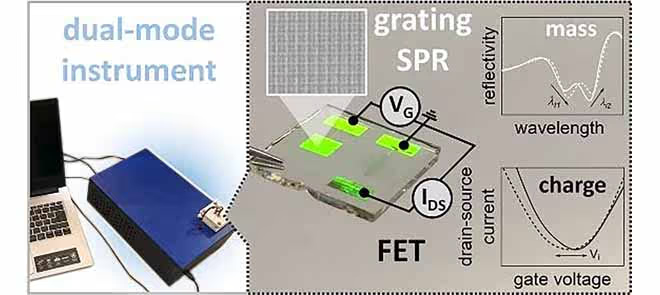
Understanding biomolecular interactions at the solid-liquid interface is key to biotechnology innovations. This study describes the development of a multimodal sensor that integrates optical and electronic readout principles on a single chip, enabling simultaneous monitoring of surface mass and charge density variations associated with (bio)interactions. Combining grating-coupled surface plasmon resonance (SPR) with coplanar-gated field-effect transistors (FET), this scalable, portable platform offers high-precision, dual-mode analysis of complex bio-interfaces for next-generation diagnostics.
Low Latency Visual Inertial Odometry With On-Sensor Accelerated Optical Flow for Resource-Constrained UAVs
Author: Kuhne Jonas, Benini Luca, Magno Michele
Published in: IEEE Sensors Journal (Volume: 25, Issue: 5, March 2025)
Summary Contributed by: Jonas Kühne (Author)
Visual-inertial odometry (VIO) is increasingly used for autonomous navigation in unmanned aerial vehicles (UAVs). This study introduces a low-latency VIO system that integrates an on-camera optical flow accelerator with an existing state-of-the-art VIO pipeline. Offloading motion tracking to the sensor itself significantly reduces computational load (53.7%), energy consumption (14.24%), and latency (49.4%). This approach maintains, and in some cases even improves, tracking accuracy, making it ideal for resource-constrained UAVs.
Published in: IEEE Sensors Journal (Volume: 25, Issue: 6, March 2025)
Summary Contributed by: Payal Savani
Sensors are the silent sentinels of technology, translating invisible changes into meaningful data. Among them, pH sensors are vital for monitoring hydrogen ion concentration in biomedical and environmental fields. The study explores a high-performance Extended-Gate Field-Effect Transistor (EGFET) based pH sensor, developed by modifying zinc oxide with phosphorene. It has boosted sensitivity from 51.0 to 62.5 mV/pH and lowered the drift rate from 1.428 to 0.714 mV/h.
Published in: IEEE Sensors Journal (Volume: 25, Issue: 5, March 2025)
Summary Contributed by: Gianluca Barile (Author)
The ease of fabrication and versatile use make capacitive sensors a popular choice. This work introduces a fully differential analogue read-out circuit for differential capacitive sensors, featuring an auto-balancing bridge with voltage-controlled capacitors (VCCs) and integral negative feedback. The interface achieved 102 mV/pF sensitivity, and a linearity error of 0.47%, with 8–11 ms dynamic response times. The design enhances sensitivity and linearity, reduces parasitic effects, and demonstrates strong potential for precision sensing.
The Implementation of Single VCII-Based RC Sinusoidal Oscillators: 28 Novel Configurations
Author: Barile Gianluca, Scarsella Massimo
Published in: IEEE Sensors Journal (Volume: 25, Issue: 5, March 2025)
Summary Contributed by: Gianluca Barile (Author)
The design of sinusoidal oscillators is a challenging research area. This work presents 28 novel, energy-efficient RC (Resistor-Capacitor) sinusoidal oscillators based on a single second-generation voltage conveyor (VCII). These designs significantly reduce component count compared to traditional operational amplifier circuits and operate in current-mode, enabling low power consumption without requiring an additional voltage output buffer. Experimental validation confirmed 16 configurations operating as expected, highlighting their potential for advanced sensor interfacing applications.
Design and Optimization of a Highly Sensitive Surface Plasmon Resonance Biosensor for Accurate Detection of Mycobacterium tuberculosis
Author: Mahmud Russel Reza, Barua Bobby, Islam M. Shariful, Mondal Tanu Prava, Rafi Shah Ali
Published in: IEEE Sensors Journal (Volume: 25, Issue: 6, March 2025)
Summary Contributed by: Russel Reza Mahmud (Author)
Surface Plasmon Resonance (SPR) has transformed medical diagnostics. This paper presents a highly sensitive SPR biosensor developed for the accurate detection of tuberculosis (TB) causing bacteria, Mycobacterium tuberculosis. By leveraging a novel hybrid structure incorporating black phosphorus and optimized material layers, the sensor achieved remarkable angular sensitivity, enabling rapid, label-free diagnosis with high precision. It can detect even trace amounts of bacteria, providing a powerful tool for faster and accurate TB screening.
Enhancement of Target Localization Based on Angle-of-Arrival Measurement via Quantum Sensor Networks
Author: Chai Hongzhou, Hui Jun
Published in: IEEE Sensors Journal (Volume: 25, Issue: 6, March 2025)
Summary Contributed by: Hongzhou Chai (Author)
With the advancement of quantum information technology, integrating quantum resources, such as entangled photons into traditional measurement fields can improve parameter estimation accuracy. This study introduces a novel quantum-enhanced angle-of-arrival (AoA) estimation method for evaluating the performance of a quantum sensing localization system. The work contributes to realizing quantum navigation and localization with drastically improved integrated accuracy, thereby refining its applications in radar, navigation, wireless communication, and target localization.
Published in: IEEE Sensors Journal (Volume: 25, Issue: 5, March 2025)
Summary Contributed by: Simone Benatti (Author)
Accurate hand motion modeling is important for intuitive human–machine interaction (HMI). This paper introduces an event-based high-density surface electromyography encoding method for multifinger force estimation, optimized for real-time, low-power microcontroller applications. Evaluated on the High-densitY Surface Electromyogram Recording (HYSER) dataset in realistic multiday settings, it showed competitive accuracy. With energy consumption under 6.5 μJ per sample and latency below 280 μs, it enables efficient, real-time regression for future wearable HMI applications.
The emerging application of consumer grade EEG measuring sensors and advancement in technology, which had made it portable and affordable, has made it accessible in the general market. EEG devices now have a broader use other than medicine. The researchers, educationists, game developers, engineers, and psychiatrists are enthusiastic about the consumer grade EEG device, which has made the study of the brain accessible and its application quite convenient.
The design of a flexible tactile sensor using liquid metal (LM) and elastic fibers provides sensing capability and enhances the performance of a hand prosthesis. This study details the measurement principles of the LM-based force sensor, the design and fabrication process, and the sensor signal processing circuit. The proposed flexible tactile sensor offers reliable performance with high sensitivity in three axes, low error, and improved functionality in hand prostheses.
A non-profit organization, IEEE is the world's largest technical professional organization dedicated to advancing technology for the benefit of humanity.
Copyright 2023 IEEE – All rights reserved. Use of this website signifies your agreement to the IEEE Terms and Conditions
This site is also available on your smartphone.