



Unobtrusive Multimodal Monitoring of Physiological Signals for Driver State Analysis
Driver inattention and drowsiness remain the leading causes of road accidents, presenting an ongoing challenge to traffic safety. While modern vehicles feature advanced driver-assistance systems (ADAS) such as lane departure warnings, collision avoidance, and adaptive cruise control, accurately assessing a driver’s state remains difficult.
Current monitoring solutions typically rely on behavioural indicators like eye movements or steering patterns, which, although unobtrusive, are highly susceptible to external factors such as poor lighting and visual obstructions. A more proactive and reliable approach involves physiological monitoring, particularly through signals linked to the autonomic nervous system (ANS), enabling early detection of fatigue and stress before they impair driving performance.
Photoplethysmography (PPG) and electrodermal activity (EDA) may provide practical solutions, both of which can be monitored through sensors integrated into the steering wheel. PPG measures heart rate through blood volume changes, and EDA reflects skin conductivity. However, signal quality may be affected by factors such as hand movement and contact pressure, which cannot be corrected using inertial measurement units.
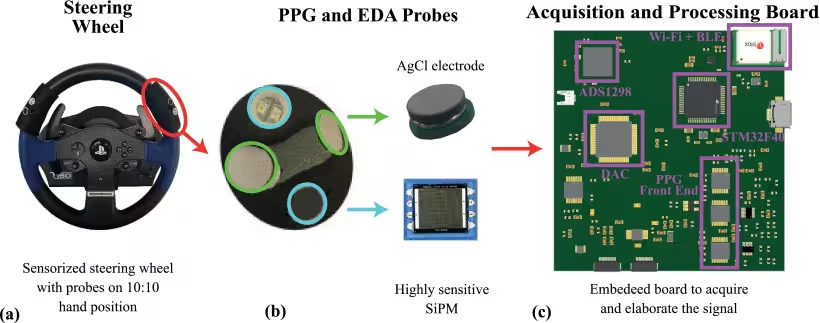
This paper presents a new version of smArt steeriNG wheel for driver Safety (ANGELS), which is an enhanced, low-power embedded system for continuous, unobtrusive driver state monitoring via simultaneous PPG and EDA sensing and processing. Building on the original ANGELS platform, version 2 integrates a second EDA sensor and novel signal-processing algorithms to detect heart rate and skin conductance response peaks in real time, without the need for accelerometer data to filter out motion artifacts.
The hardware design embeds silicon photomultipliers paired with red and infrared light-emitting diodes alongside dry Ag/AgCl (silver/silver chloride) electrodes at the 10 and 2 o’clock hand positions on a custom leather cover. Signals are digitized by a multichannel analogue-to-digital converter and processed on-board by a microcontroller.
Three validation studies, encompassing 150 minutes of data, confirm the robust performance and reliability of ANGELS v2. In a fingertip comparison, signals recorded by ANGELS correlated strongly (correlation coefficient = 0.84) with a medical-grade reference during induced skin conductance responses.
In a high-fidelity driving simulator with twelve participants, ANGELS v2 achieved a mean absolute error of just 1.19 beats per minute for heart-rate detection. EDA peak counts closely matched reference measurements, with a mean absolute error of 1.9 peaks per minute when drivers held the instrumented wheel.
During controlled artifact tests with deliberate hand movements, the system’s rolling standard deviation filter and adaptive Pan-Tompkins-inspired thresholding achieved 92.0% accuracy in rejecting unusable windows, with 91.9% sensitivity and 85.0% positive predictive value. Processing latency averaged 69.8 ms per 10-second segment, while on-board computation consumed only 4.6 mJ, validating real-time performance. By integrating PPG and EDA sensing with robust artifact mitigation, ANGELS v2 delivers clinical-grade physiological metrics without relying on intrusive sensors or inertial data.
Its cost-effective components and energy-efficient design support seamless integration into production vehicles, offering continuous, autonomous monitoring of driver physiological state to enhance safety and enable early detection of fatigue or stress.