



Bismuth Functionalized Inkjet-Printed Electrochemical Sensor for Aqueous Lead (II) Detection
Lead is a heavy metal that easily dissolves in water, making water toxic for human consumption and harmful for the environment. Its neurotoxic properties affect both the central nervous system (CNS) and the peripheral nervous system (PNS). Even a small amount can have severe neurological and cardiovascular effects and may cause severe health issues. In children, a trace amount of exposure can lead to significant developmental problems, including behavioral disorders, attention deficiencies, learning disabilities, and speech and hearing impairments.
Detecting lead contamination in drinking water is crucial for protecting public health and ensuring environmental safety. Conventional laboratory-based techniques such as atomic absorption spectroscopy and inductively coupled plasma mass spectrometry offer high accuracy. However, they are often expensive, time-consuming, and require specialized facilities and trained personnel. This creates a need for affordable, portable, and user-friendly solutions that can deliver reliable on-site measurements.
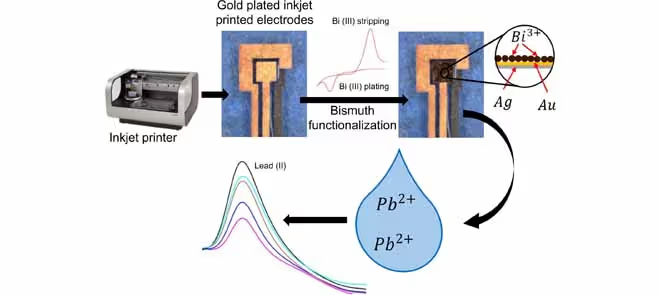
This work presents a novel bismuth-functionalized, inkjet-printed electrochemical sensor designed for rapid and ultra-sensitive detection of lead in aqueous environments. The device is fabricated using inkjet printing, an additive manufacturing technique that enables precise deposition of conductive inks on flexible substrates, allowing for scalable and cost-effective production.
The sensor features an inkjet-printed gold-plated electrode coated with a thin bismuth film deposited via under-potential deposition. This bismuth layer significantly enhances sensitivity by forming lead-bismuth alloys during detection, improving the stripping efficiency and signal-to-noise ratio for trace lead measurement.
Two strategies for bismuth incorporation were investigated and rigorously evaluated for performance, reproducibility, and stability. They were ex situ functionalization, where bismuth is deposited before measurement, and in situ functionalization, where bismuth is introduced during the electrochemical process.
Electrochemical detection is based on square wave anodic stripping voltammetry (SWASV), optimized alongside cyclic voltammetry (CV) to ensure high sensitivity and low detection limits. Using these techniques, the sensor demonstrated ultra-trace detection capabilities with limits of detection as low as 0.64 μg/dL (ex situ) and 1.09 μg/dL (in situ), exceeding several health and safety benchmarks recommended by the World Health Organization.
The sensor is fabricated on a shape memory polymer (SMP) substrate, which enables high sensitivity (due to its increased effective electrode surface area), durability, and seamless integration into compact, portable platforms. Its user-friendly workflow requires minimal sample preparation and delivers on-site results within minutes, making it suitable for deployment in schools, homes, industries, and field inspections. Moreover, the inkjet printing approach allows high-throughput, reproducible manufacturing with precise control over electrode geometry and surface area, ensuring consistent device performance.
This work demonstrates how combining additive manufacturing, bismuth-based functionalization, and electrochemical sensing can transform laboratory-grade detection techniques into affordable, portable, and high-performance tools. Real-time, point-of-use lead monitoring empowers communities, supports regulatory compliance, and advances environmental and public health management.
Beyond lead detection, this sensor platform is highly adaptable and can be readily modified to target other heavy metals and environmental contaminants by adjusting electrode surface chemistry or functionalization strategies. This flexibility makes this technology a versatile, scalable, and sustainable solution for environmental monitoring.