



The Dynamics of Flexural Ultrasonic Transducers With Nitinol Plates
The flexural ultrasonic transducer (FUT) is a class of piezoelectric sensor commonly found in car parking systems. They are cylindrical proximity sensors operating around 30-40 kHz, with commercial variants almost exclusively fabricated using aluminium. The FUT operates through the vibrations of a piezoelectric (lead zirconate titanate) ceramic disc bonded to the aluminium plate. These vibrations force the plate to bend in specific plate-mode shapes that resonate at ultrasonic frequencies.
FUTs are highly efficient, and very low voltages (under 10 V) are often sufficient to produce ultrasound fields strong enough to detect obstacles. This has made them useful for the automotive industry for car parking sensor systems. However, the main limitations to wider application (for example, in gas or liquid flow measurement) have been maintaining geometrical consistency and ensuring their resilience to elevated environmental temperatures, particularly above 30°C. These challenges make controlling FUT resonance extremely difficult.
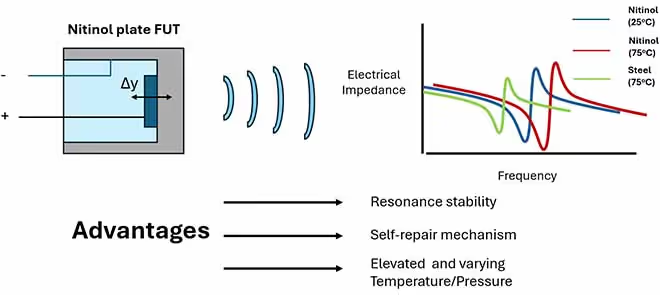
This research investigates the use of a shape memory alloy, Nitinol, to address these challenges. Nitinol is a binary alloy of nickel and titanium. FUT resonance is in part dependent on Young’s modulus, which is an inherent physical property of materials. Nitinol’s moduli can be readily controlled via temperature or stress. The hypothesis for this work was to investigate FUTs with tuneable resonance frequencies to overcome the key challenges of FUTs and enable their wider applications.
The researchers hypothesized that by using Nitinol, adaptive resonance frequency tuning would be possible, where the Young’s modulus of the material increases when Nitinol is heated, due to the transition of the material’s microstructure from more compliant martensitic to stiffer austenite. Nitinol also exhibits the shape memory effect, where deformations in the material’s structure can be recovered through heating. This would enable the potential for remote sensor repair in practical applications.
In this study, two Nitinol FUTs were created to showcase the resonance frequency responses and the ability to generate and detect ultrasound at different temperatures. Two Nitinol FUTs were fabricated with very close resonance frequencies, less than 1% difference across several vibration modes, demonstrating a viable manufacturing method.
One of the key experiments was to measure the resonance frequency as a function of temperature. A somewhat unexpected outcome was that the resonance frequencies remained generally stable up to 80°C, shifting less than 1%. This contrasts with some prior work, which shows a highly tuneable resonance frequency.
It has been hypothesised that there is a complex interplay between the physical stiffening of Nitinol and the influence of nonlinearities in the dynamic response of the FUT, which can arise from sources including excitation conditions, temperature, and the nature of the materials themselves, including piezoelectric. These factors will be further studied. The ability of deformed Nitinol integrated in an FUT to be remotely recovered was also demonstrated, showing the potential of remotely repairable FUTs with stable resonance frequency response at elevated environmental temperatures. These FUTs may feature in future fluid flow measurement systems.