Get exclusive breakthroughs on sensors in IoT, energy, healthcare, and more, delivered straight to your inbox.
"IEEE Sensors Alert" is a pilot project of the IEEE Sensors Council. Started as one of its new initiatives, this weekly digest publishes teasers and condensed versions of our journal papers in layperson's language.
Author: Yang Xh, Gao Shuai, Ge Zhongxuan., Jones Adam, Li Kang, Liu Zhihai, Ma Minghua., Sivanathan Sivagunalan, Teng Pingping, Tian Fengjun, Wang Shengjia, Wen Xingyue., Zhang Bo, Zhang Yang, Zhang Yu, Zhu Zheng
Published in: IEEE Sensors Journal (Volume: 25, Issue: 11, June 2025)
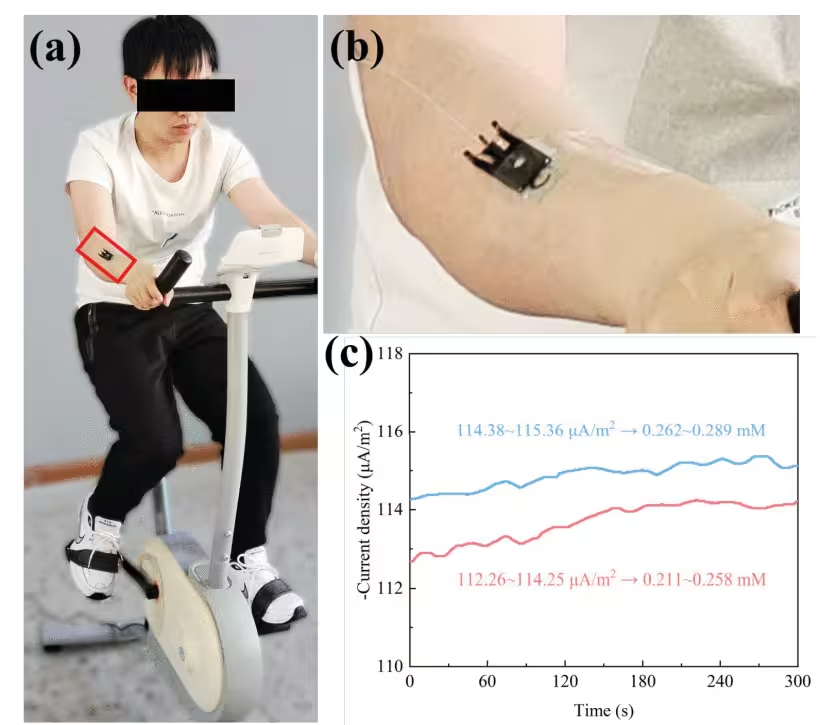
Diabetes management usually involves frequent checks of blood glucose levels. This study proposes an early prototype of a skin-friendly photoelectrochemical (PEC) sensing patch for noninvasive glucose monitoring. The patch uses a tiny optical fiber coated with specialized materials and an enzyme that reacts only with glucose. It delivers fast and accurate readings, even at very low glucose levels, making it a promising tool for painless, real-time health monitoring.
Design and Implementation of a System to Control Bioreceptor Layer Formation on Au Electrodes
Author: Przadka Marcin Paweł, Pala Katarzyna, Wojcieszak Damian
Published in: IEEE Sensors Journal (Volume: 25, Issue: 11, June 2025)
Summary Contributed by: Payal Savani
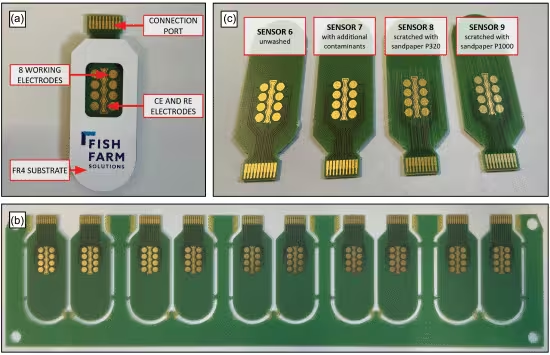
In electrochemical biosensors, electrodes convert biochemical reactions into accurate electrical signals. Their surface quality and preparation directly influence the sensor's accuracy. This study introduces an in-situ quality control system to monitor bioreceptor layer formation on gold electrodes in aquaculture biosensors. By integrating real-time measurements of the wetting angle and electrochemical impedance, the system detects defects early, ensures consistent electrode performance, improves reproducibility, and enables efficient, automated production of biosensors.
Published in: IEEE Sensors Journal (Volume: 25, Issue: 11, June 2025)
Summary Contributed by: Alessandra Fusco (Author)
Monitoring and tracking the breathing rate (BR) accurately is vital for healthcare applications. However, current contactless methods are often restrictive and face challenges in real-life scenarios. This study presents a deep learning approach that uses frequency-modulated continuous wave (FMCW) radar to estimate breathing rates across multiple ranges. The method achieves high accuracy with minimal memory requirements, making it suitable for reliable, accurate, and cost-effective monitoring in everyday environments.
Braille Recognition Based on a Dual-Mode Tactile Sensor With Piezoresistive and Piezoelectric Properties by the CNN-ResNet-BiLSTM Fusion Model
Author: Wang Feilu, Hu Anyang, Liu Mengru, Song Yang, Zhu Jinggen
Published in: IEEE Sensors Journal (Volume: 25, Issue: 9, May 2025)
Summary Contributed by: Saurabh Dubey
Braille is a tactile writing system to assist visually impaired individuals in reading and writing. This research presents a micropyramid-structured dual-mode tactile sensor that combines piezoresistive and piezoelectric properties to capture static and dynamic pressures for Braille Recognition. A CNN-ResNet-BiLSTM fusion model analyzes the sensor data and extracts spatiotemporal features to identify Braille characters accurately and improve tactile information processing. This compact, robust system enables reliable and real-time Braille recognition.
Highly Sensitive Enzyme-Modified Field Effect Transistor Based Biosensor for Sarcosine Detection
Author: Saikia Onishaa, Dutta Jiten Ch
Published in: IEEE Sensors Journal (Volume: 25, Issue: 12, June 2025)
Summary Contributed by: Onishaa Saikia (Author)
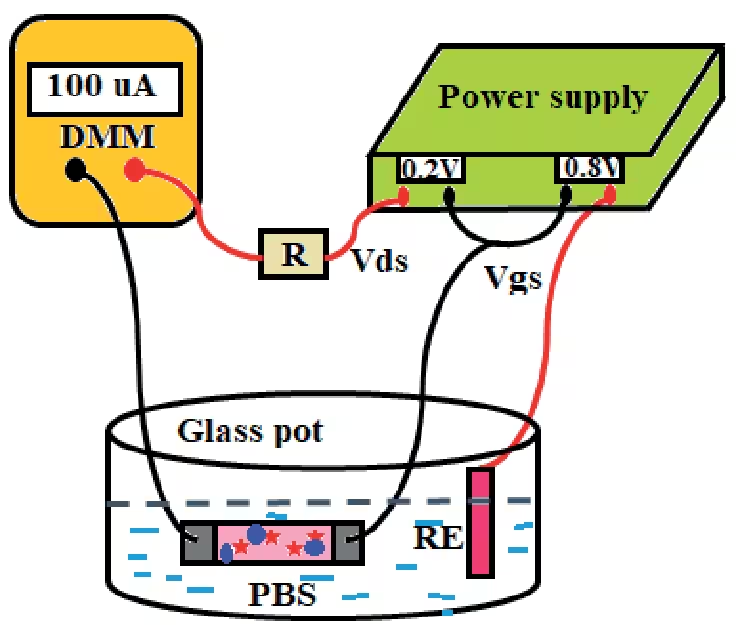
Precise measurement of very low concentrations of Sarcosine present in the human body is challenging. This study introduces an enzyme-modified field effect transistor based biosensor that integrates a nano-composite based enzyme supporting layer with a high-k dielectric CNT-ISFET. This biosensor achieves high sensitivity, a very low limit of detection, acceptable stability, along with good repeatability and reproducibility, making it ideal for detecting Sarcosine, a crucial biomarker for Prostate Cancer.
A Novel All-Solid-State Levocetirizine-Selective Potentiometric Microsensor
Author: Dere Nursen
Published in: EE Sensors Journal (Volume: 25, Issue: 11, June 2025)
Summary Contributed by: Payal Savani
Antihistamines like Levocetirizine (LEV) are globally used to treat allergies. Accurate pharmaceutical formulations and quality control are essential to ensure the effectiveness of drugs. This study presents a novel all-solid-state potentiometric microsensor that selectively detects Levocetirizine utilizing Levocetirizine-tetraphenylborate (LEV-TPB). This compact, low-cost microsensor shows low detection limits, a wide operating range, short response times, high accuracy, sensitivity, and selectivity, making it a reliable solution for the effective monitoring of Levocetirizine.
Bismuth Functionalized Inkjet-Printed Electrochemical Sensor for Aqueous Lead (II) Detection
Author: Arif Annatoma, Acevedo-Gonzalez Alexis J., Cabrera Carlos R., Roberts Robert Christopher
Published in: IEEE Sensors Journal (Volume: 25, Issue: 11, June 2025)
Summary Contributed by: Arif Annatoma (Author)
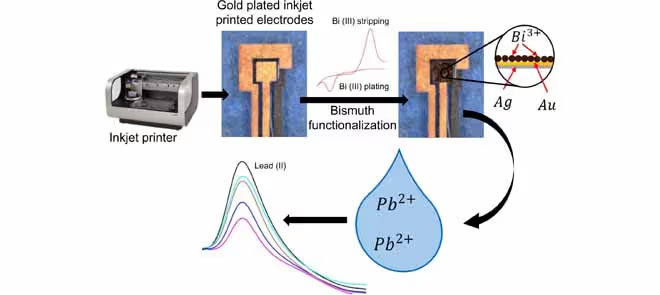
Routine monitoring of water quality includes testing it for lead contamination. The paper presents an innovative 3D bismuth-functionalized, inkjet-printed electrochemical sensor offering reliable and rapid detection of lead(II) in water. This affordable, reusable, flexible, and scalable sensor provides a portable solution with high sensitivity and selectivity, enabling communities and industries to protect public health, meet environmental compliance standards, and integrate advanced sensing technologies, thereby ensuring water safety in real-world applications.
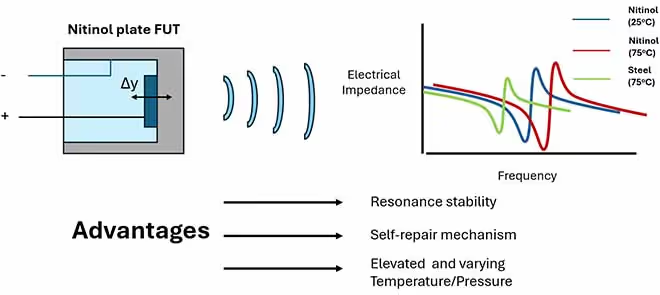
The Dynamics of Flexural Ultrasonic Transducers With Nitinol Plates
Author: Hamilton Alexander, Adams Sam, Chambers John, Feeney Andrew, Hafezi Mahshid, Liu Yuchen
Published in: EEE Sensors Journal (Volume: 25, Issue: 12, June 2025)
Summary Contributed by: Alex Hamilton (Author)
The dynamics of commercial aluminium flexural ultrasonic transducers, such as proximity sensors for car parking, are sensitive to fabrication inconsistencies and temperature, which limit their applications. This paper introduces Nitinol for better control of sensor dynamics. Through stress and temperature dependent moduli, Nitinol sensors exhibit a stable resonance frequency up to 80°C. This stability is due to the complex interplay between the dynamic nonlinearity of the piezoceramic and Nitinol moduli.
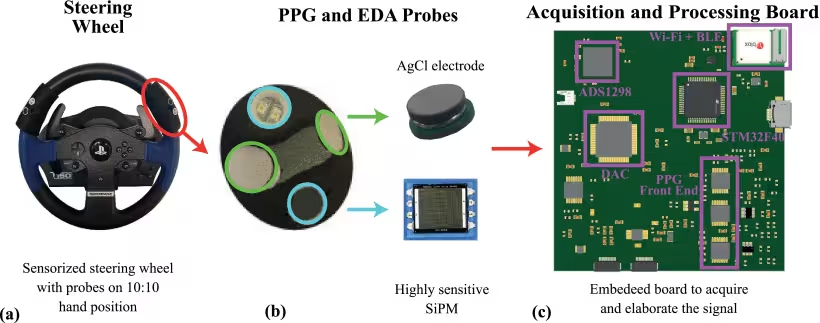
Unobtrusive Multimodal Monitoring of Physiological Signals for Driver State Analysis
Author: Amidei Andrea, Pavan Paolo, Rabbeni Roberto, Tagliavini Giuseppe
Published in: IEEE Sensors Journal (Volume: 25, Issue: 5, March 2025)
Summary Contributed by: Andrea Amidei (Author)
Driver distractions, stress, and fatigue are leading causes of accidents. This study introduces ANGELS v2, an enhanced smart steering wheel system that processes electrodermal activity (EDA) and photoplethysmography (PPG) signals by capturing signals such as heart rate, respiration, and skin response to assess the driver's physiological states in real time. Integrated into the vehicle's steering wheel for unobtrusive multimodal sensing, ANGELS v2 showed near-clinical accuracy in a high-fidelity simulator study.
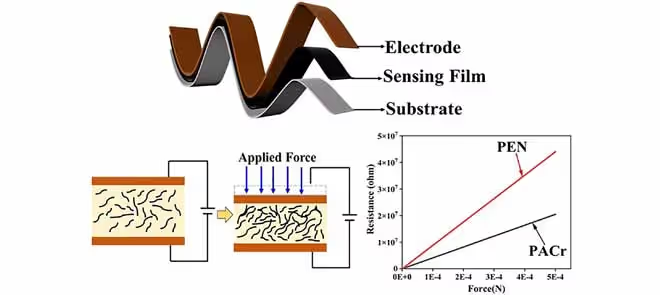
Investigation on Substrate Material for a Sensitive Flexible Piezoresistive Pressure Sensor
Author: Gupta Navneet, Neeraj Neeraj
Published in: IEEE Sensors Journal (Volume: 25, Issue: 7, April 2025)
Summary Contributed by: Saurabh Dubey
Flexible piezoresistive pressure sensors (FPPS) are revolutionizing wearable electronics, soft robotics, and healthcare monitoring. This study identifies polyethylene naphthalate (PEN) as the optimal substrate, offering superior thermal stability, flexibility, and chemical resistance. Validated through simulations, PEN-based FPPS achieved high sensitivity, superior charge transport, and improved mechanical stability than traditional alternatives. By combining multi-criteria material ranking with simulation, this research leads to the development of the next-generation wearable sensors and energy-harvesting devices.
The recent COVID outbreaks highlighted the need for breathing rate monitoring and increased the demand for hospitalized patients. Monitoring breathing rate is vital for diagnosing diseases and observing patients with pulmonary conditions. The pros and cons of different techniques are studied and categorized under contact and remote modes of respiratory monitoring systems. Various Radar-based methods found to be more suitable for respiration monitoring are discussed.
Radar detection of smaller targets requires lowering the radar cross-section and velocity thresholds. With it, an abundance of target signatures gets generated, making it necessary to classify only relevant targets. Micro-motions of targets are significant characteristics. Micro-Doppler signatures have emerged as an effective method of classifying such targets. The study presents a systematic review of various micro-Doppler-based radar target signature analysis and classification techniques.
A non-profit organization, IEEE is the world's largest technical professional organization dedicated to advancing technology for the benefit of humanity.
Copyright 2023 IEEE – All rights reserved. Use of this website signifies your agreement to the IEEE Terms and Conditions
This site is also available on your smartphone.