




Web Dynamic Stress Identification and Damping Analysis of High-Speed Spiral Bevel Gear
Spiral bevel gears are widely used in aerospace accessory transmissions for their high load capacity and smooth operation. To reduce weight, they are often designed with thin webs, which increase structural flexibility. However, this also makes them susceptible to high-frequency nodal diameter (ND) vibrations at high speeds. These vibrations can produce excessive web dynamic stress (WDS), leading to fatigue cracks and potential gear failure. Thus, identifying critical vibration modes within the operating range and implementing effective damping measures is essential.
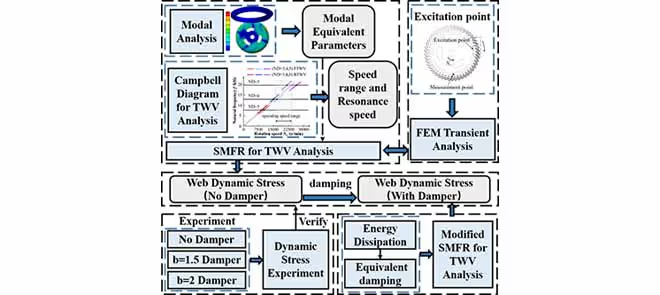
This study presents a Single-Mode Forced Response (SMFR) model to identify dangerous ND vibration modes in high-speed spiral bevel gears. The model combines prestressed modal analysis with traveling-wave vibration (TWV) resonance analysis, using Campbell diagrams to locate resonance points. Unlike full finite element method (FEM) simulations, which are accurate but computationally heavy, the SMFR model offers a simplified yet reliable approach.
Prestressed modal analysis incorporates centrifugal and meshing loads, yielding natural frequencies representative of real operating conditions. TWV analysis distinguishes forward (FTWV) and backward (BTWV) traveling waves, identifying resonance at 17,753 rpm (4-ND FTWV) and 21,211 rpm (5-ND BTWV). Web dynamic stress calculations indicate that the 5-ND mode exceeds the safe limit of 100 MPa, confirming it as a critical vibration mode requiring mitigation.
To mitigate the identified dangerous vibrations, a passive ring damper was introduced, leveraging frictional energy dissipation between the damper and a groove machined into the gear web. The SMFR model was modified to account for this damping effect, incorporating different contact states, including stick, stick-slip, and full slip. Parametric studies revealed that the axial width (b) of the damper has the most significant and linear impact on performance. For instance, increasing the width from 1.5 mm to 2 mm reduced the 5-ND resonance amplitude from 15.5 µm to 4.2 µm and lowered the WDS from 123.5 MPa to 43 MPa, achieving up to 65% vibration reduction.
The model’s accuracy and the damper’s effectiveness were rigorously validated through both FEM transient response analysis and a high-speed dynamic measurement experimental platform. Strain gauge measurements confirmed the dangerous nature of the 5-ND mode, with a maximum strain reaching 643.7 µε without a damper. The installation of a 2 mm-wide damper reduced this strain to 225 µε, closely matching the SMFR predictions. Additional wear analysis using Archard’s theory indicated stable damping performance over 10⁸ vibration cycles, aligning with typical engine maintenance intervals.
Comparison with existing studies validated the SMFR model, demonstrating that ring dampers effectively control vibrations in high-speed spiral bevel gears. The results suggest placing the damper groove near the gear root, maximizing its axial width within space limits, and limiting radial thickness to keep damper mass below 5% of the gear.
This study establishes a validated and practical framework for improving the reliability of high-speed thin-walled spiral bevel gears. The SMFR model enables the accurate identification of critical vibration modes, while optimized ring dampers provide an effective and low-cost means of suppressing them. Together, these contributions provide a solid theoretical and applied basis for preventing web fatigue failures and advancing safer, more reliable aerospace gear transmission designs.