




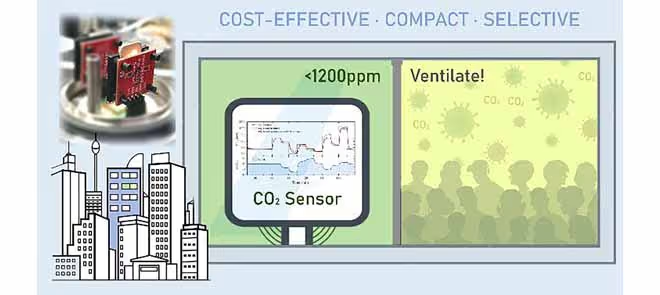
Ultralow-Cost and Selective Water-Based Colorimetric Ink for Indoor CO₂ Monitoring
Indoor air quality (IAQ) or the air quality within buildings has a significant impact on the health and comfort of the occupants. The rise in health issues related to poor IAQ highlights the need for effective monitoring. High carbon dioxide (CO₂) levels often indicate poor air circulation and the accumulation of exhaled air carrying impurities and pathogens. Hence, monitoring CO₂ helps evaluate air quality and assess infection risk. The current standard commercial IAQ monitoring devices are highly complex, expensive to produce, and may yield inaccurate results due to interference from mixed hydrocarbons.
This study presents a simple but effective alternative: a water-based ink that visibly changes color in response to CO₂. The sensing principle relies on a selective reaction between an amine compound and CO₂, which shifts the equilibrium of the dye Thymol Blue, resulting in an apparent color change from greenish to yellow. By tuning the ink formulation with glycerol and polyethylene glycol, the design achieved both strong reactivity and reliable printability on ordinary paper substrates. The resulting colorimetric films are stable, reversible, and compatible with scalable manufacturing. The colorimetric ink sample is mounted on its printed paper holder and placed inside a gas-tight dark chamber equipped with mass flow controllers to maintain controlled environments.
The optical properties of the inks were characterized by illuminating the samples with a white light-emitting diode (LED) placed underneath, and measuring the transmitted light with an Ultraviolet-Visible (UV-Vis) Spectrometer attached to the transparent lid of the customized gas chamber.
To monitor the color change, the researchers employed a low-cost optical readout using a commercial LED-photodiode module. This setup captures both reflected and transmitted light, ensuring reproducibility and making integration straightforward. Because humidity strongly influences the CO₂-amine reaction, the study designed a two-step calibration procedure: first correcting the baseline shift due to relative humidity and then adjusting the incremental signal. This strategy effectively compensates humidity variations in the 10-70% RH range, enabling reliable performance in realistic indoor conditions.
The resulting labels operate in the relevant 150-1500 ppm range, respond within seconds to minutes, and return fully to baseline upon CO₂ removal. They exhibit excellent selectivity against common interfering gases such as carbon monoxide (CO), nitrogen dioxide (NO₂), and formaldehyde (CH2O). Importantly, they also demonstrate stability over a week of continuous operation, with consistent responses to repeated CO₂ exposures. Tests on multiple batches fabricated on different days confirmed reproducibility across samples, with only minor baseline variations. This robustness is critical for scaling the technology beyond the lab.
The study shows that accurate quantification is possible with only conventional calibration and analytical fitting, without the need for machine learning models. This approach predicts CO₂ at ppm resolution with errors below 9-6%, rivaling commercial sensors while remaining far cheaper and simpler. The design also shows potential for integration with other colorimetric inks, enabling multiparametric sensing platforms that can simultaneously monitor multiple indoor pollutants.