




Two-Electrode Screen-Printed pH Sensors for Monitoring Soil and Other Growing Media
Nutrient cycling is a critical component of soil health and has a significant impact on food production. The growing environment depends on data such as soil moisture, temperature, nutrients, and pH levels, with high spatial and temporal variations. Acidity/alkalinity, or pH, is a soil parameter that affects soil and plant health as well as greenhouse gas dynamics. Even small fluctuations in soil pH can have a substantial effect on the availability of nutrients for crops and the activity of soil microbes.
Continuously measuring pH in soils at high spatial density poses challenges with current sensors, primarily due to their cost, maintenance needs, and the requirement for frequent recalibration. Current approaches often require soil sampling, thereby reducing spatial and temporal data density.
This work presents a printed pH sensor designed to enable large-scale, affordable pH monitoring in growing media such as soil and hydroponic systems. The sensors are fabricated using screen printing, which is a common technique for manufacturing low-cost printed electronics. The printed working electrode incorporates a dye, alizarin, which changes its electrochemical behavior depending on pH. On its own, the uncoated working and reference electrodes can suffer from drift.
To improve the sensor’s stability, the researchers added a Nafion membrane over the working electrode and a salt membrane over the reference electrode, reducing the signal drift and extending sensor lifetime. Testing also showed that the fully coated, two-electrode sensors achieve near-Nernstian sensitivity of 56.4 mV/pH. The sensor's accuracy is comparable to that of commercial pH probes, yet it is achieved using a printed sensor.
This sensor design condenses the electrode configuration from a traditional three-electrode sensor to a more simplified two-electrode configuration. The two-electrode configuration is simpler to manufacture and reduces the complexity of the read-out electronics. It consists of a working electrode (WE) and a shared electrode that functions as both the reference electrode (RE) and counter-electrode (CE). This design simplifies both the printing process and the read-out electronics.
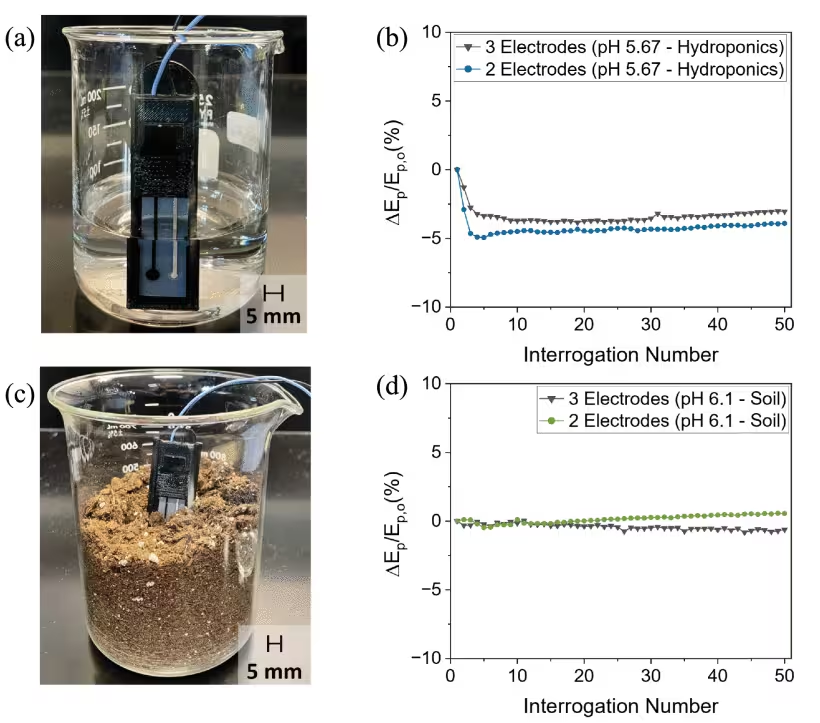
In this report, the researchers demonstrate that the two-electrode sensors perform comparably to three-electrode sensors in both buffer solutions and growing media. Cost-effective readout electronics are also presented, using an Arduino microcontroller and a simple circuit to determine pH with two-electrode sensors. This system was able to read out the pH of buffer solution and growing media with a comparable sensitivity to a lab-grade potentiostat.
This work shows that screen-printed pH sensors stabilized with the addition of membranes over the working and reference electrodes can be paired with cost-effective read-out electronics, enabling higher spatiotemporal resolution data collection. These sensors have been shown to work in both buffer solutions and directly in various growing media, such as hydroponic fluid and soil. The research will enable the collection of real-time pH data in the field to aid with land management practices.