



Time-Series Forecasting in Industrial Environments: A Performance Study and a Novel Late Fusion Framework
Industrial time series data are crucial for predictive maintenance. Soft sensors that forecast future equipment efficiency can help schedule maintenance proactively and improve Overall Equipment Effectiveness (OEE). However, manufacturing data are often noisy, non-stationary, and influenced by interactions across different process stages, making reliable forecasting challenging.
This study presents a structured benchmark of modern deep-learning forecasters, grouping them into four families: multilayer perceptrons (MLPs), recurrent networks, Transformer-based models, and Temporal Convolutional networks (TCNs). It evaluates representative state-of-the-art models from each category using real manufacturing datasets.
The performance of forecasting models is influenced more by their internal signal processing capabilities than by the specific architecture. It is crucial to filter industrial noise and successfully isolate distinct temporal features. Models with minimal temporal preprocessing tend to underperform on these industrial signals. In contrast, approaches that explicitly reduce noise or separate trend and seasonal structure are more stable and accurate, especially when working with limited or low-dimensional data.
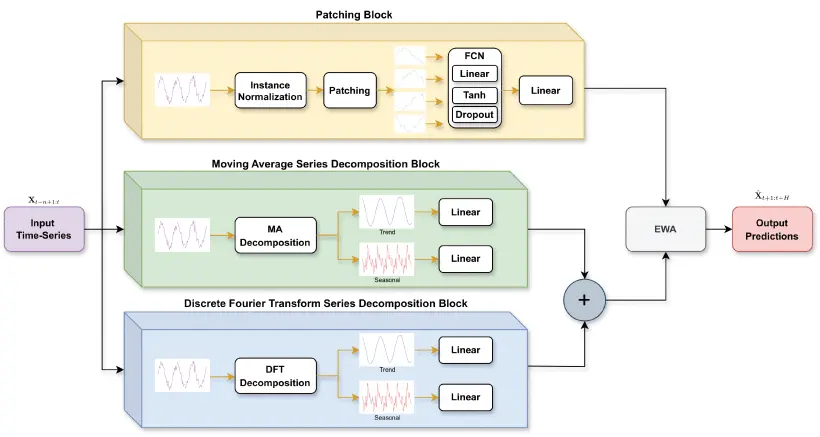
Building on this, this study proposes a lightweight late-fusion soft sensor that combines three complementary “views” of the same input window for forecasting. A patch-based block focuses on localized, short-range patterns by slicing the input into non-overlapping segments, embedding each patch with a small shared MLP, and then using a linear layer that can exploit correlations across variables.
Two additional blocks capture longer-range structures through decomposition: a moving-average scheme to separate trend and residual seasonality, and a Fourier-based scheme to isolate dominant frequencies and reconstruct a smoothed component. Both generate forecasts using simple linear heads. The final forecast uses a late-fusion mechanism that utilizes a learnable decay parameter to dynamically shift the model's focus, prioritizing localized, patch-based features for near-term forecasts while transitioning to global, frequency/trend-based components as the prediction horizon extends.
Experiments use two manufacturing datasets. The primary dataset spans 345 days from a ten-stage antenna assembly line, where sensor-derived variables are used to compute OEE factors. The study focuses on the Availability and Performance factors, since quality is near-constant. Data are downsampled to hourly resolution and modelled with a 7-day input window, forecasting 8–72 hours ahead. A secondary dataset from a single-stage sink manufacturing process includes vibration/temperature variables, with inactive periods removed and low-variability signals excluded before applying the same windowing and horizon setup.
PDFLinearEWA demonstrates strong accuracy with modest resource use across horizons. For the antenna predictions, it achieves the best overall performance at short and mid horizons (reported RMSEs of 0.169/0.173/0.173 for 8, 24, and 48 hours), while remaining competitive at 72 hours (where MICN outperforms it). On the sink dataset, PDFLinearEWA excels particularly at longer horizons, showing a significant advantage over short-horizon specialists (RMSE 2.360 vs 3.123 at 72 hours compared to FiLM). Ablation results support the architectural design, showcasing that patching is most beneficial at short horizons, while decomposition becomes more valuable as the horizon extends. The simple exponential fusion outperforms more complex fusion networks that tend to overfit.
The work advocates for practical, low-computational deployment-friendly forecasting in manufacturing, emphasising robust temporal feature extraction and lightweight fusion over increasing model complexity.