



Thermal Fault Detection of High-Speed Direct-Driven Blower Components Using Thermal-Visible Image Fusion and Semantic Segmentation
High-speed direct-driven blowers are powerful and efficient industrial fans widely used across various applications. Due to their continuous operation, early fault detection is critical to prevent damage, reduce downtime, and ensure safety. Among potential issues, thermal faults caused by abnormal temperatures are particularly common, making precise thermal fault-detection systems both practically important and economically beneficial for these blowers.
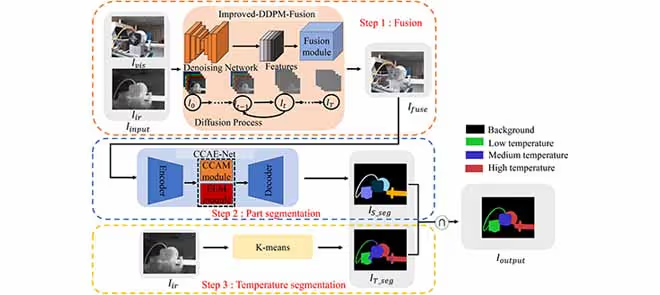
Existing thermal fault detection methods often rely solely on infrared images or prioritize visual quality over thermal accuracy. This study presents an end-to-end system for blowers that integrates infrared and visible images with semantic segmentation and temperature-level classification to achieve precise fault detection. Since no prior dataset existed, the authors collected 334 aligned thermal-visible image pairs and expanded them to 1,336 images using augmentation techniques, including mirroring, cropping, panning, and Gaussian noise, ensuring sufficient data diversity for training.
The study introduces an improved denoising diffusion probabilistic model (DDPM) for fusing infrared and visible images, called the Improved-DDPM-Fusion (IDF) network. Previous methods, such as Dif-ffusion, produced visually appealing results but lacked interaction between the denoising and fusion stages, limiting the retention of essential infrared information. IDF overcomes this by jointly training both modules in an alternating end-to-end manner, enabling continuous feedback and better preservation of thermal and visible features. The approach concatenates thermal and visible images into a four-channel input and applies Gaussian noise across diffusion steps, with a learned reverse process guided by a U-Net enhanced with spatial and channel attention. By combining a P2-weighted perceptual loss for diffusion with a structural-similarity fusion loss, IDF produces clearer fused images with richer thermal detail, enhancing subsequent segmentation performance.
For segmentation, the system employs the Criss-Cross Attention and Contour Enhancement Network (CCAE-Net), which integrates a Criss-Cross Attention Module (CCAM) with a Contour Enhancement Module (CEM). Using a ResNet101 encoder and lightweight decoder, CCAE-Net extracts multi-scale features and produces precise component masks. CCAM replaces heavier multiscale attention mechanisms, reducing memory usage and computation by roughly 75%, while CEM emphasizes edge and contour features, particularly important for thermal or low-light fused images. Trained with a combination of contour loss and cross-entropy loss (optimized at ω = 0.1), the network achieves high segmentation accuracy at a low inference cost.
Finally, thermal images are processed using K-means clustering to classify each pixel into four temperature levels: background, low, medium, and high. Analysis of the dataset reveals typical temperature distributions for components, such as the motor fan being medium in 67% of samples, ventilation pipes high in 86.3%, and power cords low in 75.6%. Thermal faults are detected when components deviate from these normal ranges—for example, a motor fan rising from medium to high or an inverter increasing from low to medium—triggering early warnings for preventive maintenance.
This research presents the first end-to-end thermal fault detection system for industrial blowers, overcoming limitations of previous methods. The proposed method enables faster and more accurate component temperature classification, enabling targeted detection of overheated regions in the blower for effective thermal fault identification.