



Temperature and Strain Sensing Characteristics of a 128° YX-Cut LiNbO3 Rayleigh-Mode SAW Sensor From Room to Cryogenic Temperatures
Cryogenic environments, where temperatures fall far below freezing, are essential in many advanced technologies. Superconducting magnets in particle accelerators, liquid-fuel rocket engines, space telescopes, and medical systems such as magnetic resonance imaging (MRI) and cryo-electron microscopes all rely on stable operation at extremely low temperatures.
Accurately measuring temperature and mechanical strain under these conditions is difficult. Electrical sensors are affected by electromagnetic interference and heat from wiring. Optical sensors require long, fragile fibers and are challenging to install in compact or sealed systems.
This study demonstrates that surface acoustic wave (SAW) sensors offer an effective alternative for cryogenic monitoring. SAW devices are small piezoelectric chips that use sound waves traveling along a crystal surface to detect environmental changes. SAW sensors are particularly well-suited for harsh, remote, or inaccessible cryogenic environments because they do not require batteries and can operate wirelessly.
The device studied here is a Rayleigh-mode SAW delay-line fabricated on 128° YX-cut lithium niobate (LiNbO₃), a material known for its strong electromechanical coupling and high temperature sensitivity. The sensor was evaluated from room temperature down to 80 kelvin (–193 °C), covering the temperature range used in most cryogenic systems.
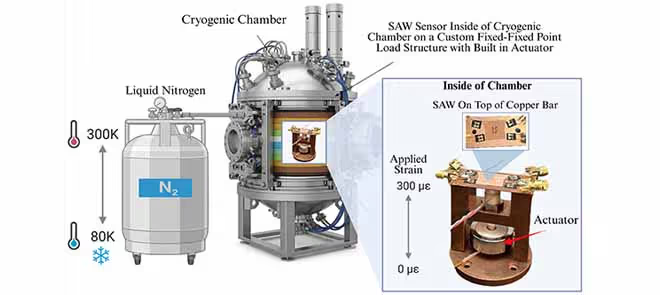
Two measurement configurations were studied. In one case, the device was placed freely on a cold plate inside a liquid-nitrogen-cooled cryogenic chamber. In the second case, it was bonded and wired to a copper structure so that controlled mechanical strain could be applied while the temperature was varied. In both setups, temperature and strain were determined by tracking tiny phase shifts in radio-frequency signals reflected by the SAW device.
One of the most important results is that bonding and wiring do not degrade temperature accuracy. The temperature sensitivity of the free-standing and mounted devices differed by only 0.15 parts per million per kelvin in the most critical cryogenic range (80–130 K), corresponding to a difference of less than one-third of a percent. This shows that the sensor can be attached to real structures without any harmful mechanical stress or measurement error.
To explain and predict this behavior, a detailed multiphysics computer model was developed. The model includes how lithium niobate’s elastic, thermal expansion, and piezoelectric properties change with temperature. Unlike earlier models limited to room temperature, this one accurately predicts sensor behavior down to cryogenic levels. The simulated frequency shifts closely matched the experimental phase shifts across the entire 280–80 K range, confirming that the physics of the device is well understood.
The sensor maintained strong temperature sensitivity at low temperatures, measuring changes of only a few hundredths of a kelvin. At the same time, sensitivity to mechanical strain increased as temperature decreased. Near room temperature, strain has little effect on temperature readings. However, at deep cryogenic temperatures, it became more significant. It should be compensated for in precision applications.
This research demonstrates that lithium-niobate SAW sensors can provide reliable, accurate temperature and strain measurements in extreme cryogenic environments. It creates a strong foundation for future passive, wireless sensing systems in aerospace, energy, and biomedical technologies.