




Tattoo-Like Flexible Ethylene Sensor for Plant Stress Monitoring in Real-Time
Plants may not speak, but they constantly communicate through invisible chemical signals. One of these molecules, ethylene, plays a major role in how plants respond to stress- from drought to overwatering, from cold to hot, from brightness to darkness, and to poor nutrition. Detecting ethylene early could give farmers a powerful way to prevent crop loss and optimize harvest timing. Until now, however, monitoring this gaseous ethylene, a crucial plant hormone, has required expensive and bulky laboratory equipment.
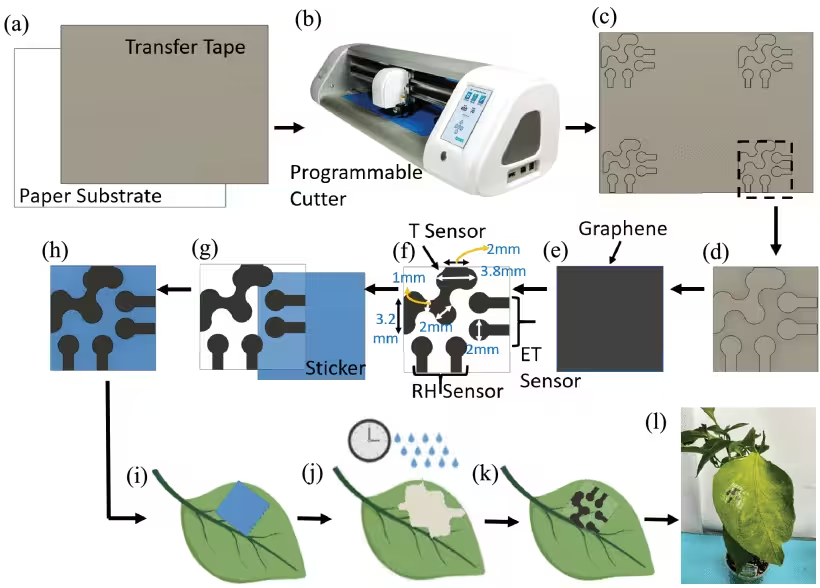
This work presents a novel, tattoo-like, flexible ethylene sensor that attaches directly to plant leaves, enabling real-time monitoring of ethylene emission. The thin, soft sensor works like a temporary tattoo. It can be easily applied or peeled off a leaf without harming the plant. Once in place on the backside of the leaves, it continuously tracks ethylene emissions, giving a live “health readout” of how a plant is coping with its environment.
The innovation lies in combining wearable electronics, nanomaterials, and smart data systems into a simple, low-cost platform. The tattoo incorporates three miniature sensors that measure ethylene, temperature, and humidity-all printed on a flexible substrate. This design allows ethylene readings to be corrected for microclimate variations at the leaf surface, where stress signals originate. The ethylene sensor itself uses a chemiresistive coating of copper complexes and single-walled carbon nanotubes (SWCNTs), which interact selectively and reversibly with ethylene gas, measurably changing the electrical resistance.
This cost-effective leaf tattoo ethylene sensor provides flexibility, plant wearability, multiplexing capability, excellent detection limits, and a linear operating range. It has demonstrated a sensitivity of 0.6295 k Ω/ppm, a limit of detection (LOD) of 0.13 ppm, and maintains a linear response up to 115 ppm. It can operate continuously in the field and can procure, process, and transmit data wirelessly via an Internet of Things (IoT) interface. Agriculturists or researchers can instantly view live ethylene, temperature, and humidity levels on a mobile app from anywhere, and at any time.
In experiments with bell pepper plants, the tattoo sensors successfully detected distinct ethylene patterns in response to various stressors, including water deficiency, heat, cold, and prolonged darkness. These patterns were statistically significant, meaning that the sensor could clearly distinguish between different types of plant stress. The data revealed how ethylene rises during stress and falls after recovery, thus effectively showing the plant’s “stress language.”
Beyond its scientific novelty, the work has practical significance for smart agriculture. By scaling up production using roll-to-roll manufacturing, these tattoo sensors could be deployed across greenhouses and farms for large-scale, non-destructive plant monitoring. It could be used for early identification of stressed areas, fine-tuning irrigation and fertilization, and ultimately reducing crop losses.
This research opens the door to a new generation of plant wearables — flexible, intelligent, and connected — that allow humans to understand plants' hidden biochemical cues in real time. The team's vision is clear: a future where every plant can tell its story, one molecule at a time.