



Smart Insoles With Textile Capacitive Sensors for Efficient Gait Phase Recognition
Gait analysis is an important parameter for diagnosing mobility disorders caused by neurodegenerative conditions, such as Parkinson's, Alzheimer's, or strokes. With the growing demand for rehabilitation services, tele-rehabilitation solutions powered by wearable sensors offer a cost-effective alternative to in-person clinical assessments. This paper presents an affordable gait analysis solution that uses sensorized pairs of insoles and an AI-based system for automated gait-phase recognition.
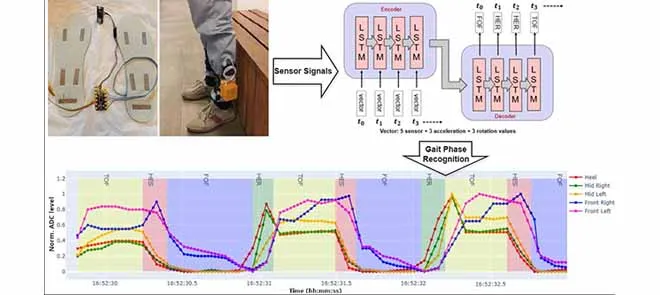
The researchers used commercially available, inexpensive insoles as a base. Capacitive textile sensors made of silver-based conductive thread (SilverTech 150) were embroidered onto insoles using an industrial machine to form five capacitive sensor pads. Each insole includes 5 sensors, positioned at the heel, mid-left, mid-right, front-left, and front-right areas, each sending measurements with a frequency of 12H. The total cost per unit is less than €0.60.
The sensors from both insoles connect to an MPR121 controller for signal preprocessing, and the Arduino Nano 33 IoT with accelerometer-gyroscope capabilities and WiFi/Bluetooth connectivity. The collected data were sent wirelessly and stored on the Arduino Cloud.
The sensing mechanism detects changes in proximity-induced capacitance. When the foot compresses the insole, it alters the fibre separation, effective electrode area, and dielectric properties, resulting in measurable capacitance shifts. Durability testing conducted over 1,000 wear cycles showed negligible changes in sheet resistance and friction, supporting the system's longevity.
A sequence-to-sequence (seq2seq) recurrent neural network utilizing Long Short-Term Memory (LSTM) modules was employed to identify the 4 basic gait phases. The model processes vectors containing input from the five capacitive sensors and the Arduino IMU measured acceleration and rotation to predict the ongoing gait phase.
The model was trained and evaluated using data from 20 healthy volunteers (13 men, 7 women; ages 21–48) who wore the insoles during standardized walking exercise, repeated at slow, normal, and fast paces. Participants' lower bodies were video-recorded to assist with the manual data annotation of the gait phases: Heel Strike (HES), Foot Flat (FOF), Heel Rise (HER), and Toes Off (TOF). Class imbalance regarding TOF and FOF phases constituted over half of all samples. It was addressed through data filtering and augmentation strategies, including inverting right-foot sensor data.
The model achieved 90% accuracy and an F1 macro score of 87.1% on the combined test set. Performance improved at slower walking speeds, as slower movement yields higher sensor resolution per phase, thereby improving accuracy. The innovative use of the MPR121 controller, which provides noise filtering and multiple signal levels, enables better deep learning-based pattern recognition. Finally, the selected sensor type offers inherent durability, high performance, and low manufacturing costs.
Future directions for the system include the recognition of minor gait events and the miniaturization of the wearable equipment containing the microships and batteries. Overall, this work demonstrates that low-cost, textile capacitive sensors, embroidered on common shoe insoles, combined with deep learning, can be used reliably for gait analysis. This offers a viable, affordable alternative to commercial solutions for remote rehabilitation and early detection of mobility impairments.