



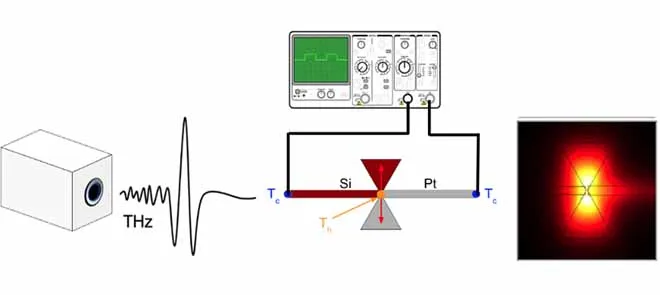
Silicon–Platinum Bowtie-Coupled Thermoelectric Terahertz Detector
THz technology has various real-world applications, including security screening, atmospheric monitoring, medical imaging, and next-generation wireless communications. Terahertz (THz) radiation is electromagnetic radiation in the frequency range of approximately 0.1 to 10 THz. These frequencies are higher than those of microwaves but lower than those of infrared radiation, placing the THz range between microwaves and infrared.
Current THz sensors require cryogenic cooling. Alternatively, THz sensors that function at room temperature tend to have low sensitivity, are bulky, and require high power to operate. The researchers in this work have designed a miniaturized, self-powered THz detector that operates at room temperature by coupling micro-antennas to thermoelectric generators.
This innovation consists of a bowtie-shaped antenna measuring 6.3 micrometers in length that concentrates incoming THz radiation at a tiny junction where two different materials — silicon (Si) and platinum (Pt) — meet. The absorbed radiation heats this junction, and the resulting temperature difference generates a measurable voltage through the Seebeck effect. Here, no external bias voltage is required since the detector powers itself directly from the radiation it captures. This self-biasing property eliminates the need for a power supply, resulting in reduced system costs, smaller size, and low energy consumption.
The antenna geometry was designed to resonate at approximately 5 THz. It was confirmed by finite-element simulations in COMSOL Multiphysics. Silicon was selected for its high Seebeck coefficient, and forms one leg of both the bowtie antenna and the thermocouple. Platinum was deposited using a focused ion beam (FIB) system to form the second leg, eliminating the need for additional lithographic steps. This dual-function design enables each antenna arm to serve as a thermocouple element, thereby simplifying the fabrication process.
Nine such bowtie elements were connected in series on a silicon-on-oxide substrate, boosting the combined output voltage and the effective radiation-collection area while maintaining a small footprint.
The detector was evaluated using a broadband blackbody source across the 3.8–8 THz frequency range. It achieved a voltage responsivity of 207 kV/W, which means it can produce 207,000 volts of signal for every watt of absorbed radiation. Additionally, it has a noise equivalent power (NEP) of 0.24 pW/√Hz and a specific detectivity (D*) of 3.3 × 10⁹ cm·√Hz/W, placing this detector among the best uncooled, room-temperature THz thermal detectors reported to date. Furthermore, the thermal time constant is approximately 9 ms, which is consistent with the thermal mass of the device.
This work demonstrates that antenna-coupled thermoelectric detectors are a viable and competitive platform for uncooled THz sensing. The measured specific detectivity (D*) is within one order of magnitude of the fundamental limit for thermal detectors. The detectors efficiently capture THz radiation, convert it into heat, and generate a voltage signal without the need for cooling or external energy sources. The compact design offers advancements in security scanning, medical imaging, and wireless communication, and the smart combination of materials and antenna technology enhances the hidden spectrum. Future work will focus on array uniformity, polarization response, and optimized individual element geometries.