



Semiquantitative Lateral Flow Assay Using a Handheld Device With a Transmissive Readout
Lateral flow assays (LSA) are widely used diagnostic tests that are user-friendly, affordable, and can deliver quick results without the need for laboratory facilities or specialized training. Therefore, they are widely used in clinical settings, at home, in the field, and for point-of-care testing facilities. However, a persistent limitation of this format is that the results are typically qualitative, providing only positive or negative readings rather than quantitative values.
In a lateral flow test, a faint line carries the same weight as a dark one. Though it is adequate for screening purposes, several diagnostics require quantitative information to diagnose and determine infection progression, verify whether a contaminant has dropped below a safety limit, or adjust treatment based on biomarker levels.
In this work, instead of resorting to advanced detection technologies, the researchers aimed to extract more from optical measurements of lateral flow tests using a compact reader that can be held in one hand. The key novelty involved studying how the interaction length between light and gold nanoparticles (AuNPs), which induces a color change, influences signal strength. In this approach, the gold nanoparticles in assay strips are not merely sitting on the surface; they can actually bind within the porous nitrocellulose membrane, roughly 50 micrometers deep.
Consequently, light bouncing off the top surface reached them only partially. Passing light through the strip from one side to the other gave it a much longer path through the material and a proportionally stronger interaction with those particles. Spectroscopic measurements confirmed the advantage that transmission mode produced signals averaging 82% stronger than those in reflection across the tested concentration range.
To measure transmission, it was necessary to change the LFA structure by modifying the rigid backing card typically present under the nitrocellulose membrane. This card significantly reduced light transmission by nearly a factor of a hundred. To address this issue, the researchers removed the card from the three measurement zones (test line, control line, and a blank reference area) while keeping it at the ends for structural support. This simple design change made the whole approach feasible.
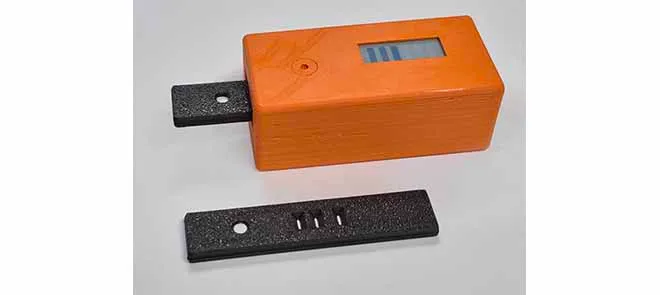
The reader uses three green LEDs and three photodiodes on opposite sides of a cartridge slot. In this work, this configuration, which enables the monitoring of multiple wavelengths through a single color was investigated. The photodiode records the transmitted intensity, and a microcontroller compares the readings with the blank reference. A result between 0 and 7 appears on a small display within eight seconds.
Testing conducted across 24 strips at four different analyte concentrations showed clear group separation. Both between-group and within-group variability remained below 3%. Negative strips consistently returned a value of zero while positive ones scaled with concentration levels. The reader principle can be adjusted to any lateral flow test using a colored label.
This research has addressed the limitations of traditional rapid tests, improving accuracy while maintaining their compactness, user-friendliness, and affordability. It shows potential for monitoring various chronic and infectious diseases and on-site diagnostic applications.