



Remote Vital Sign Monitoring With IMU-Assisted Handheld IR-UWB Radar Sensor
The rapid rise in the global aging population has shifted the focus to prevention and to assisting senior citizens in living independently and with dignity. Radar technology has emerged as a promising modality for non-contact, non-invasive, and privacy-preserving monitoring of physiological parameters such as heart rate and breathing rate. In conventional settings, radar sensors are mounted on a stationary surface during vital-sign measurements, restricting their applicability.
This paper introduces the first handheld impulse radio ultra-wideband (IR-UWB) radar system integrated with a three-axis inertial measurement unit (IMU) that compensates for naturally occurring hand vibrations. Handheld radar-based vital sign measurement can significantly expand the practical usefulness of radar in healthcare and search-and-rescue applications.
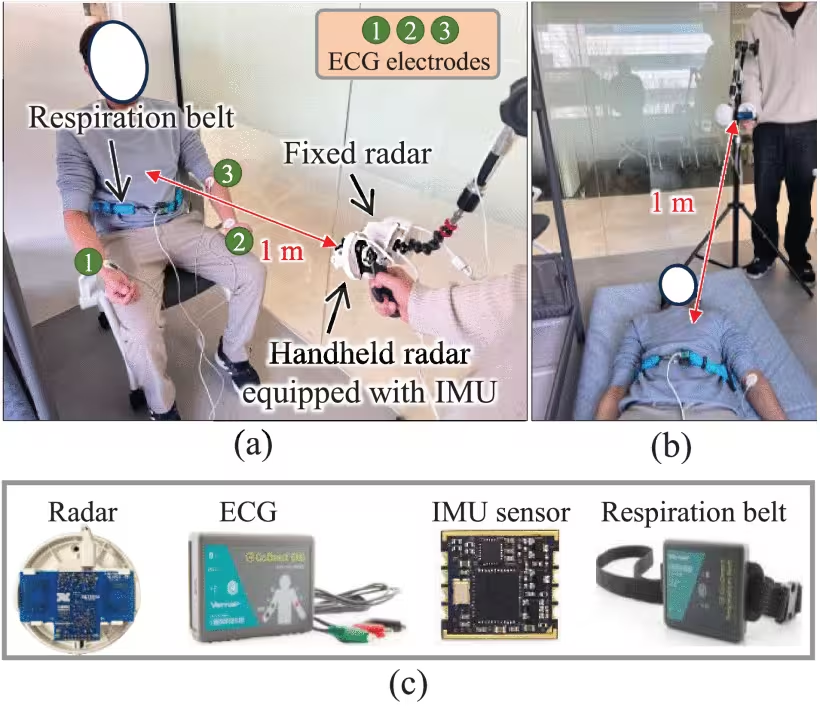
The IR-UWB radar detects periodic chest movements caused by cardiac and respiratory activity, which appear as slight variations in the radar return signal. In handheld radar, the radar returns also include artifacts from hand-induced vibrations. To mitigate these effects, an IMU sensor is employed to track hand movements with the proposed algorithm. Handheld movements are tracked frame by frame, and corresponding compensations are applied to update the radar range bin, yielding a signal that predominantly contains chest motion components.
Before measuring vital signs with the handheld radar, a preliminary experiment was conducted to compare radar performance between the fixed and handheld configurations, both aimed at a static wall target. Power spectral density (PSD) analysis using Welch’s method demonstrated that a fixed radar aimed at a static wall exhibits minimal low-frequency noise. In contrast, the handheld radar shows several low-frequency components caused by hand tremors. These components were significantly reduced after applying the calibration proposed in this paper.
Electrocardiogram (ECG) and respiration belts were used as reference sensors for heart rate and breathing rate measurements, respectively. Mean absolute error (MAE) and statistical correlation analyses were performed to evaluate the effectiveness of the proposed algorithm.
The results indicate that applying IMU-based range calibration enables the handheld radar to effectively measure vital signs, achieving an MAE of 2.01 breaths per minute for breathing rate and 2.72 beats per minute for heart rate. In contrast, without range calibration, handheld radars were unable to extract reliable vital signs.
Correlation analyses between radar and reference sensors, performed before and after calibration, further confirmed the effectiveness of the proposed calibration framework. Low MAE indicates that the radar-measured values are close to the reference sensor values. A high correlation between the radar and reference suggests that heart and breathing rate values track each other.
Addressing the variability in experimental conditions is crucial to enhancing the practical applicability of handheld radar systems in real-world scenarios. Vital sign measurements before and after exercise were also recorded. It validated the robustness of the proposed algorithm under extreme physiological conditions. Post-exercise vital signs were significantly higher than normal resting values, demonstrating that the proposed algorithm can effectively mitigate hand vibrations even during elevated physiological activity. Future work may include overcoming movements larger than naturally occurring hand vibrations.