




Recyclable and Self-Healing Stretchable Strain Sensor Based on Liquid Metal and Diels–Alder Polymer for Smart Wearable Applications
Wearable sensors that can stretch, bend, and move with the human body are transforming the future of health-monitoring devices, soft robots, and smart textiles. However, the flexible electronics currently used remain prone to damage and cannot be repaired once damaged. This limits their lifespan and reduces both their economic and environmental sustainability, highlighting the need for improved substrate and circuitry materials that enable the broad, sustainable use of flexible and stretchable electronics.
State-of-the-art stretchable sensors typically rely on either intrinsically conductive substrates or non-conductive substrates embedded with conductive materials. Here, the focus is on the latter, representing a step toward creating more durable, smart, and environmentally sustainable flexible devices.
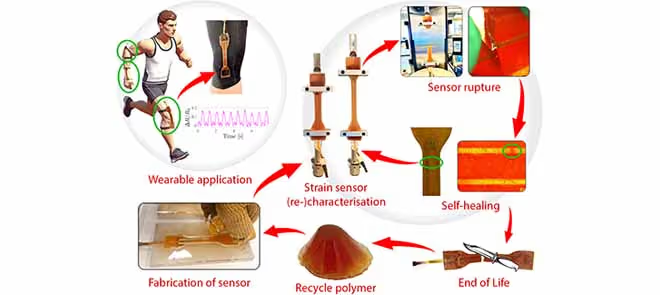
This study introduces a stretchable, self-healing, and recyclable strain sensor. The innovative sensor combines two key materials: a Diels–Alder (DA) self-healing polymer and a liquid metal (LM), Galinstan (an alloy of gallium, indium, and tin) as a conductive material. This combination allows the sensor to autonomously repair damage while maintaining electrical conductivity under strain, fully recovering even after being completely cut in two.
Both the polymer and the liquid metal self-heal independently. The DA polymer network contains reversible chemical bonds that break under stress but reconnect upon contact, a process accelerated by gentle heating. Simultaneously, the Galinstan forms a thin oxide layer at damaged sites, temporarily sealing the breach—analogous to a blood clot—until the polymer reconnects and electrical conductivity is restored.
The device ensures reliable electrical contact and effective strain isolation. Its fabrication involves casting two layers of DA polymer around a sprayed Galinstan circuit, creating a robust, hermetically sealed structure. The device is designed according to ASTM D412-C (Standard Test Methods for Vulcanized Rubber and Thermoplastic Elastomers) dumbbell geometry, with an increased width to safely accommodate the liquid metal circuit and reduce the risk of short circuits during rupture. This wider profile allows a U-shaped Galinstan pathway with a 7 mm gap between channels, providing sufficient separation and enlarging the self-healing surface area, thereby enabling more effective reconnection after damage.
The device was tested through multiple damage–healing cycles, during which it was repeatedly cut and rejoined. It recovered approximately 80–85% of its mechanical strength and over 100% of its electrical sensitivity (gauge factor) after each cycle. It also exhibited strain-rate-independent electrical behaviour, minimal signal drift (<5%) over 800 stretches, negligible hysteresis (<1%), and a fast response time of 220 ms, which is critical for accurate motion detection.
The DA polymer is reprocessable, enabling recycling at the end of its life. Liquefying the polymer and separating the components by centrifugation enables the recovery of both the polymer and the liquid metal, reducing waste.
During testing, the sensor embedded in a fabric sleeve successfully monitored finger, wrist, elbow, and knee movements. Due to the dual self-healing mechanism of the polymer and liquid metal, the sensor fully recovered after damage and regained nearly its original performance each time. These advanced features highlight its potential for applications in rehabilitation, motion tracking, and soft robotics.