




Phytic Acid/MXene@Polyurethane Sponge-Based Flexible Pressure Sensor With Assistance of MC-GRU Model for Motion Posture Recognition
Emerging applications in industrial automation, robotics, sports medicine, and wearable electronics have increased the demand for flexible sensors that function reliably under dynamic conditions. Flexible pressure sensors offer adaptability and easy integration, but their performance—sensitivity, detection range, and stability—is heavily dependent on the properties of active materials.
Traditional materials for pressure sensors include conductive polymers, semiconductors, nanofibers, metal nanoparticles, and carbon-based materials. MXenes are particularly noteworthy due to their large surface area, high conductivity, and rich surface functional groups, which enhance adhesion, mechanical strength, and tunability. However, conventional MXene-based sensors often face challenges like narrow detection ranges, structural instability, and poor flame retardancy.
To address these challenges, this study employs phytic acid (PA)—a biocompatible, renewable organic acid—as a dual-function modifier for MXene nanosheets, serving simultaneously as a conductive dopant and a flame-retardant binder.
The sensor is fabricated through a layer-by-layer self-assembly process. First, MXene nanosheets are modified with phytic acid using a hydrothermal method. These PA-modified MXene nanosheets are then uniformly deposited onto a 3D polyurethane (PU) sponge, producing a flexible PA/MXene@PU (PMP) sponge sensor. The porous honeycomb structure of the PU sponge provides excellent elasticity, low Young’s modulus, and mechanical robustness, while the PA–MXene composite forms a wrinkled conductive network that significantly improves electron transport.
By forming strong hydrogen bonds with the surface groups of MXene, PA enhances both electrical conductivity and mechanical strength. This combination of PA-modified MXene and porous PU sponge endowed the sensor with a high sensitivity of 16.71 kPa⁻¹ and a wide detection range of 0-175 kPa. It can detect subtle pressures as low as 0.01 N, as demonstrated by successful sensing of impacts from water droplets and tiny sodium chloride (NaCl) solution droplets, highlighting its potential for micro-pressure applications such as environmental monitoring or micro-expression detection. The sensor also exhibited excellent flame-retardant properties, with self-extinguishing capability within 20 seconds of ignition.
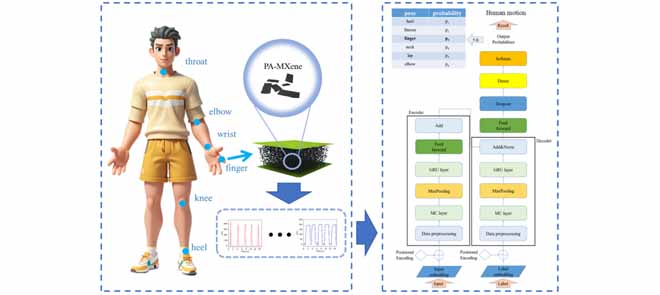
During practical motion experiments, the sensor was placed on the fingers, wrists, elbows, knees, throat, and chest. It accurately tracked facial expressions, finger bends, wrist and elbow movements, knee motion, walking patterns, forearm muscle activity, swallowing, and breathing, delivering clear and consistent signals across all activities.
To translate these rich sensor data into actionable insights, the PMP sensor was combined with deep learning algorithms to assess its capability for recognizing human posture. A Multilayer Convolutional Neural Network with a Gated Recurrent Unit (MC-GRU) was developed for this human motion recognition task. This hybrid deep learning approach successfully learns spatial and temporal patterns from sensor data, reaching 99.83% classification accuracy across six categories of joint activity.
The integration of advanced material engineering with intelligent signal processing underscores the sensor's considerable potential for next-generation applications in smart wearables, intuitive human–computer interaction, and personalized health monitoring systems. Its flame-retardant property adds a crucial safety feature for wearable electronics. Overall, the PA/MXene@PU (PMP) sponge sensor exhibits remarkable capability for precise and reliable recognition of human motion and posture when combined with the MC-GRU model.