




Nonlinear Behavioral Model of Capacitive MEMS Microphone for Predicting Ultrasound Intermodulation Distortion
Micro-electromechanical systems (MEMS) capacitive microphones provide a broader frequency response than traditional microphones due to their compact size and design emphasis on flat, high-fidelity audio performance. Their compact build enables precise control of acoustic and mechanical properties, making them ideal for hearing aids, smartphones, and other audio-sensitive applications. MEMS microphones often exhibit resonance near or above 20 kHz, increasing their sensitivity to ultrasonic signals.
Although ultrasonic signals are typically inaudible, nonlinearities in the microphone can lead to intermodulation distortion (IMD). These IMD products are lower in frequency and can corrupt the audible range of the microphone. For microphones used in hearing aids, the distortion will be heard as clicks, tones, and low-frequency sweeping sounds when the user is near an ultrasonic emitter, such as a ceiling occupancy sensor.
To minimize these undesirable effects, it is essential to understand the origins of distortion—especially asymmetrical distortion, which produces low-frequency IMD products.
This paper explores how various design features influence IMD using a nonlinear behavioral model, also referred to as a large signal model (LSM). The study identifies the MEMS transducer as the primary contributor to distortion, while the associated application-specific integrated circuit (ASIC) demonstrates relatively linear behavior.
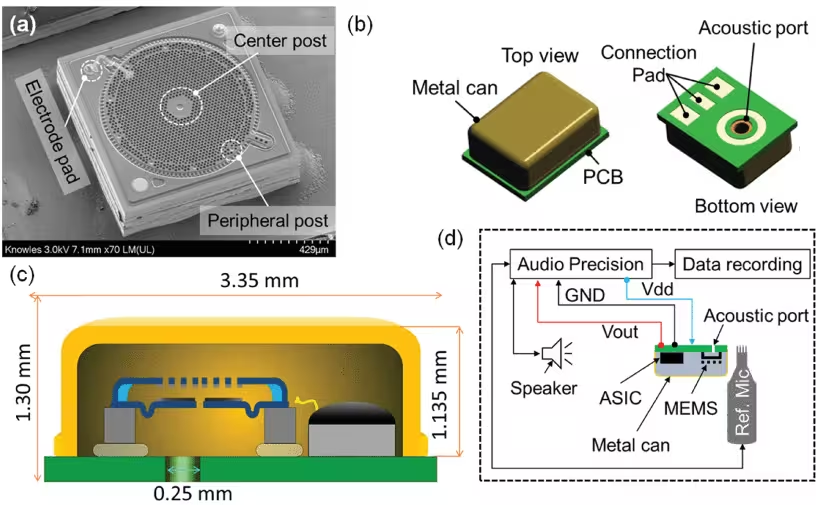
The large signal model is split into the acoustic, mechanical, and electrical domains. In the acoustic domain, the model is based on the acoustic port and Beranek models. The mechanical domain consists of four subblocks: i) acoustic pressure vs. diaphragm displacement, ii) maximum displacement, iii) applied DC bias vs. transducer’s capacitance, and iv) the nonlinear electrostatic force caused by the applied DC bias voltage. In the electrical domain, the model includes parasitic capacitance and ASIC input capacitance, with parasitics calculated from the diaphragm’s proximity to the PCB and backplate.
The model was used to evaluate the change in IMD while varying several microphone design parameters, such as ASIC input capacitance, bias voltage, port diameter, and the gap between the diaphragm and backplate. Simulations were performed using COMSOL Multiphysics to model diaphragm and backplate deflection under sound pressures ranging from -200 Pa to +400 Pa.
Results show that IMD improves with lower ASIC input capacitance, reduced bias voltage, smaller port diameter, and a larger diaphragm-backplate gap. However, these improvements may come at the cost of reduced sensitivity and increased noise—highlighting key trade-offs in microphone design.
The simulations were validated with real microphone measurements, confirming the model’s accuracy near resonance and in the ultrasonic range. This model enables designers to consider IMD alongside sensitivity and noise, helping to balance trade-offs and optimize overall performance.
This model demonstrates strong potential for hearing health applications, offering excellent electro-acoustic characteristics, including a flat frequency response, low noise, wide dynamic range, and low IMD.
This study has two key limitations: diaphragm thickness affects IMD due to increased deflection and nonlinear forces, and the ASIC design has yet to be explored beyond the input buffer. Future works may examine the impact of diaphragm thickness and ASIC distortion on overall microphone IMD.