



NEMO: Real-Time Noise and Exhaust Emissions Monitoring for Sustainable and Intelligent Transportation Systems
The transportation sector contributes to one of Europe's most pressing environmental pollution and public health challenges. While road traffic noise significantly contributes to cardiovascular disease, sleep disruption, and cognitive decline in children, transportation fumes generate 29% of global CO2 emissions. Research shows that a small fraction of the highest-emitting vehicles account for nearly 80% of road pollution. Identifying and addressing these outliers is crucial for achieving climate-neutral transport for cleaner cities.
NEMO (Noise and Emissions Monitoring and Radical Mitigation), developed under an EU Horizon 2020 project, is a real-time monitoring system that simultaneously detects noise and exhaust emissions from road vehicles and trains. Unlike existing solutions such as Bruitparif's Hydra system, which focuses solely on noisy road vehicles, NEMO offers a unified, comprehensive approach covering multiple transport modes and both pollution types.
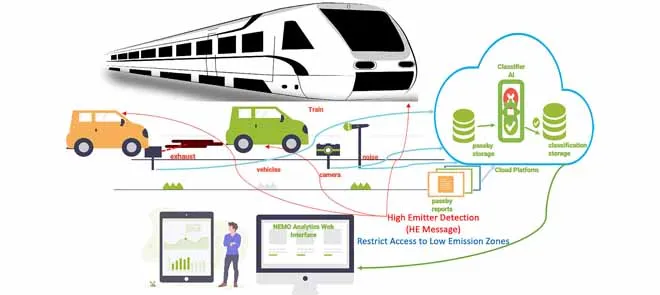
The system combines roadside remote sensing devices (microphone arrays, exhaust sensors, weather stations, license plate cameras, and vehicle classification sensors) with a cloud-based platform called Nautilus. With each passing vehicle, sensor data is synchronized into a "pass-by report," enriched with registration information, and processed by an AI-enabled classification model. A neural-network-based classifier compares each measurement against a Sound Expectation Model built on physics-based formulas for tire-road, powertrain, and dynamic noise, and in real-time labels vehicles as normal, medium, or high emitters based on these measurements.
A key technical innovation is NEMO's noise-source detection algorithm, which uses microphone arrays and beamforming to identify loud vehicles in dense traffic streams. To ensure accurate measurements of individual vehicles, a peak-level correction method eliminates interference from nearby vehicles even in peak traffic.
Results are communicated after classification through NEMO's Classification Dialog System via multiple channels: V2X onboard units that display warnings directly on in-cabin screens, email alerts, SMS notifications, and a dedicated mobile app. Based on each vehicle's emission profile, tolling fees can also be calculated, enabling cities to enforce variable charges in low-emission zones.
NEMO was deployed and tested across Rotterdam (Netherlands), Florence (Italy), Barcelona (Spain), and Teesdorf (Austria). In Rotterdam, approximately 315,000 vehicle pass-bys were recorded: 74% were classified as normal emitters, 19% as medium, and 7% as high. In Teesdorf, real-time infrastructure-to-vehicle communication was successfully validated in controlled scenarios at 50 and 70 km/h. The system also extends to railways; train wagons are monitored against wagon-type-specific noise thresholds. Field data showed significant proportions of high-emitting freight and passenger trains.
An intuitive analytics dashboard for infrastructure managers is provided. It allows authorities to query, filter, and visualize data by vehicle type, fuel, model, or location, supporting evidence-based policymaking. Privacy is preserved through GDPR-compliant measures, including real-time license plate recognition without storing original images and the immediate deletion of audio recordings.
NEMO combines IoT sensors, artificial intelligence, remote sensing, and cloud infrastructure to provide cities with a scalable, cost-effective solution for cleaner and quieter mobility. Future work will expand the platform to address maritime emissions and leverage 6G communication and edge computing to reduce notification latency, paving the way for the next generation of sustainable and intelligent transportation systems.