



Multisensor Smart Eyewear for Biomarkers Acquisition
Smart eyewear is rapidly evolving from an emerging technology to a promising futuristic platform for health monitoring. Its strategic position on the eye, with convenient proximity to the head and natural points of contact with the skin, enables smart eyewear to access physiological signals that are difficult to capture with traditional wearables such as wristbands or chest straps.
This work presents a compact, multisensor smart eyewear system designed to unobtrusively acquire a wide range of physiological and activity parameters while preserving the comfort, autonomy, and everyday usability of regular eyewear or glasses.
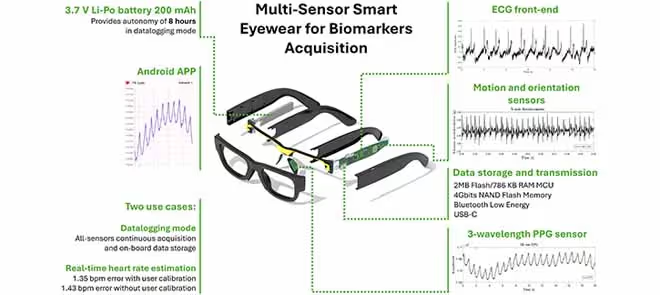
The proposed device is fully embedded within a standard eyewear frame. It integrates three interconnected Printed Circuit Boards (PCBs): a main board housed in the left temple, a flexible PCB running across the front, and a probe board placed in the left nose pad. The three-board architecture was specifically designed to conform to the mechanical constraints of a standard eyewear frame while preserving sensing performance and wearability. In addition, component selection and system design were driven by the power constraints of a battery-powered device.
The integrated sensors include a 3-wavelength optical sensor for photoplethysmography (PPG), front-end and electrodes for on-demand electrocardiography (ECG), inertial sensors, and environmental and capacitive sensors. By combining these elements in a single wearable platform, the system can monitor cardiovascular parameters such as Heart Rate (HR) and blood oxygen saturation (SpO2), detect physical activity and head movements, and support sensor fusion for advanced parameter estimation.
Unlike many previous prototypes that rely on bulky external modules or additional battery packs, the proposed system is entirely standalone and powered by a 200-mAh rechargeable lithium-polymer (Li-Po) battery, enabling continuous operation for approximately 8 hours with all sensors active. In addition, onboard flash memory allows the device to store up to 526 MB of data, enabling extended data collection. Moreover, the system includes USB-C and a Bluetooth Low Energy (BLE) module for wired and wireless communication.
This work presents two operating modes. In the first mode, the proposed system works as a wearable data logger, continuously recording synchronized signals from all embedded sensors. This capability is particularly valuable for collecting datasets in both controlled and free-living conditions. In the second mode, the device performs real-time signal processing directly on board, estimating heart rate from the PPG signal and wirelessly transmitting both raw data and computed metrics to a smartphone application.
Overall, this work demonstrates that smart eyewear can be used beyond simple sensing or interaction tasks and can serve as a powerful, unobtrusive tool for continuous, real-time health monitoring. By combining multisensor integration, low-power embedded processing, and convenient wearability within a standard frame, the proposed platform addresses many of the limitations of existing head-worn devices. This approach opens the door to future research on wearable devices and on the applications of smart eyewear in personalized healthcare, long-term physiological monitoring, and real-world biomedical research.