



Machine Learning-Enhanced Flexible IL-6 Sensor for Rapid Threshold Detection
Inflammation is the body’s natural defense against injury or infection. However, when it becomes excessive or uncontrolled, it can signal serious and even life-threatening conditions. One of the most critical indicators of inflammation is interleukin-6 (IL-6), a protein released by the immune system. Elevated IL-6 levels are associated with diseases like cancer, rheumatoid arthritis, and, most critically, sepsis, in which early diagnosis increases survival chances. In many clinical situations, knowing whether IL-6 has crossed an abnormal threshold is more important than measuring its exact concentration.
Laboratory blood tests typically measure IL-6 levels. Though accurate, these tests are invasive, time-consuming, and unsuitable for continuous monitoring outside hospitals. Recent research has shown that IL-6 levels in sweat closely reflect those in blood, creating an opportunity for minimally invasive, wearable sensing technologies. Sweat-based monitoring could enable earlier warnings, continuous tracking, and faster clinical decisions without repeated blood draws.
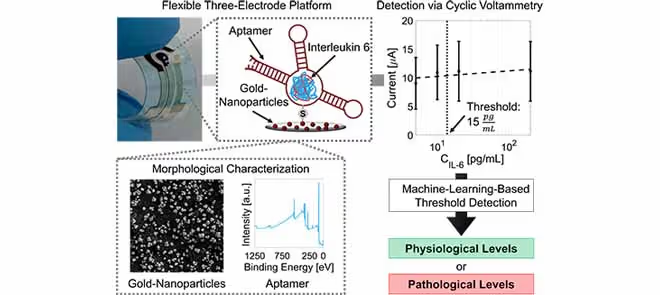
This work presents a flexible electrochemical sensor for detecting IL-6 in sweat at picogram-per-milliliter (pg/mL) concentrations. The sensor is fabricated using a scalable screen-printing process on a thin plastic substrate, allowing it to bend and conform to the skin. Its sensing surface is enhanced with gold nanoparticles to improve electrical performance and is functionalized with IL-6-specific aptamers—short DNA strands that selectively bind to IL-6 molecules. When IL-6 in sweat binds to these aptamers, it induces subtle changes in the electrical behavior of the sensor.
These changes can be measured using cyclic voltammetry, a simple, energy-efficient technique well-suited to compact, battery-powered devices. However, at typical clinically relevant IL-6 concentrations, the variations in electrical signals captured by this technique are too insignificant to enable accurate interpretation. To address this challenge, the researchers complemented cyclic voltammetry with machine learning, rather than relying on complex hardware or highly sensitive laboratory techniques.
Rather than extracting a single value from the electrical signal, the machine learning algorithm analyzes the entire measurement pattern and learns how it changes as IL-6 levels rise. The system is trained to distinguish between normal (physiological) and elevated (pathological) IL-6 levels, focusing on threshold detection instead of exact quantification. Among several tested methods, a lightweight classifier known as k-nearest neighbors proved especially effective, correctly detecting, in nearly all cases, whether IL-6 levels exceeded a clinically relevant threshold.
This approach is designed with real-world wearable applications in mind. The sensor avoids complex chemical labels, the measurement technique is low power, and the machine learning model is computationally simple enough to run on small embedded electronics. By focusing on threshold-based alerts rather than precise concentration values, the system simplifies interpretation and reduces the risk of false alarms—an essential consideration in medical monitoring.
This work demonstrates that combining flexible sweat-based electrochemical sensors with machine learning can enable reliable, noninvasive detection of critical inflammatory markers. The approach lays the foundation for future wearable devices capable of continuously monitoring inflammation, providing early warnings of disease escalation, and supporting timely medical intervention without the need for invasive blood tests.