



Kinematic Assessment of Upper Limb Impairment in Stroke Survivors Through IMUs During Box and Block Test
Stroke survivors often experience brain damage that also causes motor impairment. The death of neurons in the central nervous system diminishes the ability to generate and control movements, impacting even essential activities such as walking, maintaining balance, and manipulating objects. A careful assessment of the level of impairment is crucial for designing effective rehabilitation treatments and monitoring the progress over time.
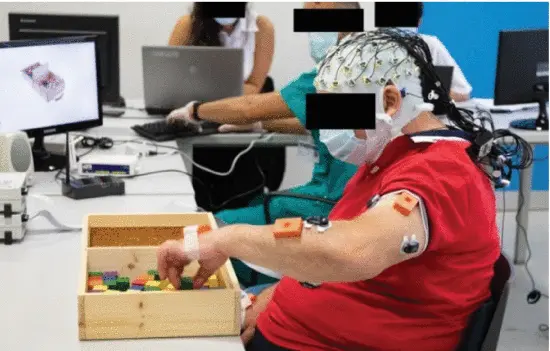
Upper limb capabilities are commonly assessed using the box and block test (BBT). In this test, the patient is required to move a series of small, colored wooden blocks from one side of a square box to the other. The task involves hand-eye coordination, object manipulation, and movement planning skills. The performance index is determined by counting the number of blocks correctly moved in one minute.
In this study, researchers applied motion capture (mocap) technologies to demonstrate their potential to enhance clinical value by providing additional quantitative movement descriptors. Mocap has been applied for decades to assess motor control, generating useful data for calculating indices of motor accuracy, velocity, and smoothness in typical point-to-point reaching tasks. However, its application to BBT was still unexplored, partly due to the complexity of traditional mocap technologies based on stereophotogrammetry- a combination of multiple cameras and reflective markers. This complexity contrasted with the simplicity of the BBT.
This work uses Inertial Measurement Units (IMUs), which offer several advantages, including easier, faster patient preparation, greater workspace flexibility, and improved sustainability. Patients were fitted with a wireless IMU on their upper limbs, torso, and pelvis - a total of 8 sensors. The orientation data from each sensor were fed into a biomechanical model to derive translation data for the patient's hands in relation to their trunk and the rotation angles of their upper-body joints. The only additional task for the patients was an easy sensor-to-segment calibration procedure, previously validated using simple static positions.
The developed solution tracks patients' gestures during the task execution. Its validity was tested in an experiment involving 10 stroke survivors and 14 healthy subjects who served as a control group. Each BBT repetition was isolated and segmented into three phases: reaching, transfer, and returning. A set of motion control indices was calculated from 20 repetitions per patient on both the affected and non-affected sides and, for healthy subjects of the control group, from 20 repetitions on the dominant side only. It resulted in a dataset consisting of three groups.
The study showed significant differences among the three groups, which were analyzed statistically. Several kinematic biomarkers of pathology emerged, including the maximum hand speed, average hand acceleration, normalized range of hand excursion, and lumbar angle. Some of these biomarkers also showed significant correlations with the BBT score, strengthening their validity as indicators of impairment and as tools for tracking motor recovery in rehabilitation. These findings pave the way for future studies involving larger participant groups and for further exploration of potential stroke-related motor impairment indices and their progression over time.