




Key Metrics and Experimental Test Bench for Assessing Highly Sensitive Magnetometers in Research
Ultralow magnetic field sensing is an emerging technology for detecting extremely weak magnetic fields, down to femtotesla (10⁻¹⁵ tesla) levels. It is increasingly applied in medical diagnostics, geophysical exploration, navigation, and industrial inspection, offering a noninvasive and real-time method of data acquisition (DAQ).
While Superconducting Quantum Interference Devices (SQUIDs) remain the gold standard technology for such measurements, modern sensor technologies, such as Spin-Exchange Relaxation-Free Optically Pumped Magnetometers (SERF-OPMs) and other emerging magnetic sensors, offer non-cryogenic operation and have advanced rapidly over recent years. These sensors are essential for applications such as Magnetoencephalography (MEG), Brain–Computer Interfaces, Biomagnetic Diagnostics such as Magnetocardiography (MCG), Magnetomyography (MMG), and non-destructive Testing, where detecting femtotesla-level magnetic fields is required. However, objective performance comparisons between different sensor types and commercial multichannel systems have remained challenging due to the lack of unified, traceable evaluation methods.
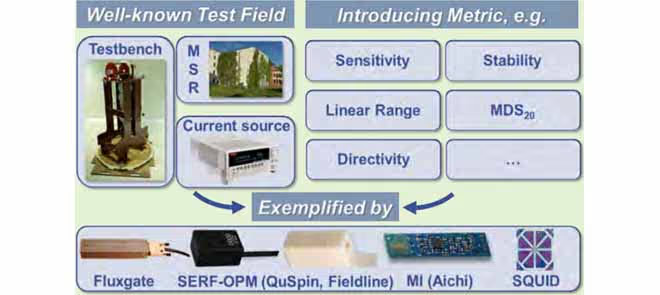
This study presents for the first time a comprehensive experimental test bench, the Device ALignment ACactuator (DALAC) system, developed for evaluating magnetometer units under highly controlled and reproducible conditions.
The device is constructed entirely from nonmagnetic materials with minimal magnetic susceptibility, preventing distortion of the test field. Its main structural components are fabricated from cotton-based plastics and assembled with nylon screws, while the ball bearings employ polymer tracks and glass balls to ensure smooth, interference-free motion. The DALAC's modular design also makes it possible to adapt it to the characterization of multichannel sensors as well as emerging sensor concepts, with test fields up to 1.5 µT. The system is mounted within a magnetically shielded Room at the Physikalisch-Technische Bundesanstalt (PTB) in Berlin. It is capable of precise three-dimensional rotation and spatial alignment of magnetometers within a homogeneous magnetic test field.
The required evaluation tests are typically performed using sinusoidal magnetic test fields of precisely known amplitude and frequency. The corresponding responses at sensor output are simultaneously recorded and compared with high-precision SQUID reference sensors operating in parallel. A set of key performance metrics was developed to enable objective comparison, including sensitivity, frequency response, bandwidth, linearity, and both frequency and amplitude stability, among others.
A significant contribution is the introduction of a figure-of-merit called MDS₂₀ (Minimum Detectable Signal), which combines the intrinsic sensor noise at 20 Hz with the minimum sensor-to-source distance. This parameter provides an intuitive, comparable measure of detection capability across different sensor types and geometries. The study also details the influence of angular alignment between the sensor and test field (directivity), and sensor stability over extended periods, using tools such as Allan deviation analysis to quantify mid-term amplitude and frequency stability.
Beyond technical benchmarking, the presented work establishes a unified methodology for evaluating magnetometers according to metrological standards, which is particularly important since manufacturers often provide only partial specifications, or none at all, and for the characterization of research-grade devices or new magnetometer types. The methodologies developed in this contribution ensure consistent, traceable performance evaluation across laboratories, support cross-technology comparison, and accelerate the development of next-generation magnetometers.