



ISI Mitigation Using Neural Networks in Molecular Communication With an Imperfect Transmitter Between Bionanosensors
The emerging field of molecular communication (MC), often referred to as bionanosensors, enables tiny devices to communicate. The inspiration comes from cellular interactions in living organisms and how they exchange information through chemical molecules. This approach is promising for very small-scale applications, such as biological sensing, where conventional wireless communication is impractical.
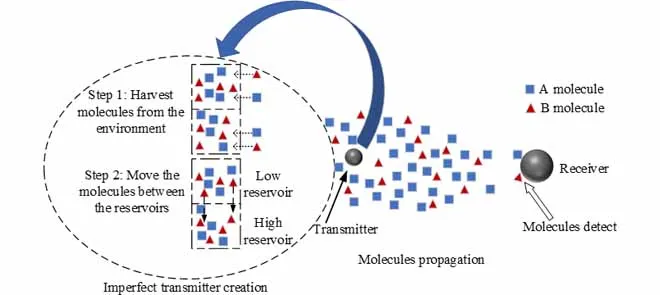
Diffusion-based molecular communication (DBMC) systems that use bionanosensors face significant challenges due to inter-symbol interference (ISI), making it difficult to maintain a stable signal at such a small scale. ISI occurs when molecules in the environment move randomly and linger, thereby interfering with previously transmitted signals. It makes it difficult for the nanosensor to receive the intended message accurately. The situation becomes even more complicated when transmitters release molecules inconsistently due to design constraints, energy limitations, or environmental factors, further distorting the communication process and increasing the likelihood of errors.
This paper studies a binary MC system using biological nanosensors, focusing on decoding methods that reliably recover transmitted information in the presence of strong interference and noise. To address this challenge, the researchers investigate learning-based detection techniques using computational models, such as deep neural networks (DNNs) and convolutional neural networks (CNNs). These methods are attractive because they can identify complex patterns in data without prior knowledge of the communication channel, which is often unknown or subject to change in biological environments.
The influence of the input data format on detection performance was also studied. Two input types were considered: (i) directly using the number of molecules received and (ii) using the ratio of different types of molecules received. The results show that using the received molecule counts yields better performance, as this representation preserves more information.
Simulation results demonstrate that both deep neural networks and convolutional neural networks achieve performance close to optimal detection. Among all methods, convolutional neural networks outperform the others due to their strong ability to capture local patterns in the received signals. Conventional techniques, such as K-means clustering, also performed competitively under certain conditions. Furthermore, increasing the concentration difference between transmitter molecular reservoirs reduced interference and improved detection accuracy.
The comparison of different detection methods considered their accuracy, computational complexity, and practical deployment feasibility. Among them, optimal detection achieved the best performance but required extensive simulations to determine decision thresholds, resulting in very high computational cost and limited practicality.
K-means clustering has moderate complexity while having competitive performance. Deep neural networks exhibited relatively low computational complexity and high deployment feasibility, but they have lower detection accuracy. Convolutional neural networks require higher computational effort due to convolution operations, yet they offer a favorable balance between complexity and performance.
This research highlights that neural network-based detection offers a robust, practical solution to improve reliability in MC systems. It enhances nanoscale communication and enables reliable communication between bionanosensors. These advancements could lead to advanced nanomedical systems and contribute to the development of reliable, efficient, and intelligent nanocommunication networks for healthcare applications.