



In Situ Temperature-Compensated Puncture Force Sensing for Brain Stereotactic Puncture Needle Using Fiber Bragg Grating
Needle puncture is a critical procedure in neurosurgical intervention. It creates a channel to access intracranial targets, enabling subsequent surgical procedures such as tissue biopsy and drug delivery. However, any deviation from the pre-planned puncture pathway could damage delicate neurovascular structures, resulting in serious functional loss. Therefore, real-time, accurate monitoring of the needle-tissue interaction force is essential for safety, providing surgeons with instant feedback to stop or adjust their approach before causing any harm.
Fiber Bragg grating (FBG) sensors are compact, biocompatible, and immune to electromagnetic interference, making them ideal choices for force sensing in interventional instruments. However, FBG sensors are sensitive to both mechanical strain and temperature changes, leading to inaccuracies and nonlinearity in force measurements. The conventional solution is to use an additional FBG located away from the strain-sensing FBG for temperature compensation. However, during needle insertion, obvious temperature gradients along the needle may lead to compensation errors.
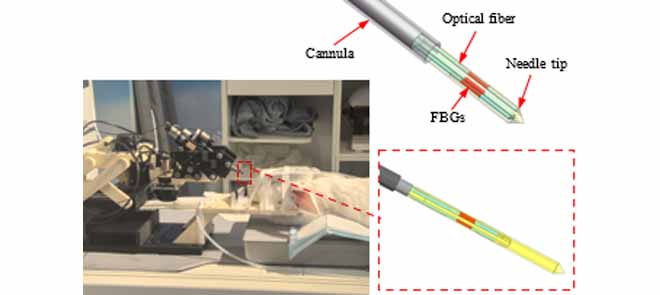
Instead of placing gratings at different locations, the design introduced in this paper integrates sensing and reference FBGs side by side to achieve in situ temperature compensation. A structured shaft with inner micro-channels is fabricated with 3D printing to accommodate the multiple FBGs in the required arrangement. Since the gratings are co-planar, any temperature change affects both gratings equally and simultaneously, thereby eliminating errors caused by spatial temperature gradients during needle insertion.
Two types of needles, one-axis and three-axis, are designed to achieve one-dimensional longitudinal and three-dimensional lateral force sensing, respectively. Both needles show excellent linearity over the 0-5 N measurement range. Additionally, the force sensing needles are used as inner stylets that can be easily assembled into and detached from outer cannulas.
Once the target is reached, the inner needle can be removed to clear the channel for other surgical tools. Therefore, the proposed needle can be seamlessly integrated with the current surgical workflow while providing additional force feedback. Furthermore, owing to their non-metallic nature, these sensors can operate in strong magnetic fields, thereby enabling their use in MRI-guided neurosurgical intervention.
To validate the performance of the proposed method, comparative puncture experiments were conducted in both water and agar phantoms. The co-planar-grating sensor used in this research clearly outperformed the conventional dual-grating sensor in terms of force-sensing accuracy and stability. It demonstrated significant advantages in handling the temperature gradients during the puncture process.
The researchers progressed from using phantom models to experimenting on actual biological tissue. In vivo animal trials of brain puncture were conducted inside a 3T MRI scanner. The results demonstrated that the proposed sensor maintained reliable force sensing throughout the entire procedure, confirming its practical effectiveness.
To conclude, the work presented here offers an improved solution for accurate force sensing in needle puncture procedures. The standalone design makes for easy integration into standard surgical workflows. This advancement enhances safety and precision in MRI-compatible neurosurgery, ultimately leading to better patient outcomes.