



Impact Solenoid Modeling for Current-Dependent Piston Position Estimation
Impact solenoids are specialized electromagnets equipped with captive pistons and free-moving plungers to convert electrical energy into mechanical impact and are designed to exert high force on other objects. These solenoids are used to test the impact resistance of hardware, to emboss materials during manufacturing, and to generate acoustic signals for non-destructive testing.
Impact solenoids are used in a wide range of applications. They often function as automatic hammers in industrial automation, turbine and generator testing, and the assembly of robots and equipment. For many of these applications, knowing the precise trajectory of the impact would help improve processes and support preventive maintenance. Usually, this requires installing an additional sensor to accurately measure piston position, or using specialist solenoids with built-in sensors.
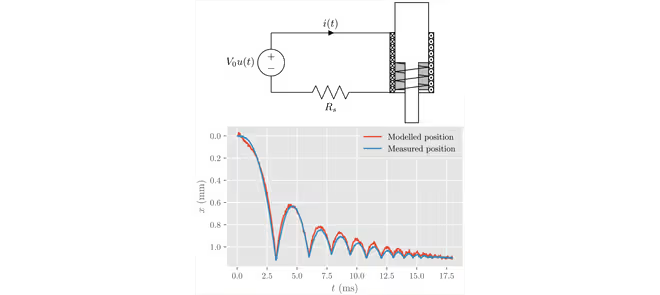
This work introduces a framework for estimating piston position based on the current through the solenoid coil, measured with a shunt resistor, and physical parameters of the solenoids. The solenoid parameters can be directly measured or determined using a reference sensor, which can be deployed on a single test system rather than on all pistons. Given the current measurements and solenoid parameters, the piston position can be identified with high precision.
A magnetic model was derived from Maxwell’s equations to establish the desired piston position estimation technique. The result is general enough to capture the behaviour of any captive, spring-return, open-frame impact solenoid. This model yields the piston position of such a solenoid if the current through it, starting from excitation, is known. However, the magnetic model itself is very sensitive to the total resistance, which is the sum of the coil, MOSFET, and shunt resistances, and can change with temperature and gate voltage.
To alleviate the model’s sensitivity to this time-varying parameter, the proposed system explores the property that secondary impacts occur approximately at the same stroke length as their neighbours. The resistance given to the model is thus slightly modified on either side of the rated resistance, so that neighbouring impacts occur at similar distances, ensuring that the resistance used for each impact matches variations in temperature and gate voltage.
The system was validated using two off-the-shelf low-cost impact solenoids, the DSOS-0416-09D and TAU-0530T. For each test solenoid, a piece of sheet steel was impacted, with coil current measured via a shunt resistor, and the actual piston trajectory measured via a laser vibrometer. For the DSOS solenoid, the estimated piston displacement differed from the vibrometer-measured displacement by 28.1 μm. The larger TAU solenoid had an estimation error of 104 μm.
The work provides a cost-effective but still accurate way to add trajectory observations to off-the-shelf impact solenoids. Most system errors occur near solenoid energisation, away from the actual impact, and are influenced strongly by the piston's initial magnetisation. Deployments that include magnetic resets for the solenoid may achieve even lower error rates. Future work will explore which magnetic return voltage profiles can maximise these accuracy improvements.