



Hydrothermally Synthesized pH-Tailored Ag-Doped ZnO Nanostructure for Printed Room-Temperature NO₂ Gas Sensor
Nitrogen dioxide (NO2) is a harmful air pollutant, and developing a sensor that can detect it at room temperature is a major challenge for environmental monitoring. Conventional metal oxide sensors often require high operating temperatures. This research addresses this limitation by using the hydrothermal synthesis method to develop silver-doped Zinc oxide (AgZO) nanostructures, in which the pH of the precursor solution is the primary factor in optimizing their structural and electrical properties.
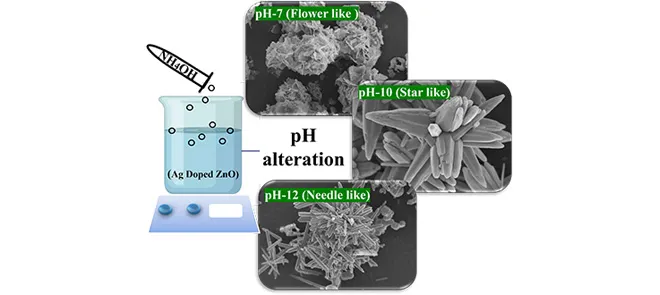
This study explores morphological evolution influenced by changes in pH levels. At pH 7, the material developed flower-like structures with thin petals. As the alkalinity increases to pH 10, the morphology shifts to star-like rods. Finally, at pH 12, the nanostructures form long, needle-like self-assemblies resembling flower-like structures. This transformation is governed by the controlled release of hydroxide ions (OH^-) resulting from the decomposition of hexamethylenetetramine (HMTA), which regulates nucleation and crystal growth kinetics.
Chemical and optical characterizations confirm the successful integration of silver into the ZnO lattice. X-ray diffraction (XRD) and X-ray photoelectron spectroscopy (XPS) analyses reveal that while lower pH levels lead to silver forming a decorative surface layer, pH 12 promotes moderate silver (Ag) doping and the formation of Ag-O-Zn bonds. This doping reduces the bandgap from 3.51 eV at pH 7 to 3.09 eV at pH 12, facilitating improved charge mobility. Although the surface area decreases at higher pH due to agglomeration (from 37.18 m^2/g at pH 7 to 5.15 m^2/g at pH 12), the pH 12 needle structures provide the most efficient pathways for electron transport.
For device fabrication, the AgZO material was formulated into a printable ink and deposited onto the interdigitated electrode printed on a quartz substrate using a commercially available silver nanoparticle ink. The pH 12 sensor demonstrated superior performance, exhibiting a stable response of 16.2% at 32 PPM of NO2. It achieved a rapid response time of 107 seconds and a recovery time of 130 seconds at room temperature. Additionally, the sensor also showed improved selectivity, with negligible interference from CO2 gas.
The sensing mechanism is primarily governed by the modulation of the surface electron-depletion layer. In ambient air, oxygen molecules capture electrons from the AgZO conduction band, leading to an increase in resistance. Upon exposure to NO2, the gas reacts with pre-adsorbed oxygen ions, releasing trapped electrons back into the material and causing a decrease in resistance. Silver (Ag) plays a vital catalytic role in this process by weakening the oxygen binding and accelerating electron return.
This pH-tailored approach provides a low-cost, scalable, and energy-efficient method for fabricating high-performance gas sensors. By optimizing the morphology, crystallinity, and defect density at pH 12, the researchers have established a novel pathway for detecting NO2 gas at room temperature, making it competitive with existing nanostructure-based sensors. Furthermore, the printable AgZO technology holds significant potential for integration into flexible, large-area environmental sensing platforms.