



Human Movement Classification With a Garment-Integrated Knot-Based Strain Sensor
Wearable sensors designed for monitoring human movement can facilitate at-home rehabilitation, game-based therapy, the care of older adults, and fitness and sports training. Strain sensors can specifically measure changes in the fabric of a garment to monitor body movement. This paper proposes a novel strain sensor that leverages conductive thread arranged in a knot-based structure. This design enables the sensor to exhibit changes in electrical resistance as it stretches and compresses, due to geometric changes in the loops of the conductive thread.
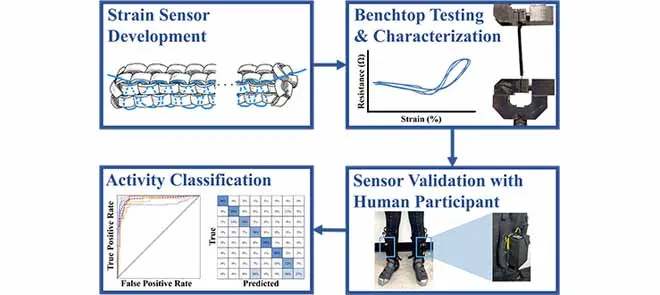
The design features a flexible, yarn-based, fabric-compatible sensor that can be customized and has a large working range for measuring strain in wearables that experience high strains. Benchtop testing confirmed that sensor performance was comparable to that of similar yarn-based strain sensors reported in the literature, including working range, gauge factor, and hysteresis. As with other yarn-based strain sensors, hysteresis remains a limitation for this sensor. However, this issue could be addressed in the future using different base materials. In this study, however, machine learning is proposed as a method to compensate for hysteresis effects, enabling improved data collection and interpretation.
Here, the researchers integrated the strain sensor into a full-body spaceflight garment, the Gravity Loading Countermeasure Skinsuit (GLCS), to detect astronaut movements aboard the International Space Station. This application is important because measuring astronaut movements can help quantify daily activities, monitor exercise, and assess adaptations in sensorimotor function, posture, and movement strategies over time in the microgravity environment. However, spaceflight presents a complex operational environment, so successful wearable devices must be simple, user-friendly, and robust against operational constraints. Thus, to create a simple movement-monitoring system, a single strain sensor was integrated at the ankle of the existing spaceflight garment, along with basic electronics.
Supervised machine learning models (i.e., multinomial logistic regression) were applied to classify full-body movements using data from a single strain sensor placed at the ankle. The model successfully classified non-local body movements across the knee, hip, ankle, and torso joints, achieving a recall rate of 56.3%. This performance was averaged across 8 tested body movement types, showing a significant improvement over a random chance of 12.5%.
By integrating strain data with inertial measurement unit (IMU) and gyroscope data from the ankle-mounted electronics, the researchers achieved enhanced activity classification compared to using each sensor modality independently. The combined model achieved a recall greater than 70%, also averaged across the 8 tested body movement types. Some specific body movements were classified with notable success, including knee flexion (98.8%), resting posture (94.1%), and hip extension (90.4%).
The machine learning methods proposed in this paper have been demonstrated in the spaceflight environment, enabling non-local monitoring using simple electronics and minimal sensors in complex real-world environments. These methods are additionally robust to sensor limitations, such as hysteresis, which is common in other resistive yarn-based strain sensors. Future applications of these sensors and methods extend beyond spaceflight and include monitoring older adults, facilitating at-home rehabilitation, improving workplace ergonomics, and enhancing sports performance.