



Highly Enhanced Sensing Performances of Si-Based Electrolyte-Gated Transistor (EGT) Using Silver Nanowire Coating Method in Chikungunya Detection
Chikungunya virus (CHIKV) is a mosquito-borne pathogen that causes fever, joint pain, and long-lasting fatigue, posing a serious public health challenge in tropical and subtropical regions. Its rapid and accurate diagnosis is critical, as symptoms often overlap with those of dengue and Zika infections. However, conventional diagnostic techniques typically require complex, lengthy laboratory procedures and trained personnel, limiting their usefulness for point-of-care testing.
To address these challenges, this study presents a highly sensitive and scalable biosensing platform based on a silicon electrolyte-gated transistor (EGT) with a silver nanowire (AgNW) spray-coated gate electrode. EGTs operate at low voltages, offer intrinsic signal amplification, and allow direct interaction between biological targets and the gate electrode, making them useful for biosensing applications. Here, the gate electrode itself functions as the sensing interface, eliminating the need for complex extended-gate structures that often introduce signal instability.
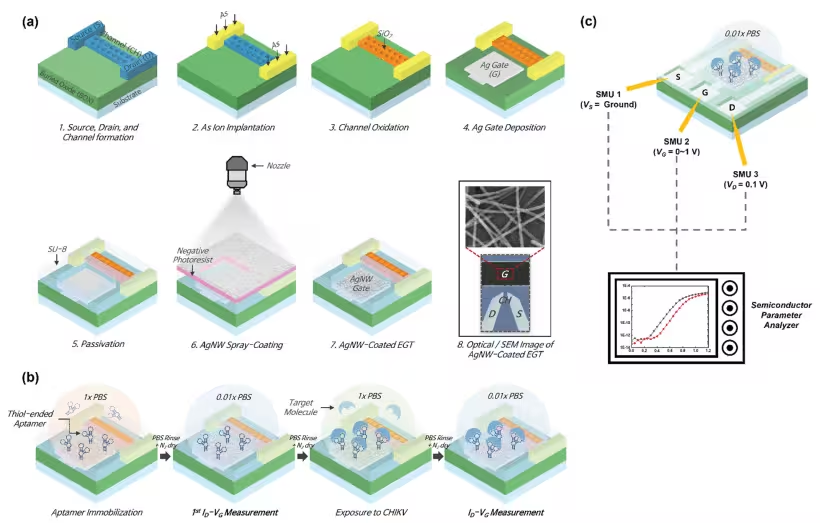
To further improve sensing performance, a network of silver nanowires was introduced onto the gate surface using a simple spray-coating and lift-off process. This approach significantly increases the effective surface area without degrading the transistor’s intrinsic electrical characteristics.
The sensors were fabricated on industry-standard 8-inch silicon-on-insulator (SOI) wafers using a top-down semiconductor manufacturing process. This approach enabled excellent electrical characteristics with high device-to-device uniformity and yield, demonstrating that the proposed biosensor platform is compatible with large-area fabrication and practical deployment using established silicon technologies.
After device fabrication, aptamers specifically designed to bind the CHIKV envelope protein were immobilized onto the AgNW-coated gate surface. The porous nanowire network provides more binding sites for aptamers, enabling a higher receptor density than conventional flat metal gates. Electrical measurements confirmed that the AgNW coating does not compromise device stability, while subsequent aptamer immobilization and virus binding produce clear, reproducible shifts in the transistor’s threshold voltage.
The sensing performance was systematically evaluated by varying the AgNW coating time. An optimized coating time of 20 seconds showed the best results, resulting in a 230% increase in sensitivity compared to uncoated devices. The sensor achieved a remarkably low limit of detection of approximately 430 pg/mL, representing nearly a 200-fold improvement over conventional electrolyte-gated transistors. Notably, the device maintained a wide dynamic range, spanning more than 4 orders of magnitude in CHIKV concentration.
To understand the performance enhancement, a lumped-capacitive model was employed to separate capacitive effects from dipole-induced signal contributions. The analysis revealed that the dominant factor behind the improved sensitivity is the increased dipole potential generated by virus–aptamer bindings, which is directly linked to the higher density of immobilized aptamers enabled by the AgNW network.
Selectivity tests further demonstrated that the proposed sensor responds strongly to CHIKV while exhibiting negligible responses to other mosquito-borne viruses, including dengue, Zika, and yellow fever. This high specificity highlights the robustness of the proposed sensor platform.
This study demonstrates a low-cost, scalable, and high-performance biosensing platform capable of detecting viral biomarkers at ultralow concentrations. The proposed silver nanowire–enhanced electrolyte-gated transistor shows strong potential for point-of-care diagnostics and can readily be extended to detect other infectious diseases and clinically relevant biomarkers.