



High-Performance THz Nanometamaterial Absorber With Negative Permittivity (0.1–10 THz) for Early Cancer Detection via Circulating Exosomes
Cancer remains a major global health challenge, leading to millions of deaths each year despite technological advancements. Early detection of cancer improves disease management, transforms treatment strategies, and significantly boosts survival rates. This urgency has prompted the development of advanced diagnostic approaches, such as liquid biopsy, multi-omics, optical sensing, and microfluidic technologies.
Liquid biopsy enables noninvasive cancer detection through blood or urine samples by identifying circulating tumor DNA (ctDNA), circulating tumor cells (CTCs), and exosomes. Exosomes are small extracellular vesicles released by cells that carry their parent cells' molecular signatures and can serve as vital early-stage cancer indicators. However, conventional detection often relies on antibody or fluorescent labeling, which can be expensive, time-consuming, and prone to false positives.
Plasmonic and nanoscale metamaterial sensors offer a promising label-free alternative for exosome detection. By leveraging unique properties like negative permittivity of metamaterials, these sensors detect subtle changes in refractive index and scattering signals on their surface to identify specific biomolecules with high sensitivity.
Terahertz (THz) technology further improves biosensing performance. THz waves are non-ionizing and interact strongly with molecular vibrations, enabling safe, non-destructive, and noncontact biological analysis while preserving sample integrity. Their high sensitivity allows the detection of subtle molecular signatures associated with cancer without the need for chemical labels.
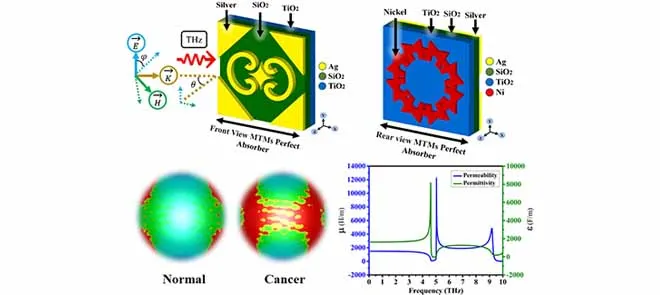
The study proposes a novel terahertz nanometamaterial absorber designed as a biosensor for early cancer detection through circulating exosomes. The device features a simple planar multilayer nanoscale architecture that avoids complex fabrication processes. It incorporates silver resonators that generate strong plasmonic interactions with electromagnetic waves, along with two dielectric layers composed of silicon dioxide (SiO₂) and titanium dioxide (TiO₂) to enhance electromagnetic confinement and absorption efficiency. A nickel backplane is included to optimize impedance matching and reduce signal noise, enabling highly sensitive detection of nanoscale biological samples.
This advanced sensor operates across an ultrawide frequency range of 0.1–10 THz and achieves absorption rates exceeding 92%, demonstrating remarkable sensitivity. The device is extremely compact, measuring just 100 × 100 × 30 nm, making it suitable for integration into portable diagnostic platforms.
A key feature of the biosensor is its ability to achieve negative permittivity at approximately 4.85 THz, which enhances sensitivity to small electromagnetic variations. Cancer-derived exosomes exhibit stronger electromagnetic coupling with the sensor due to their higher refractive index and dielectric constant. Strong confinement of electric and magnetic fields around the resonator structures further amplifies this interaction, producing distinct responses compared with normal exosomes.
The sensor’s electromagnetic performance was evaluated through numerical simulations, including field distribution analysis, surface current mapping, and scattering parameter evaluation. Results show strong field localization, minimal reflectivity, and efficient absorption, significantly improving signal-to-noise ratios. Furthermore, its polarization-insensitive design ensures consistent, reliable performance for practical biosensing.
Compared with existing THz biosensors, the proposed design offers a broader operational bandwidth, higher absorption efficiency, and significantly smaller physical dimensions. With further development, THz nano-metamaterial biosensors have the potential to play a crucial role in advancing noninvasive early cancer detection and improving global healthcare outcomes.