



Energy-Efficient Gas Sensing of NO and NO2 at Room Temperature Using Poly(triarylamine) Organic Semiconductor
The growing demand for sustainable sensing technologies has heightened interest in organic gas sensors over inorganic ones. This research explores the potential of the solution-processable conjugated polymer poly(triarylamine) (PTAA), which has attracted considerable interest due to its delocalized π-conjugated backbone, excellent film-forming ability, and thermal and chemical stability.
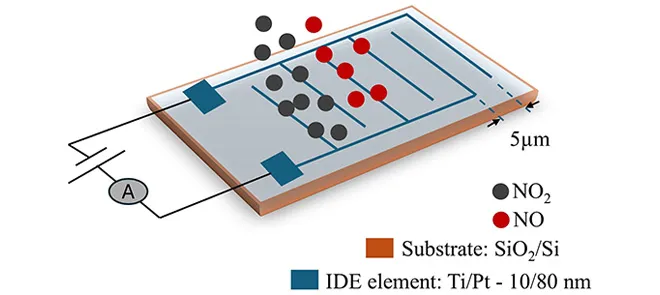
The work presents a low‑power, room‑temperature chemiresistive gas sensor based on PTAA deposited by a drop‑drying process onto prefabricated Ti/Pt interdigitated electrodes (IDEs) with 5 µm spacing. The sensor fabrication uses a simple, reproducible drop‑drying process (5 mg/mL PTAA in chloroform, 10 μL per 3×3 mm IDE area, dried at 80 °C).
X-ray diffraction analysis confirms PTAA’s amorphous morphology, showing a broad amorphous peak (≈15.84°) with a measured crystallite size of ~0.78 nm. Transmission electron microscopy and Scanning Electron Microscope (TEM/SEM) images reveal that the films are nanostructured and continuous with high-density domains. X-ray photoelectron spectroscopy combined with energy-dispersive X-ray spectroscopy (XPS/EDX) confirms the presence of carbon and nitrogen, with some minor surface oxidation. Fourier-transform infrared (FTIR) spectra identify various functional groups in the film, including aromatic C–H and C–N groups. These morphological features are essential for effective gas sensing.
Gas sensing tests were conducted in a controlled closed chamber using digital mass flow controllers and a source measurement unit with a 1 V bias across IDEs to capture current changes on exposure to target and interfering gases. The PTAA/IDE sensor exhibited a reproducible increase in conductivity when exposed to the oxidizing gases NO₂ and NO. This increase is attributed to electron withdrawal (p-type doping), which leads to hole accumulation, resulting in responses of 70.8% for NO₂ and 27.8% for NO at 5 ppm. Dynamic metrics for NO₂ were tresp ≈ 295 s and trecv ≈ 505 s, while NO produced slower dynamics (tresp ≈ 490 s, trecv ≈ 760 s). The baseline drift is attributed to slower desorption and partial trapping in the amorphous polymer.
Sensitivity measurements indicate a limit of detection (LOD) of ~1.0 ppm and a limit of quantification (LOQ) of ~1.8 ppm for NO2, with similar LOD (1.0 ppm) and LOQ (1.5 ppm) for NO, demonstrating a relevant detection capability near the occupational exposure limit (PEL = 5 ppm). Selectivity tests against 5 ppm H2S, SO2, and NH3 show much lower responses (≈9–10%), yielding selectivity factors for NO2 of roughly 7–8 times over these interferents.
Repeatability and reproducibility have been validated across multiple cycles and devices, with cycle‑to‑cycle variation for NO2 around just 3.7% and consistent responses between independently fabricated sensors.
Charge-transfer interactions explain the sensing mechanism: NO2, a strong electron acceptor, withdraws electrons from PTAA, thereby enhancing p‑type conductivity via hole-accumulation layers. A weaker interaction between the film and NO results in a lower sensor response but slower desorption.
The recovery and baseline drift for NO could be mitigated through interface engineering or surface functionalization with catalytic additives. PTAA‑based chemiresistive sensor offers energy‑efficient, room‑temperature detection of NOx with high NO2 sensitivity, good selectivity against common exhaust pollutants, and practical LOD values, positioning PTAA as a promising organic semiconductor for low‑cost ambient NOx monitoring applications.