



Distributed Stress Sensing in Polarization-Maintaining Fiber Under Circumferential Stress
In fields such as oil exploration, deep-sea operations, and structural health monitoring, sensors encounter immense physical challenges. One of the most difficult hurdles is accurately measuring "circumferential stress", which refers to the uniform radial pressure exerted on a sensor from all sides. Traditional research on polarization-maintaining fiber (PMF) has primarily focused on transverse stress, a single-directional stress. However, there is limited theoretical and experimental data on the minute optical changes induced by circumferential pressure acting from all directions.
Polarization-maintaining fibers have a unique internal structure characterized by an elliptical refractive index distribution. This research discovered that when circumferential pressure is applied to the fiber surface, this distribution undergoes asymmetric changes. By establishing a mechanical model based on elasticity theory and the Jones matrix, the research team successfully revealed the intrinsic link between pressure magnitude and the phenomenon of "polarization coupling" within the fiber.
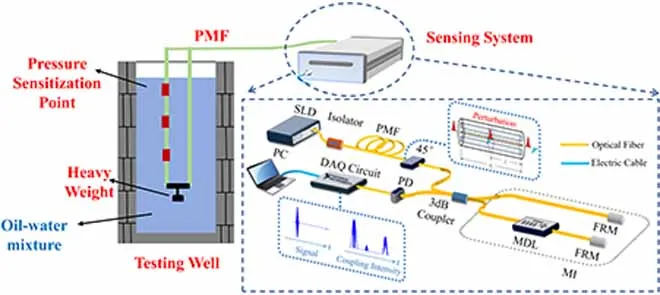
To detect these subtle signals, the system utilizes white-light interferometry. This method measures changes in coupling intensity with extreme precision. Simulation analysis further confirmed that when the action length of the stress meets specific conditions—specifically, an odd multiple of the half-beat length—there is a perfect linear relationship between coupling intensity and stress magnitude.
To assess the reliability of this system, the research team subjected it to rigorous testing, transitioning from the laboratory to a real-world oil well setting:
Pressure Tank Testing: In controlled environments with pressure ranging from 0 to 26 MPa, the sensor demonstrated a high linear correlation with a fitting coefficient of 0.9897. The measured sensitivity remained stable at 0.181 dB/MPa.
55-Meter Downhole Field Trial: In an operational oil well, the team deployed several stress-sensitive points (labelled A, B, and C) spaced 10 meters apart along the fibre. The results showed that as the depth of the oil well increased, the coupling intensity at each point also increased accordingly. When these measurements were converted to pressure, the sensitivities reached as high as 2.8 dB/MPa.
This research explores a new method for measuring stress along PMF, addressing a critical gap in the theory of polarization coupling under circumferential stress. By applying pressure around the fiber’s circumference, this method detects subtle changes in light behavior, allowing for mapping of stress over long distances. The findings demonstrate that PMF can serve as a rugged, distributed sensor capable of real-time, multi-point pressure monitoring in extreme environments.
By using a single fiber to replace a complex array of individual sensors, this solution significantly reduces system complexity and costs. This approach enables accurate, continuous monitoring of structures such as pipelines, bridges, and industrial equipment. Its distributed sensing capability improves safety, enables early damage detection, reduces maintenance costs, provides a robust new tool for safety and efficiency in the energy industry, and supports smarter infrastructure management across a wide range of real-world engineering applications.