




Development of a New Around-the-Ear Electroencephalography Device for Passive Brain–Computer Interface Applications
Passive brain-computer interface (pBCI) technology is gaining increasing demand for real-world applications, as it operates in the background to monitor user mental states or brain activities without requiring active user commands. However, conventional electroencephalography (EEG) systems typically rely on scalp-attached electrodes and conductive gels, which are bulky, uncomfortable, and impractical for long-term or daily use. To bridge the gap between laboratory precision for monitoring brain activities and convenient wearability, there is a growing need for wearable sensing solutions.
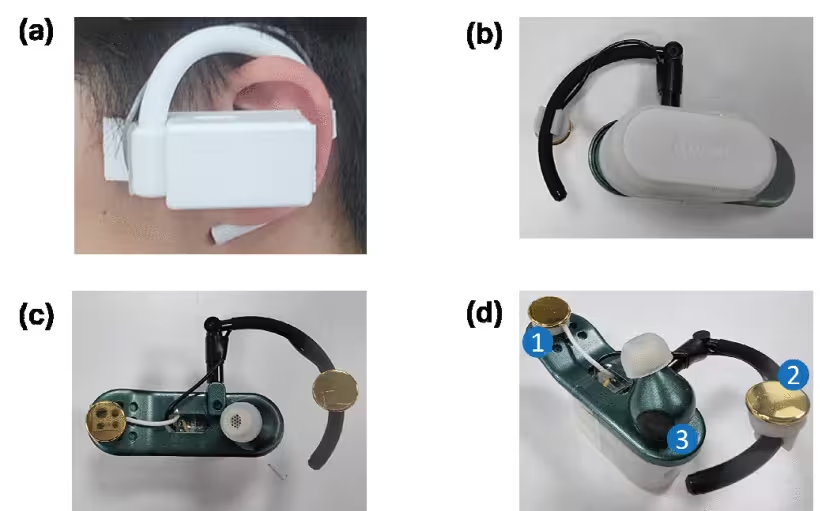
An ear-EEG offers superior wearability and user convenience compared to conventional EEG recording techniques. This work introduces a new wearable, around-the-ear EEG recording device designed specifically for practical pBCI applications. This device utilizes a dry-contact single-channel electrode system integrated into an ergonomic earbud-style design, prioritizing user comfort and ease of use for long-term recordings in daily-life scenarios.
The optimal design of the device was established through an alpha attenuation test involving 13 participants. By analyzing signals from 11 different electrode positions around and inside the ear, the bipolar combination of the preauricular point and the mastoid was identified as the optimal configuration and subsequently adopted for the device development. The final device was fabricated based on this result, using 3D printing technology with gold-plated electrodes, which were chosen for their chemical inertness and superior signal amplitude compared to silver/silver chloride (Ag/AgCl) electrodes. Verification tests showed that the signal acquisition performance of this compact device is comparable to that of commercial biosignal recording systems.
To validate the device's utility in pBCI applications, the study conducted two key experiments: predicting user preferences for video content and detecting drowsiness during online learning. In the preference prediction experiment, participants watched movie trailers intended to elicit delight and a driving test video designed to induce boredom. Statistical analysis revealed a significant correlation between beta-band power (13–30 Hz) and user preference. Using machine learning classifiers, the system achieved a prediction accuracy of 92.86%, outperforming the direct comparison of beta-band power and Bayesian approaches.
The second experiment focused on detecting drowsiness during a simulated online learning session, where participants watched a 40-minute monotonous lecture to induce drowsiness. To effectively detect drowsiness, a hybrid approach was utilized that monitors both the EEG power features and the frequency of movement artifacts associated with sleepiness. This system achieved an 80% success rate in detecting drowsiness, with the algorithm specifically tuned to minimize false alarms during alert states, ensuring practical utility in settings like driving or studying.
This research contributes to the field of wearable technology by demonstrating that a single-channel dry-electrode ear-EEG device can reliably support complex pBCI applications. The study highlights the potential to advance pBCI techniques across both research and commercial fields by effectively balancing signal acquisition performance with user comfort. It is particularly relevant for applications such as neuromarketing and neuroeducation. Future work may focus on optimizing the device's ergonomics and expanding its applicability to diverse pBCI applications, including healthcare, wellness, human–machine interaction, and adaptive technologies in daily life.