




Detection of CWA Simulants by Electronic Nose Based on Low-Powered MEMS Gas Sensor Array
Chemical warfare agents (CWAs) have posed severe risks since their first use in World War I. Although the 1997 Chemical Weapons Convention halted their development and led to the gradual destruction of the global stockpile, CWAs continue to pose a threat to public safety. The key to preventing harm is rapid, accurate early detection and effective disposal.
Direct experimentation with CWAs is dangerous and legally restricted. Hence, the researchers use chemical simulants that closely mimic the physicochemical behavior of actual agents. These simulants allow safe laboratory studies while maintaining scientific relevance and reliability.
Fast, stable, and selective detection systems are crucial for responding to accidental or deliberate CWA release. Traditional methods, such as gravimetric and metal oxide semiconductor sensors, offer partial solutions but suffer from slow response, limited selectivity, instability, and high power consumption. These constraints underscore the need for improved sensing platforms.
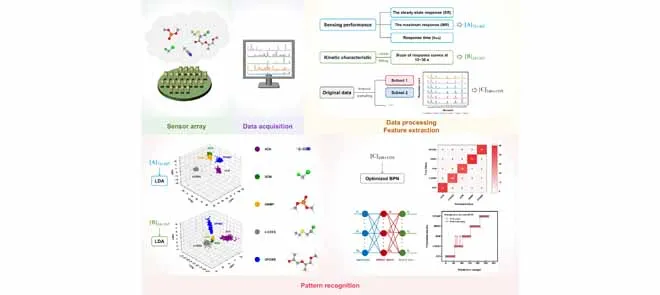
This study presents an electronic nose developed using microelectromechanical system (MEMS) technology. The platform integrates 24 gas sensors, each with a metal oxide film as the sensing layer. The system detects simulants by recognizing the unique response patterns generated during exposure.
The simulants studied include dimethyl methylphosphonate, dipropylene glycol monomethyl ether, 2-chloroethyl ethyl sulfide, acetonitrile, and dichloromethane. These compounds are widely accepted as safe surrogates for real CWAs.
Each sensor is built on a silicon microhot plate and coated with sintered thin films of tin oxide, zinc oxide, or tungsten oxide. The devices consume less than 10 mW and measure only 0.9 mm × 0.9 mm, making them suitable for portable systems.
During operation, the microhot plate heats each sensor to 150-350 °C to enhance gas reactivity on the sensing surface. The array is then exposed to known simulant concentrations, and voltage responses are continuously recorded.
Key performance metrics include steady-state and peak responses, response and recovery times, and detection limits, all evaluated under different environmental conditions. Sensors exhibit high sensitivity, reach optimum response in under a minute, and reset quickly, making them suitable for real-time monitoring. Each simulant produces a distinct response curve, serving as its fingerprint, enabling reliable compound classification.
Extracted features capture response magnitude, timing, curve shape, and rate of signal change. Linear discriminant analysis provides basic separation, but closely related simulants remain difficult to distinguish.
Training a backpropagation neural network on denser, periodically subsampled data resolves these issues, increasing classification accuracy to over 99% and improving robustness across temperature and humidity variations.
The MEMS-based electronic nose gas sensor array presented in this study provides a fast, accurate, and portable solution for detecting CWA simulants. Its combination of sensitive metal oxide sensors and machine-learning-based pattern recognition enables high selectivity while maintaining low power consumption.
However, some challenges remain, including cross-sensitivity to common Volatile Organic Compounds and environmental interference. These issues can be reduced through better signal processing, improved ecological modeling, and higher automation.
Future work will involve expanding datasets, strengthening environmental resilience, and developing more advanced classification algorithms to support compact, field-ready CWA monitoring systems for defense and public safety.