




Detection and Classification of Anomalies in WSN-Enabled Cyber-Physical Systems
Industrial setups today are more connected and intelligent than ever due to the growth of technologies like wireless sensor networks (WSNs). These configurations often integrate physical operations like chemical processes with digital technologies such as sensor-based data collection, a combination known as Cyber-Physical Systems (CPSs). CPSs are designed to achieve specific goals within the larger systems. While CPSs have enhanced efficiency and automation, they have also increased overall system complexity, making them more susceptible to anomalies and cyberattacks.
When an anomaly happens in such a system, like a sensor reporting a wrong value or a machine behaving abnormally, its detection is not always straightforward. These anomalies can lead to costly shutdowns or even dangerous failures. Early detection is, therefore, crucial.
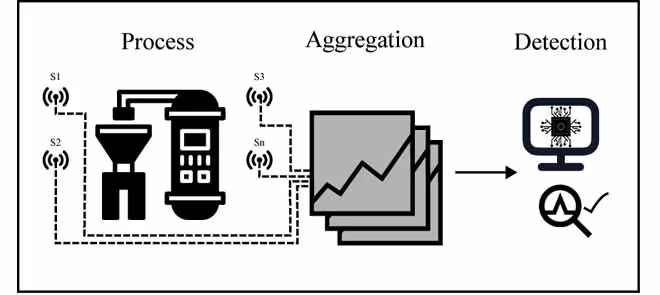
This paper introduces a generalized framework for anomaly detection in industrial environments powered by WSN. The framework is an intelligent monitoring system, ensuring smooth operation by processing data through three core components within its cyber layer. First, the Data Acquisition block gathers information from various sensors and devices. Next, the Data Fusion block combines, aggregates, formats, and aligns this diverse data, making it cohesive and understandable regardless of its source. Finally, the Data Analytics block utilizes artificial intelligence (AI) to identify and classify anomalies.
A significant advancement in this framework is the integration of Explainable AI (XAI) algorithms, which means it doesn't just tell you that there is a problem; it also explains why it thinks so. This represents significant advancement as it helps engineers and operators understand and trust the system's decisions and enables quicker action to fix issues.
To validate the framework's utility, three diverse use cases were explored: identifying faults in power grids, detecting chemical process anomalies in industrial setups, and predicting indoor CO₂ levels for smart building management. These scenarios demonstrate the framework's adaptability across sectors and its capacity to handle both cyber and physical irregularities.
Numerical results from these diverse scenarios consistently demonstrate high accuracy in anomaly detection, underscoring the framework's effectiveness in improving system reliability. The ability to identify anomalies promptly enables timely interventions, which, in turn, can significantly reduce operational risks. This proactive approach to system management is paramount in environments where even minor anomalies can escalate into major incidents.
The framework's validation has so far been limited to controlled environments; its scalability and real-time performance in large, dynamic CPSs remain unverified. Real-world scenarios typically involve much higher data volumes and stricter timing requirements, which may challenge the framework's effectiveness.
The researchers plan to expand this model and apply it to more industrial systems, aiming to improve further data flow mechanisms, accuracy, efficiency, and security in automated industrial environments.
The proposed anomaly detection framework represents a significant advancement in securing and optimizing WSN-enabled CPSs. With continued research and refinement, it has the potential to become a cornerstone technology for ensuring the safety, reliability, and efficiency of next-generation industrial systems.