



Deep Learning-Integrated Agarose-Coated Micro-Loop Fiber Resonator for Relative Humidity Measurement
Humidity sensing is crucial for various industrial and environmental applications, including semiconductor fabrication, pharmaceutical manufacturing, and agriculture. Conventional electronic sensors can be susceptible to electromagnetic interference and harsh environments. Fiber-optic sensors address these challenges due to their durability, immunity to electromagnetic interference, and ability to withstand harsh conditions.
Fiber sensors use light's interaction with the surrounding environment to detect changes in an analyte (e.g., humidity). In humidity sensing, water molecules in the air affect the sensor's light propagation, enabling humidity changes to be detected. Usually, selective coatings are applied to the fiber sensor's surface to improve its humidity response. For instance, a coating such as agarose absorbs water molecules from the air. As relative humidity increases, it absorbs more light, affecting the light propagating through the sensor and resulting in changes in the sensor's output.
Consequently, processing the sensor’s output to detect analyte changes is an integral part of sensor development. However, fiber sensors, despite their high sensitivity and promising performance, face challenges of their own in sensing data processing. For instance, optical resonators, such as the one used here, produce large volumes of rich spectral fingerprints in which spectral shifts and intensity changes may be subtle and spread across a wavelength window. Additionally, the sensors require expensive interrogation systems and manual or traditional data interpretation, which may be slow. These barriers present a significant scalability problem for optical resonator sensors.
The researchers here aimed to integrate resonator fiber sensors with deep learning to address these data-processing challenges and simplify fiber sensor development. The work consisted of two main modules. The first was preparing the coated sensor and characterizing its performance. The second module was integrating deep learning to process the spectral data.
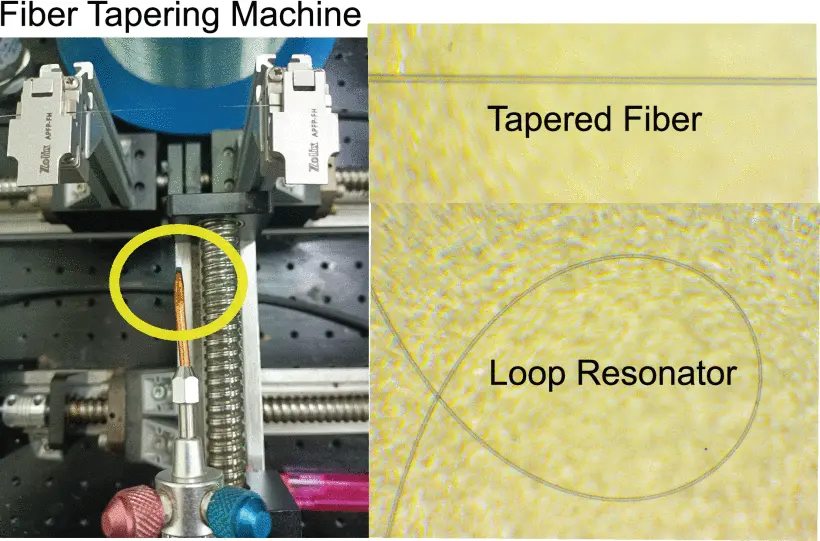
A tapered fiber using flame brushing to form the resonator loop was prepared. An agarose coating was used as the humidity-sensitive layer. Three concentrations of agarose were tested, with 0.5% showing the highest sensitivity due to the coating's porosity. Both the sensing structure and coating were selected to provide a simple, lower-cost design. The sensor showed a 0.2037 dB/%RH sensitivity and response and recovery times of ~12 s and ~8 s, respectively. The sensor output also showed minimal fluctuations during time-stability testing.
The second module focused on deep learning integration to simplify the processing of sensing signals. The spectral data collected during the experiment were converted into barcoded images. The ~5000-sample dataset was used to train, validate, and test a convolutional neural network (CNN) to classify six humidity levels, achieving ~98% accuracy.
Unlike traditional sensing data processing, which focuses either on wavelength shifts or intensity variations at a single wavelength, this approach (barcoded spectra with CNN) does both simultaneously across a wavelength window. The selected approach demonstrated that deep learning can reduce analysis time and complexity and improve the scalability of fiber sensors. This integration of fiber sensors with deep learning can accelerate the evolution of fiber sensors toward portable, multi-analyte sensing.