



Creep and Hysteresis Compensation in Pressure-Sensitive Mats for Improving Center-of-Pressure Measurements
Stability assessment is crucial in many clinical studies. Large-area tactile sensors, often referred to as Force Platforms (FPs), are commonly used for this purpose. However, commercial systems can be quite expensive and, in the case of FPs, are often heavy and difficult to transport.
In recent years, low-cost Pressure Sensitive Mats (PSMs) have been developed, many of which are based on Velostat. Velostat is a piezoresistive material with very high resistance under no load, but its resistance decreases abruptly when a load is applied. These devices are not very accurate due to the behavior of Velostat, which includes a complex, nonlinear response to pressure, along with notable creep and hysteresis phenomena.
This research demonstrates that the identified effects can be corrected, leading to improved stability measurements. Specifically, the center-of-pressure (CoP) trajectories obtained with a Velostat-based pressure sensing mat (PSM) closely match those recorded by a commercial force platform (FP), which serves as the reference device for this type of measurement.
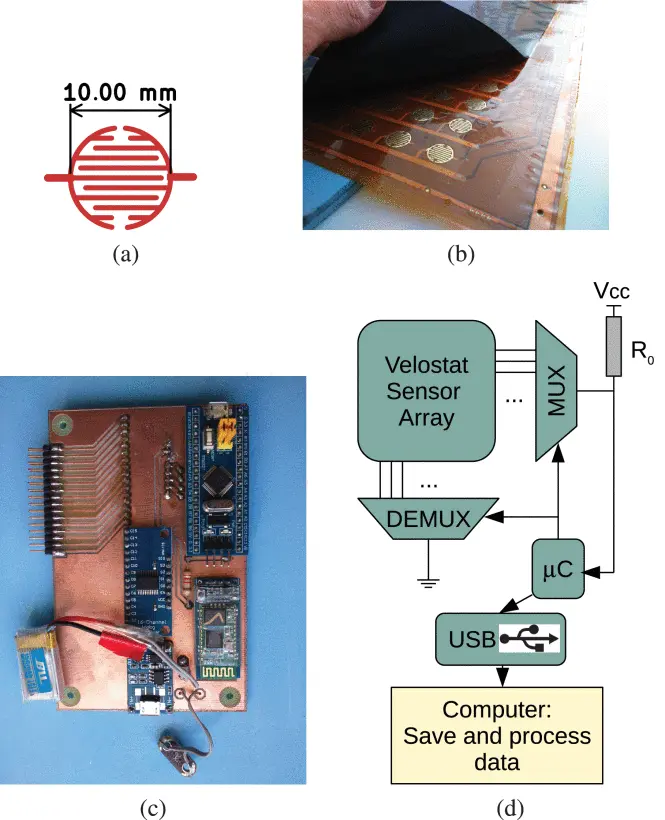
The study began by characterizing sensor behavior on a pneumatic platform (PB100E Equilibration Device by Tekscan) controlled by a proportional pressure regulator (171E2N.T.D.0009 by Pneumax). This setup enabled a uniform pressure to be applied to the sensor area. However, the active zone was not large enough to cover an entire PSM. To address this limitation, a small sensor array was manufactured on a flexible PCB using Velostat and interdigital circular electrodes with a 10 mm diameter. A series of pressure cycles was applied to the sensor, and the response was recorded. These experiments led to the development of hysteresis and creep mathematical models (a modified Prandtl–Ishlinskii model and a sum of creep operators, respectively).
A large area tactile sensor was constructed using the same materials and electrode shape. This PSM has an active area of 32 cm × 32 cm and an array of 16 × 16 taxels. While the array was manufactured similarly to the smaller array used on the pneumatic platform, a scaling factor was introduced in the mathematical models to apply them to this PSM. This scaling factor ensures consistency between the pressure measured by the PSM and the person's weight during a stability test.
Finally, a set of stability measurements with humans was conducted (single-legged and swaying in quiet standing), and the CoP was recorded with both our PSM and a commercial FP (PS-2141 PASPort by PASCO). The mathematical modeling allowed compensating for hysteresis and creep. The experiments showed that this had a significant impact on performance and that the CoP trajectories obtained with the FP and the PSM became very similar after the compensation. The distance between the trajectories decreased by 26% in this modeling compared with a naive approach that considers a linear sensor response. The improvement was clear across all subjects and movements, so the models captured a key aspect of the sensor behavior. Thus, this study promotes the availability of instruments to perform stability tests without expensive devices.