



CMUT-Based Force Sensing
High integrated force-sensing systems used in extremely constrained environments, such as needle tips in minimally invasive surgery, require maximum sensitivity and low detection thresholds. Various sensing principles, including (piezo-)resistive, inductive, piezoelectric, and optical approaches, have been explored. However, they either lack sufficient sensitivity or achieve high sensitivity at the cost of increased susceptibility to environmental fluctuations and noise.
Capacitive micromachined ultrasonic transducers (CMUTs) are parallel-plate capacitors operating at MHz frequencies and originally developed for ultrasound transmission. Each CMUT cell typically has a diameter ranging from tens to hundreds of micrometers. It can be arranged in dense array structures to enhance signal strength while reducing susceptibility to environmental noise. Their high-quality factor results in sharp resonance peaks, enabling precise resonance shift tracking. Also, CMUTs are inherently sensitive to deformations in all three spatial directions.
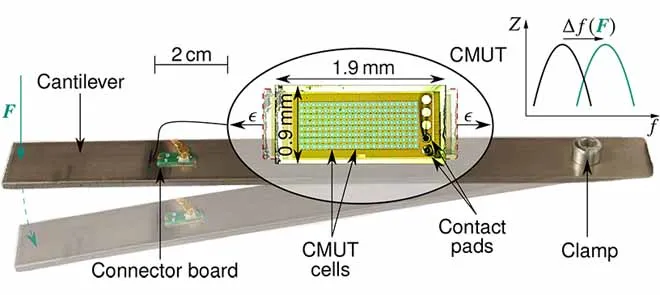
This study evaluates the feasibility of a thinned piston-structured CMUT die (1.9 × 0.9 mm²) as a force sensing element. Its performance is compared with that of a commercially available strain gauge (2 × 1.2 mm²) with a comparable installation footprint. The evaluation focuses on sensitivity and initial response threshold (IRT) as primary performance metrics to assess scalability and integration potential.
A two-stage finite element model (FEM) is developed to enable future assessments of external influences and optimization of the CMUT geometry. The model of a single CMUT cell (diameter = 48 µm) is experimentally validated. Measurements of the deflection distribution along the CMUT cell diameter deviate by less than ±5% from the simulated results.
The sensing elements are mounted on a cantilever that is deflected using a micrometer drive to achieve controlled deflections of 5 µm, corresponding to a force of 20.5 mN. The CMUT impedance spectrum is measured under different load conditions, and the resonance frequency shifts induced by cantilever deflection are evaluated.
The sensitivity of the thinned CMUT (6.1 Hz/µm) is approximately three times higher than that of the regular CMUT (1.9 Hz/µm), confirming that backplate thinning enhances sensitivity. Additionally, the thinned CMUT can detect a minimum applied force of 20.5 mN, thereby defining its IRT.
The CMUT exhibits direction-dependent behavior: compressive loading leads to lower measurement uncertainty, whereas tensile loading provides higher sensitivity at small deflections. The observed hysteresis error of 11.3%, compared to 1.19% for the strain gauge reference, highlights this directional responsiveness. The linearity error is 2.69%, compared to 0.96% for the strain gauge, and is considered promising, as this proof-of-concept design offers significant potential for further optimization.
These tailored CMUT-based force sensors demonstrate the potential to outperform commercially available systems in terms of sensitivity, multidirectional sensing capability, and minimal installation space. However, as resonance-based devices, their performance is inherently influenced by environmental factors like temperature, pressure, and surrounding media, requiring careful control and future compensation strategies to ensure measurement stability. Beyond biomedical applications, CMUT-based sensors may also be suitable for time-critical applications such as rapid blast detection and structural health monitoring in air and underwater environments, and lay the groundwork for a new class of highly integrable microscale sensors.