



Bio-Immobilization of Plasma-Polymerized Heptylamine and Glutaraldehyde for K-SPR Glucose Biosensing
Regular monitoring of blood glucose levels is essential for managing diabetes, which is one of the most common chronic diseases worldwide. Conventional glucose monitoring methods often require uncomfortable, inconvenient, and invasive procedures, such as finger pricking. Therefore, researchers are exploring alternative sensing technologies to provide rapid, reliable, and less intrusive glucose detection.
This study presents the development of an optical biosensor for glucose detection based on Kretschmann-surface plasmon resonance (K-SPR). Surface plasmon resonance (SPR) is a sensitive optical technique that detects small molecular interactions at a metal surface in real time. SPR technology has attracted attention as a promising platform for biosensing applications because it does not require chemical labels or complex sample preparation.
Maintaining the stability of biological molecules on the sensor surface is challenging during biosensor development. Many existing sensors rely on physical adsorption, in which enzymes are simply attached to the surface through weak interactions. However, these interactions can be unstable, leading to enzyme detachment over time and unreliable measurements.
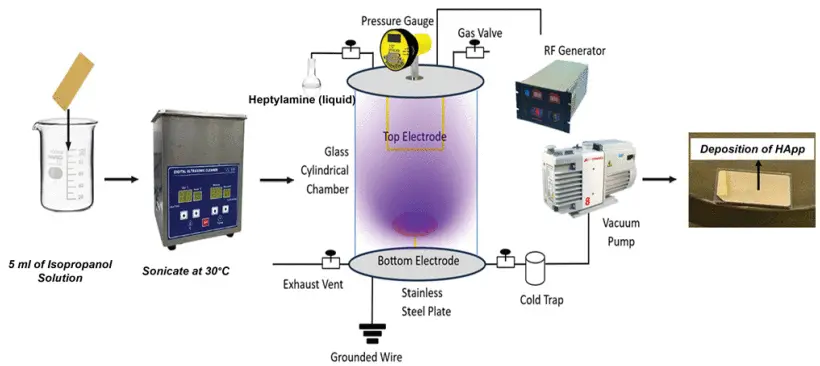
To overcome this limitation, this work introduces a bio-immobilization strategy that forms stronger chemical bonds between the sensing surface and the biological molecules. A thin film of plasma-polymerized heptylamine (HA) was deposited onto the gold sensing surface. Plasma polymerization is a dry and solvent-free technique that enables the formation of thin films containing functional chemical groups. In this case, the HA film provides amine groups that serve as active sites for attaching biomolecules.
Glutaraldehyde (GA) was then used as a cross-linking agent to bind glucose oxidase (GOx) enzymes onto the modified surface. In this process, enzymes are immobilized through covalent bonds, thereby significantly improving their stability compared with conventional physical adsorption methods. This stable enzyme layer enables the sensor to detect glucose molecules interacting at the surface reliably.
The structural characteristics of the modified surface were investigated using atomic force microscopy (AFM). The analysis revealed that plasma treatment produced a nanoscale textured surface. This slight increase in surface roughness can enhance the available surface area, allowing more enzymes to be immobilized and potentially improving the sensing performance.
The device's sensing capability was evaluated over glucose concentrations ranging from 4 to 20 mmol/L, covering normal, prediabetic, and diabetic levels. The biosensor demonstrated an average sensitivity of 7.8 °/M and achieved a detection limit of 0.55 mmol/L.
These results indicate that the proposed sensor can detect glucose concentrations relevant to clinical monitoring. Additional characterization techniques, including X-ray photoelectron spectroscopy (XPS) and Fourier-transform infrared spectroscopy (FTIR), confirmed the successful chemical bonding between the HA film, the GA cross-linker, and the GOx enzyme. The formation of stable chemical linkages helps maintain the enzyme structure and supports consistent sensing performance.
This study demonstrates that combining plasma-polymerized thin films with covalent enzyme immobilization can significantly improve biosensor stability. This approach offers a promising strategy for developing reliable optical biosensors for glucose monitoring. In the future, it could be adapted to detect other important biomarkers for medical diagnostics and environmental monitoring.